In summary:
- Master the PRESTO card’s 2-hour transfer window to stack multiple visits on a single fare.
- Skip expensive downtown restaurants; eat your way around the world for under $20 in Kensington Market.
- Leverage “neighbourhood arbitrage”: stay in vibrant areas like West Queen West to cut accommodation costs in half.
- Use free museum nights and strategic city viewpoints instead of paying for premium-priced attractions.
- For day trips, choose budget-friendly regions like the Kawarthas over premium-priced Muskoka.
Let’s be real: you looked up Toronto hotels, saw the prices, and your wallet immediately went into hiding. That first wave of “sticker shock” is a classic welcome to Canada’s biggest city. You’re hit with the reality of $300+ hotel nights, $20 cocktails, and attraction tickets that cost more than a nice dinner. The typical advice you’ll find online is predictable: “visit free parks,” “use public transit,” or “eat at food courts.” While not wrong, that advice misses the point. It tells you to abstain from the city’s best experiences rather than teaching you how to access them smartly.
The truth is, Toronto has a pulse, a vibe that you can’t find in a suburban mall’s food court. The real secret to experiencing this city on a budget isn’t just about finding cheap things; it’s about learning to game the system. But what if the key wasn’t simply avoiding costs, but mastering the city’s hidden value mechanics? This guide is your local’s playbook. We’re not going to tell you to skip the fun. We’re going to show you how to unlock the authentic Toronto experience by making strategic choices, understanding the cost-benefit calculus of every decision, and exploiting the loopholes that tourists almost always miss.
This article will break down the exact strategies you need to manage your budget effectively. From mastering the transit system to finding world-class food for less than the price of a movie ticket, you’ll learn how to get the most value out of every dollar. Forget surviving on a budget; it’s time to thrive.
For those who prefer a visual taste test, the video below showcases some of Toronto’s best cheap eats, proving you can find delicious and authentic meals across the city for less than $10.
To navigate your budget-savvy trip effectively, we’ve broken down the essential hacks into clear, actionable sections. This guide covers everything from your daily transit strategy and affordable food adventures to smart accommodation choices and free cultural experiences, ensuring you can craft the perfect itinerary without breaking the bank.
Table of Contents: A Street-Smart Guide to a Cheaper Toronto
- PRESTO Card: Is It Worth Buying for a 3-Day Trip to Toronto?
- Kensington Market: How to Eat Your Way Through the World for Under $20 CAD?
- AGO and ROM: When Are the Free Admission Nights for Museums?
- CN Tower Edgewalk: Is the $200 Price Tag Justified or Is the View Enough?
- West Queen West: Why Staying Outside the Financial District Saves You Money?
- Beyond Starbucks: Where to Find Serious Co-Working Spaces in Downtown Hubs?
- City Breaks vs. Nature Escapes: What Is the Ideal Ratio for a First Trip?
- Muskoka vs. Kawarthas: Which Lake Region Fits Your Family Budget?
PRESTO Card: Is It Worth Buying for a 3-Day Trip to Toronto?
For a short trip, the question of buying a PRESTO card versus paying cash can seem complicated, but the answer is a hard yes. The key isn’t just about the single-fare discount; it’s about understanding the “value mechanics” built into the system. A single cash fare on the TTC (Toronto Transit Commission) is expensive and inefficient. With a PRESTO card, your fare drops, but more importantly, you unlock the two-hour transfer window. This is the single most powerful budget hack for getting around Toronto. Tapping your card starts a two-hour timer during which you can hop on and off any streetcar, bus, or subway as many times as you want, in any direction, all on a single fare.
This transforms your transit from a simple A-to-B cost into a strategic tool for “experience stacking.” You can visit a coffee shop in one neighbourhood, explore a park in another, and head towards your dinner spot all within that two-hour window for the price of one ride. For a 3-day trip, the math is simple. If you plan on taking four or more trips in a single day, loading a daily pass onto your card is the most economical choice. According to budget travel expert Nomadic Matt, a PRESTO daily pass costs $13.50 CAD, compared to $3.35 per single ride, making the breakeven point very easy to reach for an active tourist.
The initial $6 CAD fee for the card itself is quickly offset by the savings and convenience. Forget fumbling for exact change; tapping a PRESTO card is faster and opens up a much more efficient way to explore the city’s sprawling, diverse neighbourhoods. For a short visit, a PRESTO card isn’t just a purchase; it’s an investment in mobility and a core part of a smart budget strategy.
Your Action Plan: Smart PRESTO Strategy for a 3-Day Visit
- Buy your PRESTO card at the UP Express station at Pearson Airport for immediate use upon arrival.
- Load a minimum of $20 to start; this covers the card fee and gives you enough for a couple of days to assess your usage.
- On days you plan to be a heavy user (4+ trips), load a daily pass for $13.50 CAD directly onto your card from any subway station machine.
- Master the 2-hour transfer: plan short stops in clusters to maximize a single fare. For example, explore Yorkville and then hop on the subway to the ROM within the same two-hour window.
- Check your balance online or at a machine before your last day to ensure you have enough for your trip back to the airport.
Kensington Market: How to Eat Your Way Through the World for Under $20 CAD?
The idea that you have to spend a fortune to eat well in Toronto is a myth, and Kensington Market is the delicious, vibrant proof. This is not a formal market but a bohemian neighbourhood where the world’s cuisines collide on colourful, graffiti-lined streets. Here, “neighbourhood arbitrage” applies to food: you escape the inflated prices of the Entertainment and Financial Districts for authentic, high-quality meals that cost less than a pint of craft beer downtown. The strategy here is “experience stacking”—building a full, satisfying meal by hopping between different vendors.
Forget a single, expensive sit-down meal. For under $20 CAD, you can create your own multicultural food tour. Start with a flaky, savoury snack from Jumbo Empanadas, where Chilean-style pastries are filled with beef, chicken, or cheese for just a few dollars. Then, walk a few steps to Seven Lives Tacos Y Mariscos for their legendary Baja fish tacos, a flavour explosion that usually costs around $6-7 CAD. Finally, round out your meal with an order of perfectly pan-fried dumplings from Mother’s Dumplings. As a case study in budget eating, Kiwi.com’s budget guide highlights this exact circuit: you can easily get a diverse, filling, and incredibly tasty three-course meal for under $20.
This approach isn’t just about saving money; it’s about experiencing the true character of Toronto. You’ll be eating alongside locals, discovering hidden gems, and tasting food made with passion. The market is also home to independent cheese shops, bakeries, and bulk food stores, making it the perfect place to assemble a high-quality picnic for even greater savings. In Kensington, your dollar stretches further, and your culinary experience is infinitely richer.
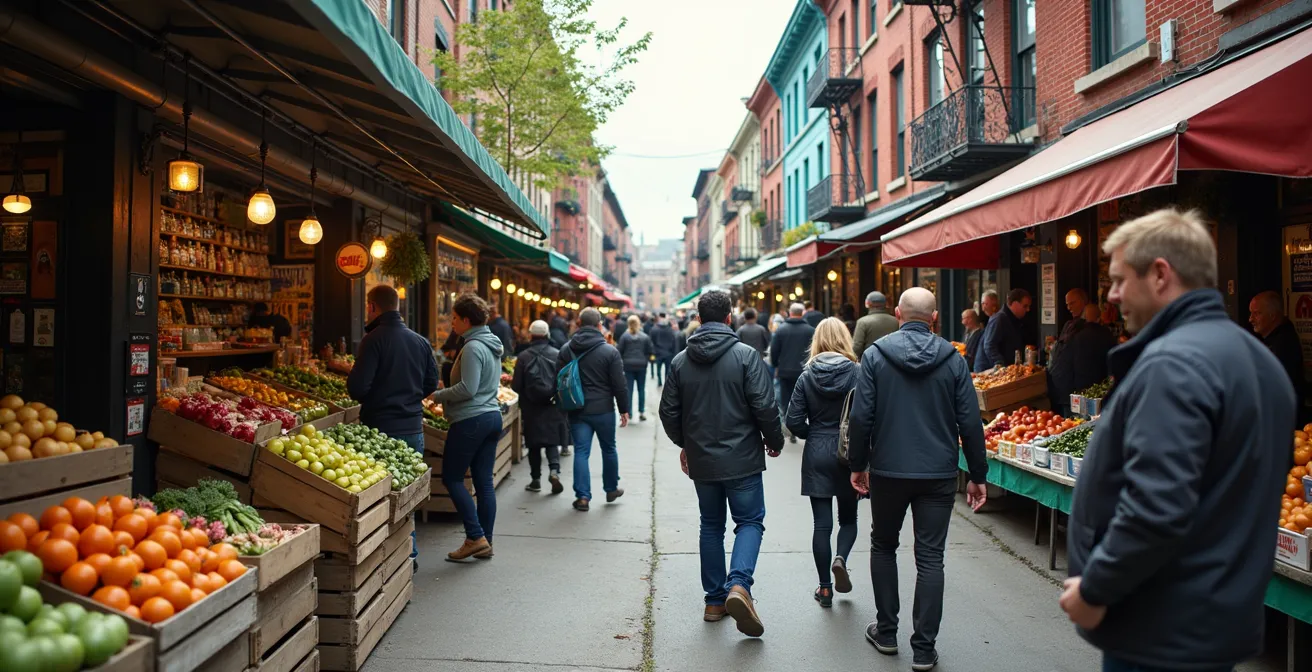
As you wander through the bustling streets, the sights and smells are as much a part of the experience as the food itself. This isn’t just a place to eat; it’s a sensory immersion into the multicultural fabric of Toronto. Forgo the tourist traps and let your appetite guide you through one of the city’s most authentic and affordable neighbourhoods.
AGO and ROM: When Are the Free Admission Nights for Museums?
Toronto’s world-class cultural institutions, like the Art Gallery of Ontario (AGO) and the Royal Ontario Museum (ROM), can take a significant bite out of a traveller’s budget. However, with a little strategic planning, you can experience them for a fraction of the cost, or even for free. This isn’t just about finding a discount; it’s about timing your visit to coincide with the city’s built-in access programs. Many visitors pay full price simply because they are unaware of these regularly scheduled opportunities.
The most well-known hack is the AGO’s free admission on Wednesday evenings. From 6 p.m. to 9 p.m., the entire permanent collection is open to the public at no cost. The only catch is that you must book a timed-entry ticket online in advance, as spots fill up quickly. This is a non-negotiable step; you can’t just show up at the door. The ROM offers a similar deal with its free third Tuesday night of the month, though this is subject to change and should always be confirmed on their website before you plan your trip. These free nights are a prime example of leveraging insider knowledge to access premium experiences without the premium price tag.
Beyond the two major players, many of Toronto’s smaller city-run museums, which focus on local history like at Fort York or Spadina Museum, offer free general admission year-round. By scheduling your museum visits around these specific times, you can save over $50 CAD for a couple, freeing up significant funds for other experiences. It’s a simple cost-benefit calculus: a bit of planning yields a huge financial return.
To make this easy, here is a direct comparison of the free admission policies at Toronto’s major museums, based on information from guides like Gray Line Toronto.
| Museum | Free/Discounted Times | Regular Price | Booking Required |
|---|---|---|---|
| AGO | Wednesday evenings | $25 CAD | Yes – online timed tickets |
| ROM | Third Tuesday evening (selected) | $23 CAD | No – but expect queues |
| City Museums | Always free | Free | No |
CN Tower Edgewalk: Is the $200 Price Tag Justified or Is the View Enough?
The CN Tower is Toronto’s most iconic landmark, and the Edgewalk—a hands-free walk on the outside of the main pod—is its most expensive thrill, clocking in at over $200 CAD. For the budget traveler, the cost-benefit calculus here is stark. While the experience is undeniably unique, that same $200 can fund several days of food, transit, and other activities. The question isn’t whether the Edgewalk is cool; it’s whether the value justifies wiping out a huge portion of your budget. For most, the answer is a clear no, especially when incredible skyline views can be had for a fraction of the cost, or even for free.
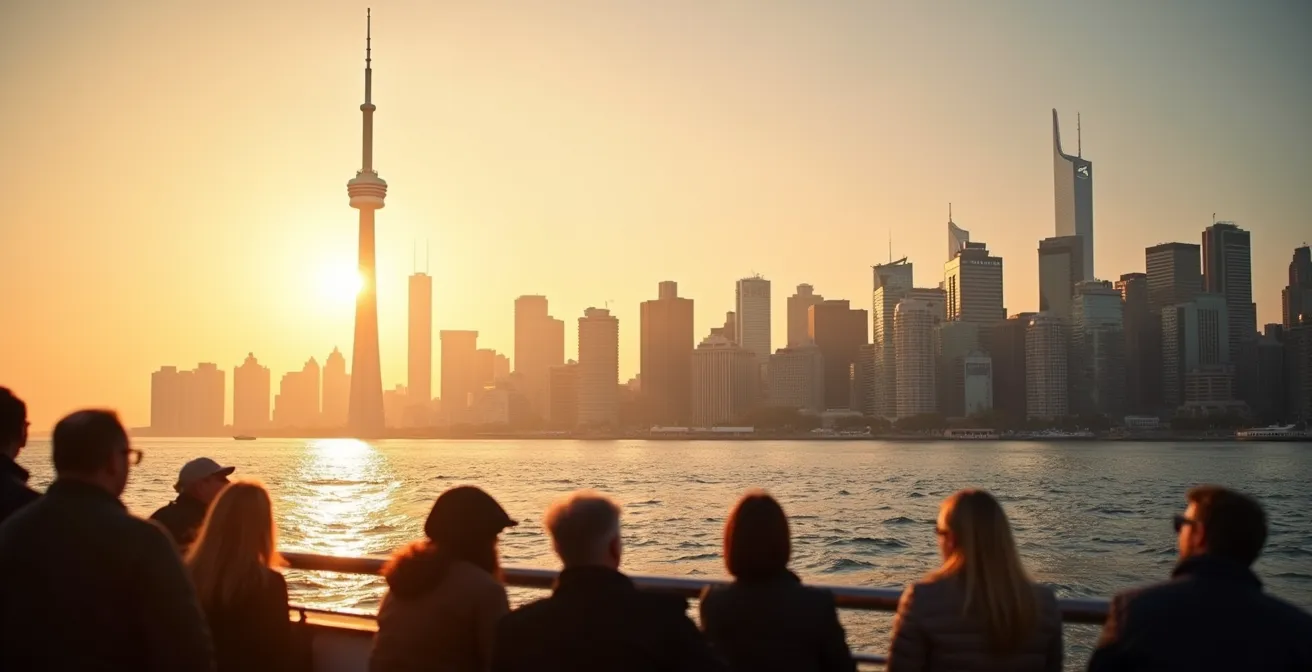
The smartest hack is to separate the *thrill* from the *view*. If you want a stunning, photo-worthy perspective of the Toronto skyline, there are far better value propositions. The absolute best is the ferry to the Toronto Islands. As travel expert Nomadic Matt notes, a return ferry ticket is only about $9 CAD and the 15-minute ride provides an ever-improving panoramic view of the city and waterfront. Once on the island, you can walk or bike to various points for the classic postcard shot of the skyline, with the CN Tower as its centrepiece. This option gives you a view, a boat ride, and access to beaches and parkland for less than the price of a coffee at the base of the tower.
There are numerous other alternatives that offer fantastic views without the tourist-trap pricing. The key is to think like a local and go where they go for a great perspective. This strategic substitution allows you to get one of the city’s most rewarding experiences while saving hundreds of dollars.
- Toronto Islands Ferry: The undisputed champion for skyline views. For just $9 CAD, you get a boat ride and access to an entire park with the best photo ops of the city.
- Chester Hill Lookout: Located in Riverdale Park, this spot is completely free and offers a classic, elevated view of the downtown core framed by trees. It’s a favourite among local photographers.
- Panorama Lounge: Situated on the 51st floor of the Manulife Centre in Yorkville, you can get a near-360-degree view for the price of a single (admittedly pricey) drink. It’s still a massive saving compared to the CN Tower.
- High Park: The overlook near Grenadier Pond provides a beautiful, naturalistic view of the skyline from the west end, and access is completely free.
West Queen West: Why Staying Outside the Financial District Saves You Money?
The single biggest expense on any Toronto trip is almost always accommodation. Tourists naturally gravitate towards the Financial District or Entertainment District, where hotels are plentiful but prices are astronomical. The ultimate hack to slash your accommodation budget is neighbourhood arbitrage: deliberately choosing a vibrant, well-connected, but less central neighbourhood where prices are significantly lower. West Queen West, along with adjacent areas like Trinity Bellwoods and Parkdale, is the perfect example of this strategy in action.
This isn’t about staying in a remote, boring suburb. West Queen West was once named one of the coolest neighbourhoods in the world by Vogue for a reason. It’s teeming with independent boutiques, art galleries, incredible restaurants, and some of the city’s best cafes and bars. You’re not sacrificing experience; you’re enhancing it by staying in an area with real local character. Crucially, it’s located directly on the 501 streetcar line, giving you a straight shot into the downtown core in about 15-20 minutes. The savings are dramatic: a comprehensive Toronto travel cost analysis shows that an average Airbnb in a neighbourhood like this can be around $100 CAD per night, versus $200+ for a comparable space downtown.
This strategy is further enhanced by the availability of high-quality, modern hostels that offer even greater savings. For solo travelers or young couples, these are a game-changer.
Case Study: The Planet Traveler Hostel Advantage
Located in nearby Kensington Market, the Planet Traveler Hostel exemplifies this budget strategy. As highlighted by the Travel Channel, you can get a dorm bed here starting around $38 CAD per night, which often includes breakfast. This places you in another one of Toronto’s most vibrant and affordable areas for food and nightlife. By choosing this option over a downtown hotel, a couple could save over $300 on a three-night stay, effectively funding their entire food and activities budget.
By opting out of the downtown hotel trap, you not only cut your biggest expense in half but also place yourself in a more authentic and exciting part of the city. You’ll eat cheaper, drink cheaper, and experience a side of Toronto that many tourists completely miss.
Beyond Starbucks: Where to Find Serious Co-Working Spaces in Downtown Hubs?
For digital nomads or travellers needing to get some work done, the default option is often to camp out at a Starbucks. But this “coffice” strategy can be a poor value proposition. You end up spending $15-20 on mediocre coffee and snacks just to justify your seat, all while dealing with spotty Wi-Fi and constant distractions. Toronto offers a far superior solution for the budget-conscious worker: free-workspace hacking. This means leveraging the city’s world-class public infrastructure to get a professional-grade work environment for zero cost.
The undisputed king of free workspaces in Toronto is the Toronto Reference Library. This isn’t your average local library; it’s a stunning architectural landmark with five floors of dedicated workspaces, quiet zones, abundant power outlets, and lightning-fast, reliable Wi-Fi. It provides all the amenities of a paid co-working space without the fee.
Case Study: The Toronto Reference Library as a Premier Free Workspace
Located at the major transit hub of Yonge and Bloor, the Toronto Reference Library is the ultimate co-working hack. As noted in local tour guides, its combination of stunning design, free high-speed internet, and designated quiet areas makes it superior to almost any cafe. For a visitor needing to do a full day of focused work or take important calls, the library provides a professional environment that would otherwise cost $25-50 for a day pass at a commercial co-working venue.
Of course, your needs might vary from day to day. The key is to have a tiered strategy, choosing your workspace based on the task at hand. If you only need to answer a few emails, a local cafe with Wi-Fi might suffice. But for a day of serious, focused work, paid options are almost never necessary in Toronto. By knowing where to look, you can save money and be far more productive.
- For Deep Focus: The Toronto Reference Library is your number one choice. It’s free, professional, and centrally located.
- For Casual Work: University of Toronto’s campus libraries (like Robarts) offer free access to public areas and have a great academic atmosphere.
- For Last-Resort Paid Options: If you absolutely need a private meeting room or guaranteed silence for a major video call, consider a day pass from a space like Staples Studio, but only if the cost of all-day coffee would exceed the ~$25 pass fee.
- The Cafe Test: Before committing to a cafe, do a quick speed test on the Wi-Fi and check for available outlets. Don’t buy anything until you’re sure the space is viable.
City Breaks vs. Nature Escapes: What Is the Ideal Ratio for a First Trip?
One of the biggest surprises for first-time visitors to Toronto is the incredible access to nature, both within the city limits and just beyond. For a short trip, it’s easy to get trapped in the downtown concrete jungle. A smarter approach is to aim for an 80/20 ratio: 80% of your time dedicated to urban exploration and 20% reserved for a refreshing nature escape. This provides a much-needed balance, allowing you to decompress and see a different side of the region without sacrificing your core city experience. The best part? These nature breaks don’t have to be expensive or time-consuming.
You don’t need to rent a car or book a multi-day excursion. Toronto’s greatest nature hacks are accessible via the same TTC system you’re already using. High Park, for example, offers 400 acres of free-to-access forests, hiking trails, and even a small zoo, all reachable by subway. But for the ultimate city-nature hybrid experience, nothing beats the Toronto Islands.
Case Study: The Toronto Islands as a Perfect Day Trip
As detailed by Kiwi.com, the Toronto Islands offer the perfect micro-nature escape. A short, 15-minute ferry ride—costing only about $9 CAD for a round trip—transports you to a car-free paradise of beaches, picnic areas, and bike paths. You can rent a bike or just walk the 4km path, enjoying serene waterfront views and the iconic skyline from a distance. It satisfies the need for a nature break in just a few hours, making it the ideal 80/20 activity for a time-crunched visitor.
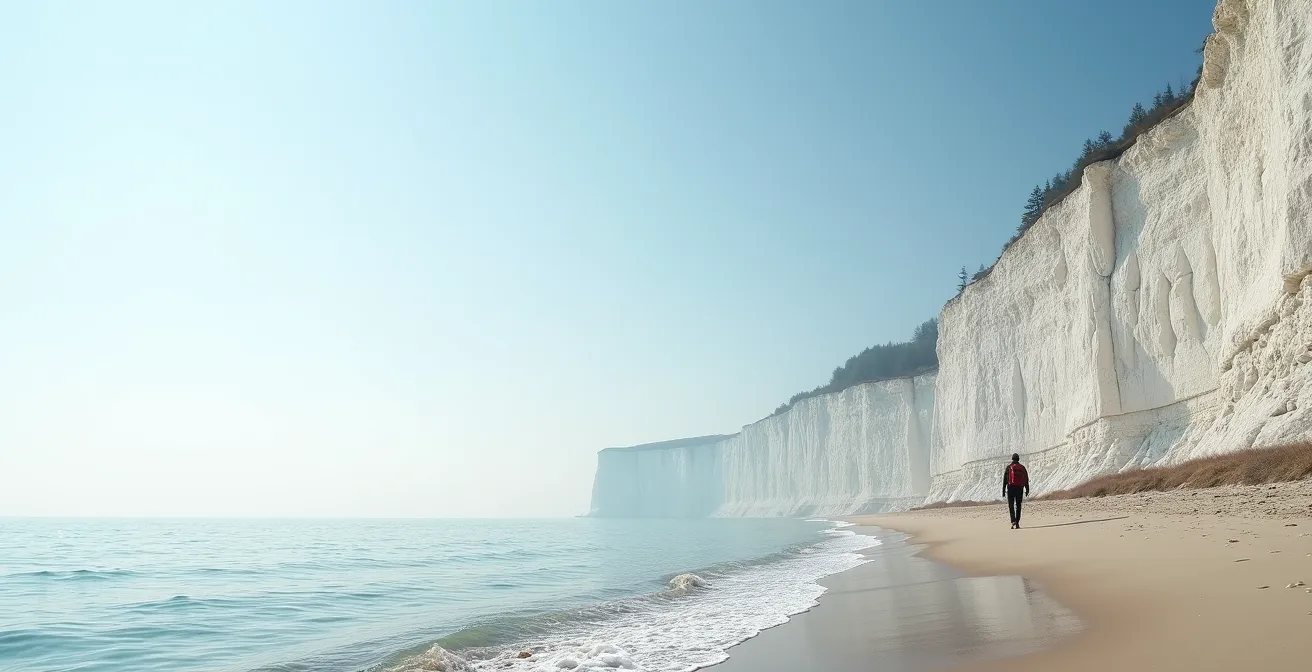
For a more dramatic landscape, take the TTC east to the Scarborough Bluffs. These massive white cliffs tower over the turquoise waters of Lake Ontario, creating a landscape that feels more like the Mediterranean coast than a major North American city. A walk along the beach at the base of the Bluffs is completely free and offers a profound sense of escape. By integrating one of these low-cost, high-impact nature escapes into your itinerary, you create a more well-rounded and memorable trip.
Key Takeaways
- The secret to a budget Toronto trip is not deprivation, but mastering the city’s “value mechanics” like transit transfers and free admission times.
- “Neighbourhood arbitrage” is your most powerful tool: stay and eat in vibrant areas like West Queen West or Kensington Market to slash costs while enhancing your experience.
- For every expensive tourist attraction, there is a low-cost or free local alternative that offers a better or more authentic experience, from skyline views to co-working spaces.
Muskoka vs. Kawarthas: Which Lake Region Fits Your Family Budget?
If your trip to Toronto includes plans for a classic Ontario “cottage country” escape, your choice of destination will have a massive impact on your budget. The two best-known regions, Muskoka and the Kawarthas, offer similar experiences—lakes, forests, and small-town charm—but at vastly different price points. Muskoka has cultivated a reputation as a luxury destination, often called the “Hamptons of the North,” and its prices reflect that. For the budget-conscious traveller, the choice is clear: the Kawarthas offer a nearly identical natural experience for a fraction of the cost.
The cost difference is not subtle; it’s a fundamental part of each region’s identity. In Muskoka, everything from cottage rentals and groceries to marina fees is marked up significantly. The Kawarthas, while still a popular destination, have retained a more down-to-earth, family-friendly atmosphere, and the pricing across the board is far more reasonable. This makes it the default choice for anyone looking to experience Ontario’s lake country without taking out a second mortgage. You get the same beautiful lakes and outdoor activities, but your money goes much, much further.
A car is mandatory for either region, so that cost is a fixed factor. However, every other variable expense, from accommodation to food, is significantly lower in the Kawarthas. For families or groups, these savings can amount to thousands of dollars over a week-long stay, making the decision a simple one for any savvy planner.
This side-by-side comparison, based on data from travel budget analyses like Never Ending Footsteps, illustrates the stark financial difference between the two regions.
| Factor | Muskoka | Kawarthas |
|---|---|---|
| Weekly Cottage Rental | $3000-5000+ CAD | $1500-2500 CAD |
| Car Rental (week) | $500+ mandatory | $500+ mandatory |
| Grocery Markup | 30-40% above city | 20-30% above city |
| Provincial Park Camping | $45-60/night | $40-55/night |
| Best For | Luxury seekers | Family budget trips |
Now that you have the playbook, the next step is to start piecing together your own custom, budget-smart Toronto itinerary. Stop thinking about what you have to skip and start thinking about how you can cleverly unlock the best of the city. Your savvy trip to Toronto awaits.