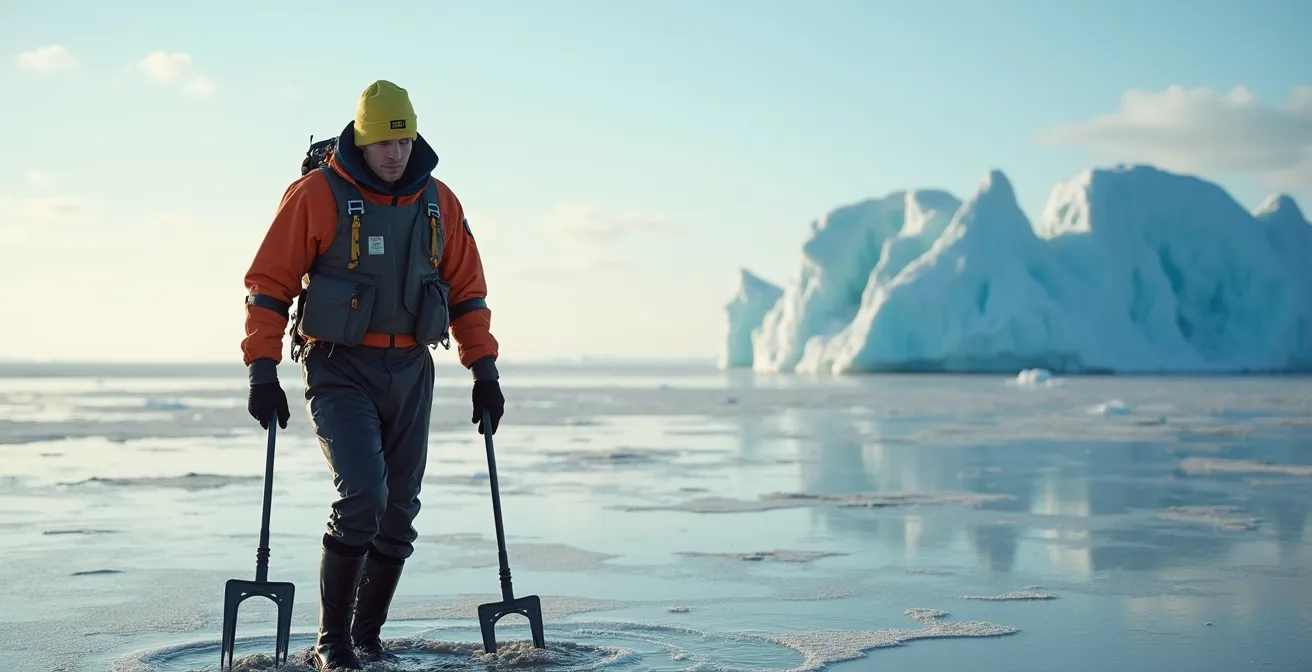
The viral “polar plunge” trend dangerously misrepresents cold water immersion as a test of willpower; it is, in fact, a severe physiological event that can incapacitate or kill even the fittest individuals in seconds.
- The initial “gasp reflex” is an involuntary response that can lead to immediate drowning, completely bypassing your conscious control.
- Hypothermia isn’t just a winter risk; cool Canadian summer water rapidly drains body heat, leading to muscular failure and mental impairment long before your core temperature becomes critical.
Recommendation: Do not attempt any cold water immersion without understanding the specific physiological stages of cold shock and having a robust, tested safety and extraction plan in place.
The allure is undeniable: a video of a triumphant plunge into icy water, a symbol of resilience and daring shared for social media acclaim. This trend, often framed as the “polar dip challenge,” presents a significant medical danger that is frequently underestimated. The target audience for this content—often young, healthy, and seeking a thrill—is precisely the demographic that misjudges the body’s reaction to sudden cold immersion as a matter of mental toughness rather than a cascade of uncontrollable physiological reflexes.
Standard advice often revolves around generic tips like “acclimatize” or “have a towel ready.” While not incorrect, this counsel dangerously fails to address the fundamental science at play. The critical threat is not the cold itself, but the body’s violent, involuntary reaction to it. This reaction, known as the Cold Shock Response (CSR), is not something that can be overcome with willpower. It is an autonomic event that can lead to drowning in less than a minute.
This article moves beyond simplistic safety tips to provide a clinical perspective on why these challenges require serious medical caution. We will deconstruct the physiological sequence of events, from the initial gasp reflex to the insidious onset of hypothermia and the failure of critical gear in Canadian extreme environments. The purpose is not to discourage adventure, but to replace bravado with a deep, evidence-based respect for the power of cold water and the absolute necessity of preparation.
The following sections will explore the specific, life-threatening stages of cold water immersion and the broader challenges of operating in Canada’s demanding northern and coastal environments. This guide is designed to arm you with the physiological knowledge necessary to make informed, life-preserving decisions.
Contents: A Medical Breakdown of Cold Environment Risks
- The Gasp Reflex: Why Falling into 2°C Water Can Drown You in Seconds?
- Hypothermia in Summer: Why 10°C Rain Is More Dangerous Than -20°C Snow?
- The Whiteout Effect: How to Handle Sensory Deprivation in Arctic Storms?
- Eating for Heat: Why You Need 5,000 Calories a Day on a Northern Expedition?
- Salt Spray and Frost: How to Keep Your GPS Functional in Coastal Extremes?
- Swimming in Northern Lakes: How to Avoid Cold Water Shock in Early Summer?
- Dry Suits vs. Wet Suits: Which Is Mandatory for BC Coastal Waters?
- West Coast Trail Preparation: Can You Carry a 40lb Pack for 7 Days on Ladders?
The Gasp Reflex: Why Falling into 2°C Water Can Drown You in Seconds?
The single most immediate danger of falling into frigid water is not hypothermia; it is the autonomic gasp reflex. Upon sudden immersion in water below 15°C, the skin’s cold receptors trigger an uncontrollable gasp for air, followed by a period of hyperventilation. If your head is underwater during this initial gasp, you will inhale water, leading to immediate drowning. This is not a matter of panic or swimming ability; it is a physiological short-circuit. Safety experts often cite the “1-10-1” principle: you have 1 minute to get your breathing under control, 10 minutes of meaningful movement before muscles become incapacitated, and 1 hour before you lose consciousness due to hypothermia. The first minute is the most lethal.
The physiological cascade includes a massive spike in heart rate and blood pressure as peripheral blood vessels constrict violently. For individuals with undiagnosed heart conditions, this can trigger immediate cardiac arrest. The Canadian Red Cross Drowning Report has highlighted the severity of this issue, with one study documenting that 2007 persons died from cold-water immersion in Canada over a ten-year period. Many of these deaths are attributable to the initial cold shock response, not prolonged hypothermia. Understanding that you cannot “tough out” this reflex is the first step toward true cold water safety.
Action Plan: Overriding the Gasp Reflex
- Immediate Focus: The instant you enter the water, concentrate entirely on controlling your breathing. Fight the urge to gasp or thrash.
- Pursed-Lip Breathing: Manually override hyperventilation by exhaling slowly through pursed lips, as if blowing out a candle.
- Head Above Water: Make it your absolute priority to keep your head out of the water. A personal flotation device (PFD) is critical for this.
- Conserve Energy: A PFD allows you to focus on breath stabilization for that first critical minute, rather than wasting energy trying to swim.
- Stabilize First, Act Second: Do not attempt to swim or self-rescue until your breathing has stabilized. Your actions in the first 60 seconds determine your survival.
Hypothermia in Summer: Why 10°C Rain Is More Dangerous Than -20°C Snow?
Hypothermia is a dangerous drop in core body temperature, and its greatest threat often lies in its deception. Many assume it is solely a risk of deep winter, but wet, “cool” conditions are far more dangerous than dry, freezing air. This is because water is an incredibly efficient conductor of heat. Research from Canadian safety apparel manufacturer Mustang Survival confirms that water transfers heat away from the body 25 times faster than air of the same temperature. Being soaked in 10°C rain on a windy day can lead to hypothermia faster than being in -20°C weather with proper dry gear.
This paragraph introduces a complex concept. To fully understand it, visualizing the body’s response is helpful. The illustration below conceptualizes the “afterdrop” phenomenon, where a person’s core temperature continues to fall even after being removed from the cold source, as cold blood from the extremities returns to the core.

As the image suggests, the thermal dynamics are complex. The greatest danger in a rescue scenario is this afterdrop effect. Improper rewarming, such as vigorous rubbing or hot showers, can accelerate this process and be fatal. Compounding factors also play a significant role. An analysis of 384 hypothermia deaths in British Columbia revealed that alcohol was a contributing factor in 40.1% of cases. Alcohol creates a false sensation of warmth by dilating blood vessels, which rapidly accelerates heat loss. Among victims under 75, water immersion was a factor in 18% of hypothermia fatalities, underscoring the lethal combination of cold water and impaired judgment.
The Whiteout Effect: How to Handle Sensory Deprivation in Arctic Storms?
In Canada’s northern territories, the physiological threat of cold is compounded by the psychological threat of the environment. A whiteout is a weather condition where blowing snow and a uniform cloud layer obliterate the horizon, making it impossible to distinguish the sky from the ground. This total sensory deprivation can induce profound disorientation, vertigo, and panic, even in experienced explorers. The brain, starved of visual cues, struggles to maintain balance and direction, leading to critical navigation errors.
In these conditions, mental fortitude becomes as important as physical warmth. The loss of determination is a significant factor in survival outcomes. As Dr. Chris Brooks, a leading expert, stated in a Transport Canada publication on cold water survival:
These people do not die of hypothermia per se. They die from a variety of problems in which moderate hypothermia is enough for them to lose their physical ability and mental determination to keep their backs to the waves.
– Dr. Chris Brooks, Survival in Cold Waters – Transport Canada Marine
This loss of mental capacity is what makes a whiteout so deadly. A disoriented individual may wander in circles, become separated from their group, or simply give up. Maintaining group cohesion and clear communication is paramount. Establishing strict protocols *before* visibility drops is a non-negotiable aspect of arctic expedition safety.
Checklist: Communication Protocols for Arctic Whiteout Navigation
- Rope Lines: Establish and secure rope lines connecting all team members before visibility deteriorates to maintain physical contact.
- Verbal Check-ins: Implement a strict schedule of verbal check-ins (e.g., every 2-3 minutes) using predetermined call signs to confirm everyone’s status.
- Designated Navigator: Assign one person as the lead navigator, solely responsible for maintaining the compass bearing and communicating it clearly.
- Cognitive Anchoring: The navigator should use cognitive anchoring techniques, such as reciting the compass bearing aloud continuously, to stay focused and combat disorientation.
- Shelter Priority: If GPS fails or the group becomes disoriented, the immediate priority is to create an emergency shelter. Group cohesion is more important than covering distance.
Eating for Heat: Why You Need 5,000 Calories a Day on a Northern Expedition?
In a cold environment, your body is a furnace that requires constant fuel. The process of thermoregulation—maintaining a stable core body temperature—is incredibly energy-intensive. A person on a northern expedition can easily burn over 5,000 calories per day, more than double their normal intake. This is due to a combination of factors: the energy needed to simply stay warm (shivering alone can burn hundreds of calories per hour), the physical exertion of moving through snow or difficult terrain, and the added weight of heavy gear. Failure to meet these caloric demands leads to fatigue, impaired judgment, and a rapid slide toward hypothermia.
Hydration is equally critical and often overlooked in the cold. The air is dry, and you lose significant moisture through respiration, but the sensation of thirst is blunted. Dehydration thickens the blood, forcing the heart to work harder and impairing the body’s ability to transport heat. The Canada Safety Council warns that hypothermia can occur at temperatures under 10°C, and dehydration significantly lowers this threshold. A proper nutritional strategy is not about comfort; it’s a core component of your survival system, focusing on a specific macronutrient balance to generate sustained heat.
| Macronutrient | Percentage | Function | Canadian Sources |
|---|---|---|---|
| Fats | 40-45% | Slow-burning sustained heat | Pemmican, maple butter packets |
| Complex Carbs | 35-40% | Immediate energy for activity | Dehydrated bannock, oat bars |
| Proteins | 15-20% | Muscle preservation | Dried caribou, freeze-dried salmon |
Salt Spray and Frost: How to Keep Your GPS Functional in Coastal Extremes?
Modern reliance on electronic navigation creates a critical vulnerability in extreme cold, especially in coastal environments like Newfoundland or British Columbia. The combination of freezing temperatures, corrosive salt spray, and pervasive humidity is a recipe for equipment failure. Batteries, the lifeblood of any electronic device, see their performance plummet in the cold. A battery showing 80% charge at room temperature might die within minutes when exposed to -20°C. Furthermore, salt spray can work its way into seams and charging ports, corroding contacts and causing short circuits. Frost can obscure screens and buttons, making devices impossible to operate.
This paragraph introduces the environmental challenge to technology. The vast, unforgiving landscape shown in the image below highlights the absolute necessity of reliable navigation when visual cues are minimal or non-existent.
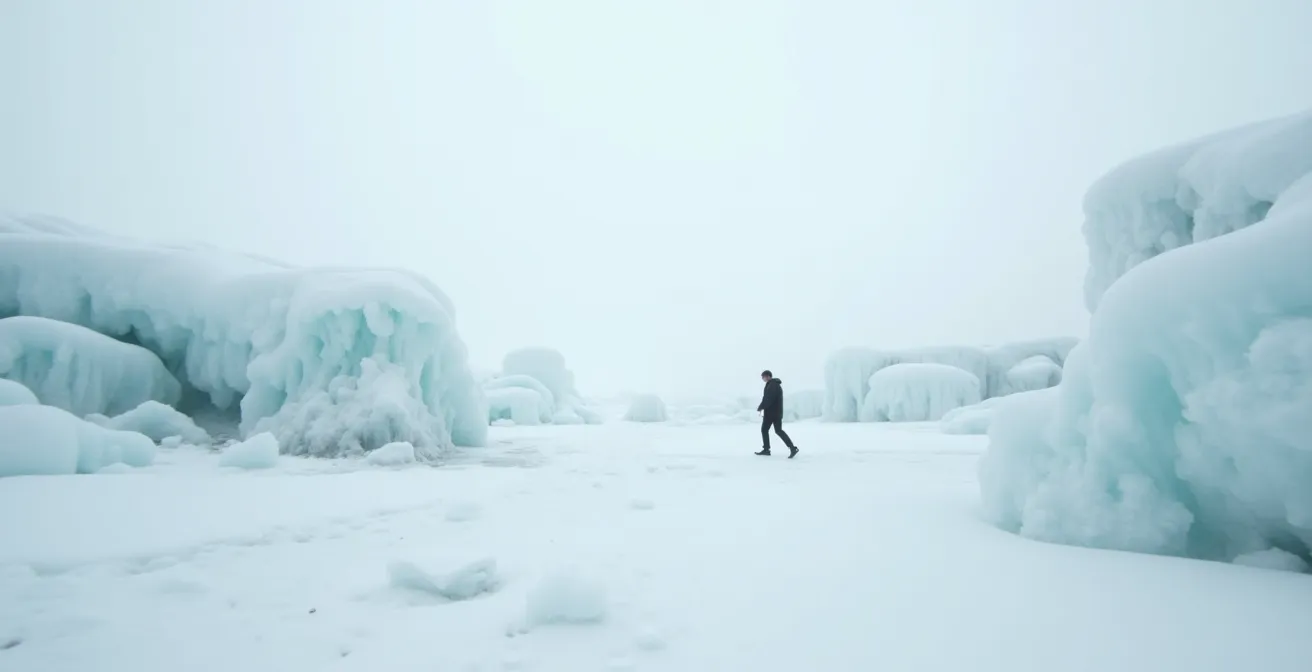
As the image illustrates, there is no margin for error. Relying on a single electronic device is reckless. The only valid approach is a multi-layered redundancy protocol. This means not only carrying a backup GPS unit but also possessing the skills and physical tools to navigate without electronics. A laminated topographical map from Natural Resources Canada and a quality compass are not optional backups; they are co-primary tools. Practice with these tools in controlled conditions is essential before you are forced to rely on them for your life. A dead GPS in a blizzard is not an inconvenience; it’s the beginning of a survival situation.
- Primary System: GPS unit. Protect it from moisture and apply dielectric grease to ports.
- Secondary System: Backup GPS unit, kept warm and dry in an inner pocket with spare batteries.
- Tertiary System: Laminated topographical maps and a reliable compass.
- Quaternary System: Dead reckoning skills, including pace counting and time/distance estimation.
Swimming in Northern Lakes: How to Avoid Cold Water Shock in Early Summer?
The danger of cold water shock is not limited to Arctic seas or winter conditions. Every year in Canada, tragedies occur in northern lakes during summer. Even when the air temperature is a pleasant 25°C, lake water temperatures may remain below 15°C, well within the danger zone for cold shock response. The Lifesaving Society reports that approximately 35% of drownings in Canada happen between October and April, when people have no intention of entering the water, but summer presents its own risks. The false sense of security provided by a warm day leads people to overestimate their swimming ability in cool water.
The physiological impact is significant. Cold water drastically reduces muscle efficiency and endurance. While studies indicate a person might be able to swim 800-1500 meters in 10-14°C water before incapacitation, this assumes they survive the initial gasp reflex and have a degree of acclimatization. An unprepared individual who jumps into a cold lake can find their muscles unresponsive in minutes, unable to swim back to the dock or boat just a short distance away. This phenomenon, known as swimming failure, is a direct result of peripheral vasoconstriction and the cooling of extremity muscles. It has nothing to do with fitness level; it is a predictable physiological failure.
Acclimatization is key, but it must be done gradually and with extreme caution. This involves repeated, brief exposures to cold water over time to lessen the severity of the gasp reflex and hyperventilation. Never swim alone in a northern lake, always wear a PFD when boating, and treat the water with respect, regardless of how warm the air feels.
Dry Suits vs. Wet Suits: Which Is Mandatory for BC Coastal Waters?
For anyone engaging in water activities like kayaking or paddleboarding in the coastal waters of British Columbia, the choice of thermal protection is a life-or-death decision. A common misconception is that a wetsuit provides adequate protection. It does not. A wetsuit works by trapping a thin layer of water against the skin, which the body then heats. This system is effective for short-duration activities in cool, not cold, water. It offers virtually no protection against prolonged immersion and can even increase the risk of Non-Freezing Cold Injury (NFCI) on multi-day trips due to constantly damp skin.
A dry suit, by contrast, is a piece of survival equipment. It uses waterproof seals at the neck, wrists, and ankles to create a completely dry environment for the wearer. Insulation is managed by layering clothing underneath the suit. This system provides hours of protection in the event of immersion, allowing a person to stay dry, functional, and capable of participating in their own rescue. For multi-day expeditions along the BC coast, where water temperatures rarely exceed 15°C, a dry suit is not a recommendation; it is mandatory.
The following table breaks down the critical differences and makes the verdict for BC coastal waters unequivocally clear.
| Feature | Dry Suit | Wet Suit | BC Coastal Verdict |
|---|---|---|---|
| Water Barrier | Complete seal | Traps water layer | Dry suit essential |
| Multi-day comfort | Stays dry | Risk of NFCI | Dry suit mandatory |
| Insulation control | Adjustable layers | Fixed thickness | Dry suit superior |
| Emergency time | Hours of protection | Limited duration | Dry suit required |
Key Takeaways
- Cold water immersion is a medical event, not a test of toughness. The body’s involuntary reflexes, like the gasp reflex, can be instantly fatal.
- Hypothermia is a year-round threat in Canada. Wet conditions in summer can be more dangerous than dry, freezing conditions in winter due to water’s rapid heat transfer.
- Preparation is multi-faceted: it includes physiological knowledge, correct nutritional strategies (5,000+ calories/day), robust gear redundancy, and specific physical training.
West Coast Trail Preparation: Can You Carry a 40lb Pack for 7 Days on Ladders?
The West Coast Trail (WCT) on Vancouver Island is a microcosm of the challenges discussed throughout this article. It combines physical endurance, technical skill, and prolonged exposure to a cool, relentlessly damp coastal environment. Hikers must carry a 40-pound pack for 75 kilometers, navigating slick logs, deep mud, and, most iconically, dozens of multi-story wooden ladder systems. These ladders are often wet and slippery, requiring immense grip strength, balance, and core stability, especially when descending with a heavy, top-heavy pack. This is not a simple hike; it is a sustained, week-long test of physical and mental resilience in a high-consequence environment.
Training for the WCT must be highly specific. General fitness is not enough. Your training protocol must simulate the unique demands of the trail, focusing on weighted-load bearing, single-leg stability, and eccentric muscle control for descending the ladders safely. Mental preparation is equally crucial. As athlete Susan Dawson-Cook described the challenge of cold water swimming, the mental journey is transformative: – ‘I went through stages of being frightened and then feeling incredibly alive. You have to clear your head and focus on your heart rate and breathing.’ This same mental focus is required to stay safe and make good decisions on day five of a cold, rainy slog on the WCT.
A successful completion of the trail is a testament to meticulous preparation. It requires an honest assessment of one’s physical abilities and a training regimen that specifically targets the trail’s unique obstacles. Arriving unprepared is not just a recipe for a miserable trip; it’s a significant safety risk that puts both you and potential rescuers in danger.
- Strength Focus: Weighted step-ups and single-leg deadlifts to simulate climbing ladders with a pack.
- Grip Focus: Dead hangs and farmer’s walks to ensure you can hold on to slippery ladder rungs.
- Endurance Focus: Long-duration hikes with a full-weight pack, ideally in wet weather conditions to test both gear and mental resilience.
- Balance Focus: Exercises that challenge stability to prepare for navigating slick logs and uneven terrain.
Ultimately, whether facing a polar plunge, a summer lake, or a multi-day coastal trek, the principle remains the same. The environment does not care about your confidence or your social media followers. It responds only to the laws of physics and physiology. True resilience is not found in a moment of reckless bravado, but in the quiet, diligent, and humble process of preparation. It is found in understanding the clinical realities of how your body functions and respecting those limits with the right training, the right gear, and the right mindset. To evaluate the best path forward, begin by assessing your current preparedness against these stark realities.