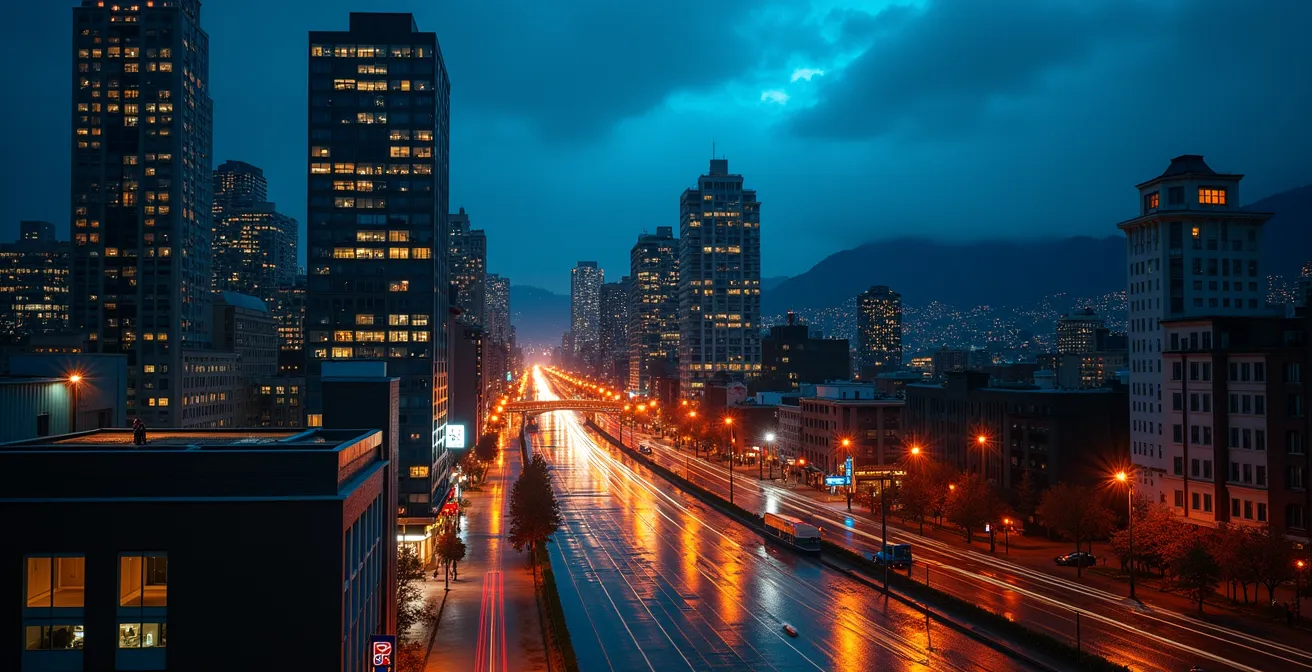
Navigating Vancouver safely at night is not about avoiding entire districts, but about understanding the city’s predictable “safety micro-climates” engineered by urban design and commercial activity.
- The boundary between tourist-friendly Gastown and the challenging Downtown Eastside is sharp and geographically distinct, often just a single street.
- Neighbourhoods like the West End offer demonstrably safer and more vibrant evening atmospheres compared to the deserted Financial District after business hours.
Recommendation: Focus on choosing your neighbourhood based on its evening activity levels and use practical tools like the right rain gear and transit shortcuts to move through the city with confidence.
For any solo traveler planning a trip to Vancouver, the question of nighttime safety inevitably arises. You’ve likely heard the whispers—warnings about the Downtown Eastside (DTES) and sensationalized stories that paint the entire downtown core with a single, ominous brush. The standard advice, “be aware of your surroundings” or “avoid certain areas,” is often too vague to be actionable, leaving you more anxious than empowered. This can lead to a limited travel experience, confined to a hotel room after sunset, missing out on the city’s vibrant evening culture.
But what if the key to navigating Vancouver safely isn’t about fear and avoidance, but about strategic understanding? The reality is that Vancouver’s safety isn’t a simple on/off switch. It’s a complex and fascinating geography of what can be called safety micro-climates. Safety levels can change dramatically from one block to the next, dictated not by random chance, but by predictable factors: urban planning, commercial hours, transit routes, and the natural flow of people. This is a city where safety is often engineered directly into the environment.
This guide moves beyond the generic warnings. We will dissect the city’s layout to show you not just *where* the tourist zones end, but *why*. We’ll explore how to choose a neighbourhood for its evening ambiance, why your gear matters in “Raincouver,” and how to use the city’s unique transit as a strategic tool. By understanding these systems, you can move from a place of caution to one of informed confidence, fully and safely enjoying all that Vancouver has to offer after dark.
This article provides a detailed roadmap for the solo traveler. We will break down specific neighbourhoods, offer practical advice for navigating the city’s unique environment, and provide data-driven context to help you make informed decisions throughout your stay.
Summary: Is Downtown Vancouver Safe at Night? A Solo Traveler’s Guide to Navigating the City
- Gastown vs. East Hastings: Where Does the Tourist Zone End?
- Yaletown or West End: Which Walkable Neighborhood Is Quieter at Night?
- West Queen West: Why Staying Outside the Financial District Saves You Money?
- The Myth of the ‘City That Sleeps Early’: Where to Find Food After 10 PM?
- Raincouver Gear: Why an Umbrella Isn’t Enough for Downtown Walking?
- False Creek Ferries: Are They a Commuter Tool or Just a Tourist Ride?
- Biking the Seawall: How to Navigate Vancouver’s Greenest Loop Without Pedestrian Conflicts?
- Toronto vs. Montreal vs. Calgary: Where Does a Digital Nomad Budget Stretch Further?
Gastown vs. East Hastings: Where Does the Tourist Zone End?
The primary source of anxiety for many visitors is the proximity of historic, tourist-friendly Gastown to the deeply troubled Downtown Eastside (DTES). The key to confident navigation is understanding that this is not a gradual blend but a sharp, visible boundary. For most travelers, the line is drawn at Carrall Street. West of this line, you’re in the heart of Gastown with its Victorian architecture, trendy boutiques, and bustling restaurants. East of it, the environment changes rapidly as you enter the area of East Hastings Street, the epicentre of the city’s homelessness, mental health, and addiction crises.
It’s crucial to approach this with factual awareness rather than fear. The issues in the DTES are complex and rooted in systemic societal problems, and the people there are not inherently a threat to tourists. However, the concentration of poverty and open drug use can be confronting and lead to unpredictable situations. From a practical safety standpoint, as a solo traveler at night, there is no reason to venture east of Carrall Street or south of Pender Street in this area.
The distinction is not just social but statistical. While downtown as a whole experiences property crime, with recent Vancouver crime statistics showing 179 cases of mischief and hundreds of auto thefts, the most severe and visible issues are hyper-concentrated. By simply staying within Gastown’s well-defined western zone, you remain in a managed, high-traffic tourist area where the atmosphere is entirely different. Think of it as a clear geographical rule: enjoy Gastown’s charm, but treat Carrall Street as your firm eastern perimeter after dark.
Yaletown or West End: Which Walkable Neighborhood Is Quieter at Night?
Once you understand where to avoid, the more important question becomes where to stay and spend your evenings. For solo travelers seeking a safe and pleasant nighttime environment, the choice often comes down to two of downtown’s most popular residential neighbourhoods: Yaletown and the West End. While both are considered safe, they offer distinctly different “safety micro-climates.” Your choice depends on the kind of quiet you prefer: the concentrated energy of Yaletown or the diffuse, community-oriented calm of the West End.
Yaletown, a former warehouse district, is known for its chic glass towers and polished restaurant patios. The evening energy here is concentrated along two main arteries, Hamilton and Mainland streets. It’s lively, well-lit, and feels safe due to the high foot traffic. However, this energy can feel performative—a “see-and-be-seen” vibe that might not be comfortable for every solo traveler. Furthermore, the activity fades quickly as you move away from these main streets into purely residential zones, and most venues close relatively early.
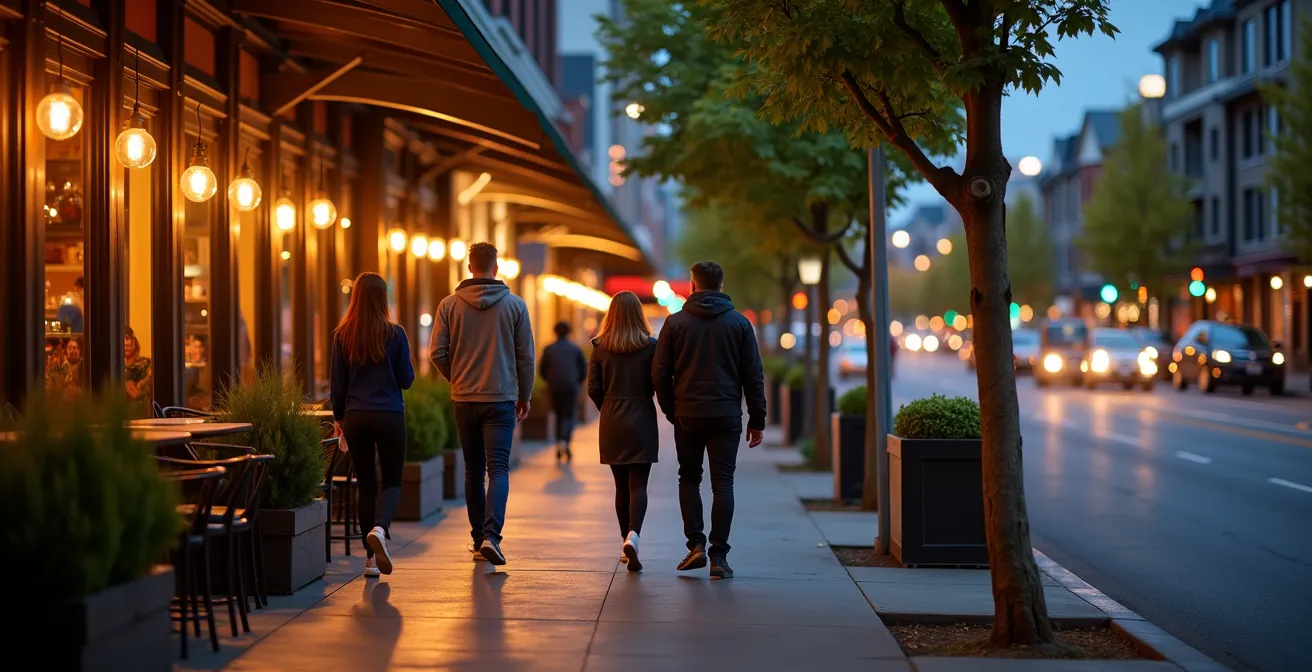
The West End, by contrast, offers a more integrated and organic sense of community safety. Streets like Denman and Davie are lined with a diverse mix of small restaurants, cafes, grocery stores, and residential walk-ups. The atmosphere is less about high-end dining and more about locals going about their lives. This creates “eyes on the street” well into the evening, providing a constant, reassuring presence. Data supports this feeling, with studies showing the West End reporting property crime rates 20% below the city average, making it a statistically sound choice. The Davie Village area, at its heart, is also one of North America’s most prominent LGBTQ+ friendly neighbourhoods, known for its exceptionally welcoming and safe environment.
For a solo traveler, the West End often feels more genuinely restful and secure at night, with a gentle buzz that lasts later than Yaletown’s concentrated burst.
| Neighbourhood | Evening Atmosphere | Solo Traveler Safety | Late Night Activity |
|---|---|---|---|
| West End | Diffuse, community-oriented quiet | Very safe, LGBTQ+ friendly Davie Village | Active until midnight on Denman/Davie |
| Yaletown | Concentrated energy on main streets | Safe but ‘see-and-be-seen’ vibe | Most venues close by 11 PM |
| Coal Harbour | Very quiet residential | Extremely safe, well-lit Seawall | Limited after 10 PM |
West Queen West: Why Staying Outside the Financial District Saves You Money?
While the title references Toronto’s famed West Queen West, the principle it illustrates is a universal rule of urban safety and a crucial one for navigating Vancouver: avoid staying in deserted business districts. In many cities, the Financial District is a hub of activity from 9 to 5, but it transforms into a silent, empty canyon of skyscrapers at night. This lack of activity and “eyes on the street” can create an isolating and eerie atmosphere for a solo traveler, even if crime rates aren’t high.
This is precisely the case in Vancouver. The area around Canada Place and the core business district on streets like Burrard and Georgia becomes unnervingly quiet after 6 PM. As one Urban Planning Vancouver Report notes, “The Financial District is deserted after 6 PM, which can feel eerie and isolating.” While it may seem central, the lack of residential life and late-night commercial activity means you’ll often be walking alone on wide, empty sidewalks. This contrasts sharply with the vibrant, safe feeling of a neighbourhood like Toronto’s West Queen West, which thrives on its mix of residential apartments, art galleries, independent shops, and late-night restaurants.
The direct equivalent in Vancouver isn’t West Queen West, but neighbourhoods like Mount Pleasant or Kitsilano. Mount Pleasant’s Main Street, for example, maintains a lively local feel with breweries, unique restaurants, and residents out walking their dogs well into the evening. This creates a natural surveillance that is far more comforting than the stark emptiness of the downtown core. The cost-saving aspect is also significant; accommodations outside the Financial District are often more affordable and provide a more authentic local experience, all while offering a superior sense of nighttime security.
The Myth of the ‘City That Sleeps Early’: Where to Find Food After 10 PM?
Vancouver has a reputation for being an “early-to-bed” city, which can be a source of anxiety for travelers arriving late or wanting a post-event meal. The fear is being stranded and hungry in a deserted downtown. However, this is largely a myth. The reality is that late-night food options are plentiful; you just need to understand the city’s activity gradient. Late-night life isn’t evenly distributed but concentrated in specific, safe pockets.
Knowing where these pockets are is a powerful safety tool. Instead of wandering aimlessly, you can head directly to a well-lit, populated area. Here’s a neighbourhood-by-neighbourhood guide to safe, late-night oases:
- West End (Best Bet): This is the champion for late-night eats. Denman Street, and to a lesser extent Robson Street, is packed with options. Japanese Izakayas and ramen shops are culturally designed for late-night dining and are extremely welcoming to solo patrons, often staying open until 1 or 2 AM.
- Gastown (Conditional): Your options here are mostly pubs with kitchens that close around 11 PM. It’s great for a 10 PM meal, but choices become scarce later. Stick to the main, brightly lit streets like Water Street.
- Yaletown (Plan Ahead): Despite its trendy reputation, Yaletown largely shuts down by 11 PM. It is not a reliable destination for late-night food. Plan for an earlier dinner if you’re in this area.
- Safe 24/7 Havens: For a guaranteed safe, bright, and welcoming spot anytime, Breka Bakery & Café is a beloved local institution. With several downtown locations, they offer a well-lit, communal environment perfect for a solo person needing a late-night coffee and snack.
By targeting these specific zones, you’re not just finding food; you’re placing yourself in an environment with built-in safety—light, people, and activity. The city doesn’t sleep; its energy just coalesces in these warm, inviting hubs.
Raincouver Gear: Why an Umbrella Isn’t Enough for Downtown Walking?
A common mistake for visitors is underestimating Vancouver’s signature weather: rain. This isn’t just about comfort; it’s a critical safety issue, especially at night. An umbrella is woefully inadequate for the realities of a coastal temperate rainforest. It occupies a hand, obstructs your peripheral vision, and is useless in the windy corridors between downtown’s glass towers. For safe and confident night navigation, the right gear is non-negotiable.
Proper rain gear allows you to keep your hands free for balance, holding your phone for navigation, or personal safety. It also ensures your full field of vision remains clear, which is paramount for maintaining situational awareness. Walking on Gastown’s historic cobblestones, which become extremely slick when wet, requires sure-footedness and an unobstructed view of the ground. In heavy rain, visibility for drivers is poor; wearing bright or reflective elements is not just a suggestion but a crucial safety measure to ensure you are seen.

Investing in the right “Raincouver” kit is investing in your safety. It means you can walk with your head up, fully aware of your surroundings, instead of hunched under a flimsy, vision-blocking umbrella. This is what allows you to confidently navigate the city’s streets, regardless of the weather, and focus on the path ahead rather than fighting the elements.
Action Plan: Essential Gear for Navigating Vancouver at Night
- Invest in the Jacket: Choose a quality hooded, fully waterproof, and breathable jacket. This is your primary shield and keeps your hands and vision free.
- Secure Your Footing: Wear waterproof boots or shoes with aggressive, non-slip tread patterns, essential for slick cobblestones and uneven sidewalks.
- Be Seen: Incorporate bright or reflective elements into your outfit. A jacket with reflective hits or a small clip-on light for your backpack greatly increases visibility to traffic.
- Keep Hands Free: Use a waterproof backpack or cross-body bag to carry your essentials. This aids balance and keeps your hands available.
- Test Your Hood: Before you go out, test your jacket’s hood. Ensure it moves with your head and doesn’t create blind spots when you turn to check for traffic.
False Creek Ferries: Are They a Commuter Tool or Just a Tourist Ride?
While often seen as a quaint tourist attraction, Vancouver’s mini-ferries that crisscross False Creek are a powerful and underutilized tool for strategic transit and safety. For a solo traveler, they represent more than just a scenic ride; they are a secure shortcut that can bypass potentially long, deserted walks, especially around dusk.
Consider the journey from Granville Island back to the downtown peninsula. The walk requires navigating under the Granville Street Bridge, an area that can feel isolated and poorly lit at night. The alternative is a five-minute ride on the Aquabus to the Hornby Street dock. This short trip deposits you directly into a well-lit, residential part of downtown, completely bypassing the less comfortable walking route. As the Vancouver Tourism Safety Guide advises, “The ferries are a strategic safety shortcut for solo travelers, providing a secure alternative to walking through potentially deserted areas around dusk.”
There are two main services, False Creek Ferries and The Aquabus, which run similar but distinct routes. It’s important to know their limitations. They are not a 24-hour service; last sailings are seasonal, typically ending between 8 and 9 PM in winter and extending to 10 PM in the summer. Furthermore, payment methods vary, and some boats remain cash-only. By planning your day to incorporate a ferry ride back to your accommodation before the last sailing, you are actively choosing a faster, brighter, and more secure route. It’s a perfect example of how understanding a city’s unique infrastructure can directly enhance your personal safety.
Biking the Seawall: How to Navigate Vancouver’s Greenest Loop Without Pedestrian Conflicts?
Biking the Stanley Park Seawall is a quintessential Vancouver experience, but a nighttime ride presents a unique set of safety considerations. It’s an excellent way to see the city, but it requires adherence to rules and an understanding of the route’s changing environment. The main conflict isn’t just with pedestrians, but with the darkness itself.
The Seawall’s safety at night is a tale of two sections. The urban portion, from Coal Harbour past Canada Place and around to English Bay, is generally well-lit and populated, making it suitable for casual evening cycling. However, once you enter the main Stanley Park loop, the environment changes. This section is a natural forest path, and large portions of it, particularly the stretch between Third Beach and the Lions Gate Bridge, are completely unlit. While beautiful, this section should be avoided by solo cyclists after dark unless you are an experienced night rider with powerful lights.
Statistically, the park is remarkably safe. Recent crime data from the Vancouver Police Department shows Stanley Park reported zero mischief cases, making it one of the city’s safest public spaces from a crime perspective. The primary risks are environmental: collisions with other users in the dark, or wildlife on the path. Adhering to the strict one-way (counter-clockwise) rule in the park is absolutely critical at night to prevent head-on collisions on blind corners.
Checklist for a Safe Nighttime Seawall Ride
- Legal Lighting: Equip your bike with a white front light and a red rear light. This is mandated by B.C. law for cycling after dusk and is essential for visibility.
- Obey the One-Way Rule: The Stanley Park section is strictly counter-clockwise. Following this rule is your best defence against collisions.
- Know Your Bailout Points: Identify well-lit access points to main roads like English Bay, Second Beach, and Lumberman’s Arch in case you need to exit the dark sections.
- Stick to the Urban Section: For a casual and safe night ride, stick to the well-lit path from Coal Harbour to Canada Place and along the False Creek side of the Seawall.
- Avoid the Deep Park After Dark: Unless you are specifically equipped for trail riding in complete darkness, avoid the unlit forested loop inside Stanley Park from dusk onward.
Key Takeaways
- True safety comes from understanding urban geography—knowing which block marks the end of a tourist zone and which neighbourhood offers a vibrant evening life.
- Your gear is a safety tool. A proper waterproof jacket and non-slip shoes are more crucial than an umbrella for maintaining awareness and stability in the rain.
- Leverage strategic transit. Use tools like the False Creek ferries not just for sightseeing, but as secure shortcuts to bypass isolated walking routes at dusk.
Toronto vs. Montreal vs. Calgary: Where Does a Digital Nomad Budget Stretch Further?
While this article focuses on Vancouver, it’s helpful to contextualize its safety within the broader Canadian landscape. For a digital nomad or any solo traveler weighing their options, the question is often not just “is Vancouver safe?” but “how does its safety and cost profile compare to other major Canadian cities?” The data suggests Vancouver is not only holding its own but actively improving.
Fears about Vancouver’s safety are often amplified online, but the official numbers tell a story of progress. Recent Vancouver Police Department statistics show a 7% overall crime decrease in the first quarter of 2024, with violent crimes down by an even more significant 9.3%. This trend indicates that municipal efforts to enhance public safety are having a measurable impact, providing a fact-based counter-narrative to anecdotal stories of decline.
When considering where a budget stretches furthest, the analysis becomes more nuanced. Vancouver’s high rental costs are undeniable and a major factor for anyone planning an extended stay. This often pushes nomads to well-connected suburbs like Burnaby. However, Vancouver offers unique assets for the modern traveler. Its focus on the tech industry has resulted in numerous secure, 24/7 co-working spaces downtown, a critical asset for those carrying expensive equipment. The city’s SkyTrain system, particularly the Expo and Canada Lines, maintains a strong security presence with dedicated Transit Police, offering a reliable and safe late-night option that feels more secure than navigating the sprawling subway systems of larger cities like Toronto.
Ultimately, while cities like Montreal may offer more affordable central living, and Calgary a different economic landscape, Vancouver provides a unique combination of stunning natural access, a robust and improving safety record, and infrastructure that caters to the needs of a modern solo traveler. The cost may be higher, but the investment often pays dividends in lifestyle and peace of mind.
By applying these principles of strategic navigation—understanding neighbourhood micro-climates, using the right gear, and leveraging transit—you can confidently and safely experience the best of Vancouver, day and night. Plan your trip not around fear, but around knowledge.