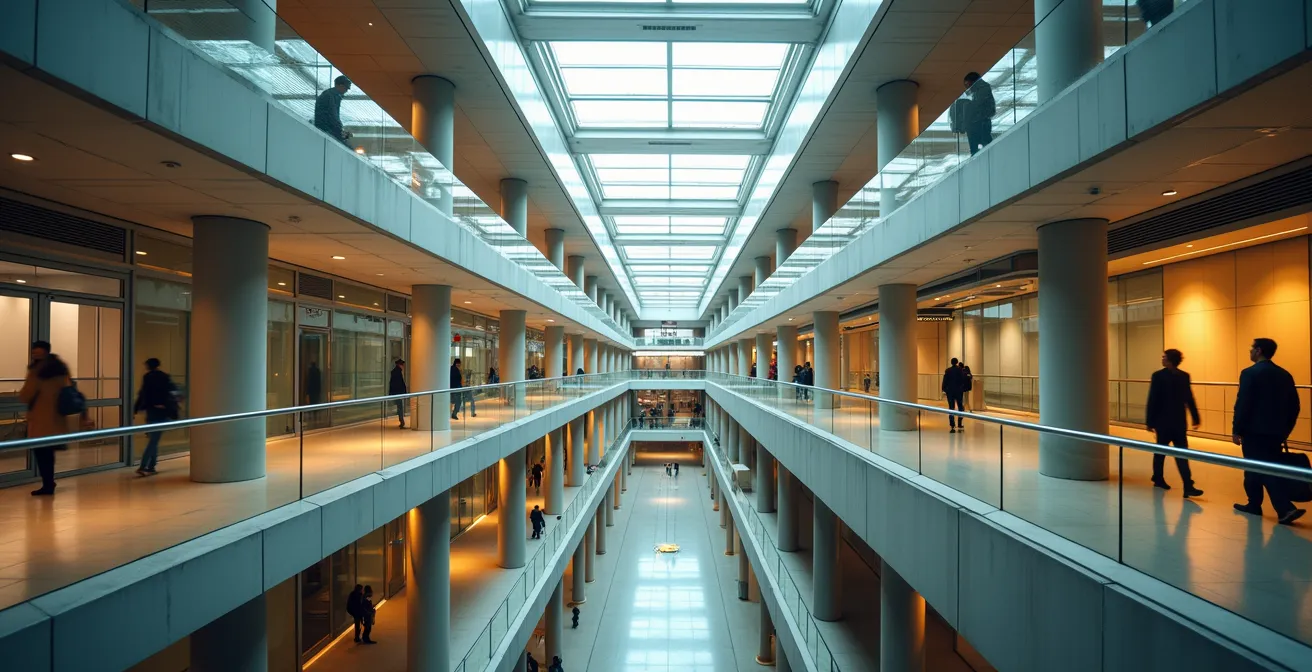
Many visitors arrive in Montreal expecting a unified, subterranean city and instead find a confusing network of shopping tunnels. The confusion stems from a core misunderstanding. The RÉSO isn’t a single, planned entity but an emergent architectural organism that has grown organically over 60 years. By understanding its fragmented, layered design—born from private development and public transit—one can stop seeing it as a failed utopia or a mere mall, and start appreciating it as a unique and complex piece of urban evolution.
You arrive in Montreal, clutching a map of the “Underground City,” envisioning a futuristic subterranean world, a seamless metropolis beneath the streets. You descend at a Metro station, follow a promising sign, and find yourself… in a shopping mall’s food court. You walk further, through a hotel lobby, a university building, and another mall. The confusion mounts. Is this it? Is the celebrated RÉSO just a disjointed series of commercial corridors designed to shield you from the winter cold? This experience is common, and it stems from a fundamental misunderstanding of what Montreal’s underground network truly is.
The popular conception of a grand, centrally-planned city beneath the city is a myth. The reality is far more complex and, from an urban design perspective, far more interesting. The RÉSO is not a singular architectural project but an emergent network, a patchwork of public and private spaces stitched together over decades. It is a living, breathing urban organism whose “architectural DNA” is a direct reflection of Montreal’s pragmatic, often bottom-up approach to city-building. Other cities have underground concourses, but none have a system so deeply and chaotically integrated into the urban fabric.
This article will demystify the Underground City. We will not just provide a map, but a new lens through which to view it. By analyzing the RÉSO as the primary case study and then expanding to other iconic Montreal architectural expressions—from the radical vision of Habitat 67 to the humble-yet-brilliant outdoor staircases—we will uncover the underlying principles of the city’s unique design philosophy. The goal is to transform your confusion into appreciation, revealing the method in the seeming madness of Montreal’s built environment.
To navigate this exploration of Montreal’s architectural soul, we will delve into its most defining features, from its celebrated public art to its most misunderstood infrastructure. This guide provides a clear path through the city’s design identity.
Summary : A Critical Guide to Montreal’s Architectural Identity
- How to Walk from Peel to Place-des-Arts Without Stepping Outside in Winter?
- Habitat 67: Can You Actually Visit Moshe Safdie’s Masterpiece?
- Le Plateau staircases: Why Are They on the Outside of the Buildings?
- Design Market: Where to Buy UNESCO-Designated Montreal Creations?
- Murals on Saint-Laurent: How to Plan a Self-Guided Street Art Tour?
- AGO and ROM: When Are the Free Admission Nights for Museums?
- How Did Gravity-Fed Wooden Grain Elevators Actually Work?
- English Theatre in Montreal: Where to Find Anglophone Culture in a Francophone City?
How to Walk from Peel to Place-des-Arts Without Stepping Outside in Winter?
The first step in understanding the RÉSO is to embrace its fragmented nature. It is not one continuous tunnel but a series of interconnected segments, primarily linking Metro stations with commercial buildings, universities, and performance venues. The walk from Peel station to Place-des-Arts is a classic example of its utility and its quirks. This journey is possible entirely indoors, but it requires navigating through multiple distinct properties, including the Cours Mont-Royal shopping centre, Place Montréal Trust, and Complexe Desjardins. Each segment has its own architectural style, signage, and operating hours, reflecting its private ownership. This is the essence of the “emergent network”: it grew not from a master plan, but from individual developers seeing the value in connecting to the public transit artery.
This ad-hoc growth is why the network can feel disorienting. There is no unified design language. The system’s total scope is vast; a study confirms that Montreal’s RÉSO network spans an impressive 32 kilometres (20 miles) of tunnels over 12 square kilometres, making it one of the largest of its kind. Yet, navigating it depends less on following a single path and more on understanding its logic of layered connections. Your journey is a cross-section of the city’s commercial and cultural life, a tour of architectural styles from the 1960s to today, all happening below the street grid. The key is to look for the cube-like RÉSO logo, which acts as the unifying thread in this diverse tapestry.
Your Action Plan: Navigating the RÉSO Like a Local
- Start at any metro station entrance and look for the distinctive RESO signs (a cube with four letters) hanging from ceilings or mounted on walls.
- Navigate using your sense of direction or a compass, as GPS signals do not work reliably underground; trust the signs over your phone.
- When you feel lost, walk to the furthest corner of your current location (e.g., a food court or lobby) to find the connecting corridors, which are often not centrally located.
- Follow the schematic maps bearing the RESO logo found throughout the network, understanding they show connections, not geographic accuracy.
- Remember that most sections are open from approximately 5:30 AM to 1:00 AM, matching the Metro’s operating hours, though individual building hours may vary.
Habitat 67: Can You Actually Visit Moshe Safdie’s Masterpiece?
If the RÉSO represents Montreal’s pragmatic, evolving urbanism, Habitat 67 embodies its audacious, visionary spirit. Designed by Moshe Safdie for Expo 67, this cluster of concrete boxes on the Marc-Drouin Quay is a global icon of Brutalist architecture and a radical experiment in prefabricated modular housing. The core question for many architecture enthusiasts is: can you get inside? The answer is a qualified yes. Habitat 67 is not a public museum; it is a private residential co-operative. Wandering its corridors uninvited is trespassing.
However, the building’s significance is such that access has been formalized. The only way to truly experience Safdie’s vision—to walk the elevated pathways and understand how each of the 354 concrete modules gives its residence a private garden in the sky—is through a guided architectural tour. These tours, often booked months in advance, provide access to the complex’s common areas and sometimes even a peek into a restored unit. For those without a tour, excellent public viewing is available from the adjacent Parc de la Cité-du-Havre and across the water from the quay, offering the classic postcard view of this concrete mountain.

Originally conceived as a blueprint for affordable housing, Habitat 67 has since become a luxury address, a testament to the enduring power of its design. Its journey from a World’s Fair pavilion to a designated Quebec heritage landmark illustrates a recurring Montreal theme: bold architectural statements becoming cherished, integral parts of the city’s identity. It stands as a physical manifestation of the high-minded design principles that, in a different way, also informed the city’s more grounded urban projects.
Le Plateau staircases: Why Are They on the Outside of the Buildings?
From the high-concept ambition of Habitat 67, we turn to a feature that is quintessentially Montrealer: the twisting, wrought-iron outdoor staircases of the Plateau Mont-Royal. To an outsider, their existence seems illogical, even cruel, given the city’s harsh winters. Why would anyone design buildings that force residents to brave ice and snow just to get to their front door? The answer, like so much in Montreal, lies in a peculiar intersection of functional requirements and municipal bylaws that shaped the city’s vernacular architecture.
The design is not an aesthetic whim but a clever solution to a legal constraint. In the late 19th and early 20th centuries, the city sought to create greener streetscapes. As one historical guide explains, this urban planning decision had a defining architectural consequence.
The external staircases emerged from 19th-century municipal bylaws requiring small green front yards, forcing builders to maximize interior living space by moving staircases outside – a defining moment in Montreal’s urban planning that shaped the identity of its working-class neighbourhoods.
– Montreal Urban Planning Archives, Historical Montreal Architecture Guide
By moving the bulky stairwells outside, builders could offer more spacious and desirable apartments within the narrow lot sizes typical of the area. What began as a pragmatic workaround became an indelible part of the city’s character. These staircases are more than just circulation; they are social spaces—de facto front porches where neighbours chat and watch the world go by. This feature starkly contrasts with the residential architecture of other major Canadian cities.
| City | Typical Feature | Social Function | Winter Adaptation |
|---|---|---|---|
| Montreal | External spiral staircases | Neighbourhood social hub | Requires de-icing |
| Toronto | Front porches | Semi-private sitting area | Often enclosed |
| Vancouver | Private backyards | Family gatherings | Year-round use |
Design Market: Where to Buy UNESCO-Designated Montreal Creations?
Montreal’s unique architectural landscape is not an accident; it is the product of a deep-seated culture of creativity. This was officially recognized in 2006 when it was named a UNESCO City of Design, joining a global network of cities where design is a strategic driver of economic and social development. This isn’t just a title; it reflects a thriving ecosystem. As a UNESCO City of Design since 2006, Montreal’s creative sector is a significant economic force, with over 25,000 professionals working in Montreal’s design sector.
For a visitor, this means that world-class design is not confined to galleries but is accessible in shops and boutiques across the city. Finding these creations means looking beyond typical souvenir stores and exploring the neighbourhoods where designers live and work. Each district offers a different flavour of Montreal’s design scene:
- Griffintown: Head to Rue Notre-Dame Ouest for sleek, contemporary furniture showrooms featuring the work of prominent Quebec designers.
- Mile End: Explore the independent fashion ateliers and artisan workshops clustered around Boulevard Saint-Laurent and Rue Saint-Viateur.
- Old Montreal: Wander the cobblestone streets, particularly Rue Saint-Paul, to discover galleries showcasing local ceramics, glasswork, and fine art.
- Plateau Mont-Royal: Along Avenue Mont-Royal, you’ll find an eclectic mix of vintage and upcycled design boutiques, reflecting the neighbourhood’s bohemian spirit.
- Downtown RÉSO: Even within the underground network, you can find established Montreal brands like Rudsak leather goods and ALDO shoes, demonstrating how commerce and local design intersect.
Shopping in these areas is more than a transaction; it’s an immersion into the city’s creative fabric. You are not just buying an object, but a piece of the city’s celebrated design identity, born from the same creative energy that produced its most iconic buildings.
Murals on Saint-Laurent: How to Plan a Self-Guided Street Art Tour?
Montreal’s “architectural skin” is not limited to brick and concrete; it is a living canvas. The most vibrant example is the collection of large-scale murals along Boulevard Saint-Laurent and its surrounding streets. This transformation of the urban landscape into an open-air gallery is largely driven by the annual MURAL Festival. Since 2013, this event has commissioned internationally renowned and local artists to create monumental works on building facades, turning a simple walk down “The Main” into a world-class artistic experience.
Planning a self-guided tour is straightforward. The highest concentration of murals is found on Boulevard Saint-Laurent between Rue Sherbrooke and Avenue Mont-Royal. The best approach is to simply walk this stretch and allow yourself to be surprised by the art that looms above. For a more structured tour, the website for Art Public Montréal offers an interactive map that pinpoints the location of both current festival pieces and older “ghost” murals that still adorn the city’s walls and back alleys. This allows you to create a custom walking route based on your location and interest.
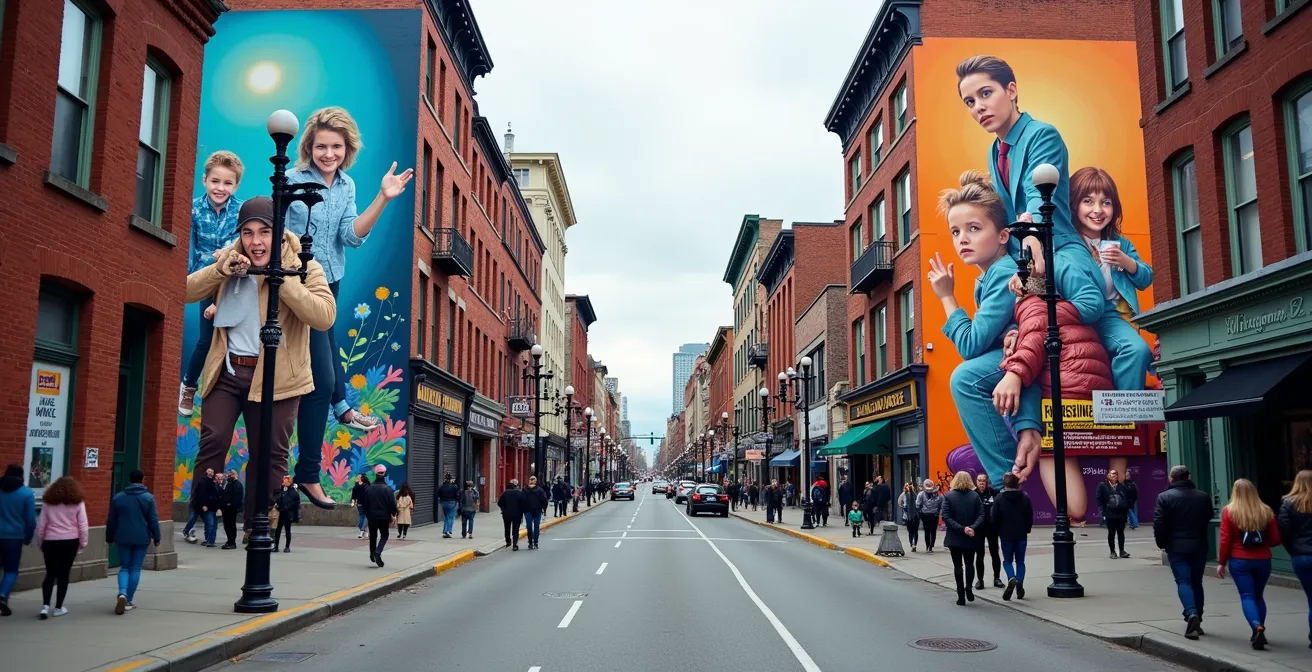
An important aspect to understand is the ephemeral nature of this art. Many murals are designed to last only a few years before being painted over (“buffed”) to make way for new creations. This constant renewal reflects Montreal’s dynamic cultural landscape. The themes often engage with contemporary issues, from local politics to global concerns, making the street art scene a real-time barometer of the city’s conversations. It is public art in its most democratic form—free, accessible, and constantly evolving.
AGO and ROM: When Are the Free Admission Nights for Museums?
When considering access to culture, many North American cities, like Toronto, have adopted a model of specific “free admission nights” for their major institutions like the Art Gallery of Ontario (AGO) and the Royal Ontario Museum (ROM). This approach designates a set time for the public to access collections without a fee, concentrating the opportunity into a few hours per week or month. While this is a valuable initiative, it highlights a fundamental difference in philosophy compared to Montreal’s approach to public art and design.
In Montreal, while museums do have their own pricing structures, a significant part of the city’s cultural offering is not housed within institutions but is integrated directly into the urban environment itself, free and accessible 24/7. The sprawling murals of the MURAL Festival, the public art installations in the Quartier des Spectacles, and the very architecture of buildings like Habitat 67 or the Biosphere are all part of this open-air museum. The city treats its public spaces as a primary venue for cultural expression.
This philosophy extends even to the much-debated RÉSO. It functions as a gallery of sorts, showcasing decades of commercial architectural trends and housing numerous public art pieces commissioned for its stations and corridors. Therefore, while a visitor in Toronto might plan their trip around a specific free evening at the ROM, a visitor in Montreal experiences a constant, ambient immersion in art and design simply by walking its streets—or its underground passages. It’s a model based on perpetual access rather than scheduled events, a key element of the city’s unique cultural DNA.
How Did Gravity-Fed Wooden Grain Elevators Actually Work?
To fully appreciate the unique character of Montreal’s architecture, it helps to place it within the broader context of Canadian design history. A defining feature of this history is a powerful strain of functionalism, an architecture born from necessity. Perhaps no structure embodies this more purely than the towering wooden grain elevators of the prairies. Known as “Prairie Sentinels,” these structures were once ubiquitous; a historical review notes that over 5,700 grain elevators dotted the Canadian prairies at their peak in the 1930s.
Their design was a masterclass in gravity-fed engineering. The process was simple and ingenious: grain was brought in by wagon, lifted to the top of the elevator by a continuous series of buckets on a belt (the “leg”), and then distributed through chutes into various tall wooden bins for storage. When it was time to ship, gravity did the work, releasing the grain from the bottom of the bins into waiting rail cars. The building’s form was dictated entirely by this function. The Inglis Grain Elevators in Manitoba, now a National Historic Site, preserves this process, showing how these structures were the mechanical heart of Western Canada’s agricultural economy.
This principle of form-follows-function provides a crucial lens for viewing Montreal. The outdoor staircases of the Plateau are a direct result of a functional need to maximize interior space under a specific bylaw. The RÉSO itself is a monument to functionalism; it exists not because of a grand aesthetic vision, but because of the practical need to connect buildings to the Metro and protect pedestrians from the climate. While Montreal’s expression is more complex and urban, it shares a common ancestor with the stark functionalism of the prairie grain elevator: design driven by solving a practical problem in the most efficient way possible.
Key Takeaways
- Montreal’s RÉSO is not a single planned “Underground City” but an organically grown network of public and private spaces.
- The city’s architectural identity, from Habitat 67 to its outdoor staircases, is often born from a unique blend of visionary design and pragmatic, function-driven solutions.
- Much of Montreal’s art and design is integrated into the public realm (e.g., murals, architecture), offering constant free access rather than relying solely on institutional free nights.
English Theatre in Montreal: Where to Find Anglophone Culture in a Francophone City?
A city’s architecture is the stage upon which its cultural life unfolds. In Montreal, a metropolis defined by its linguistic duality, this stage hosts a vibrant and resilient Anglophone cultural scene, particularly in theatre. For visitors, finding English-language performances is a way to tap into a crucial part of the city’s identity. The English theatre community is not a monolith; it is a diverse ecosystem with venues catering to every taste, from classic plays to experimental fringe works.
This diversity is a testament to the community’s ability to thrive within a predominantly Francophone environment. The physical spaces they inhabit are as varied as their productions. The Centaur Theatre, housed in the grand old stock exchange building in Old Montreal, represents the established heart of English theatre. In contrast, smaller, more adaptable venues like the MainLine Theatre on Saint-Laurent are hubs for the city’s edgy and independent creators. This reflects the city’s broader pattern: established institutions coexisting with a dynamic, grassroots creative scene.
Finding a show is a matter of matching your mood to a venue. For a polished, mainstream production, the Centaur is the go-to. For something avant-garde, the MainLine or other fringe venues are your best bet. The Segal Centre offers high-quality musical theatre, while Montreal Improv provides a steady stream of comedy. In the summer, the tradition of Shakespeare-in-the-Park offers classic theatre in a beautiful outdoor setting. This rich offering demonstrates that Anglophone culture is not just a footnote in Montreal; it is a vital, contributing thread in the city’s complex cultural tapestry, housed within the unique architectural spaces the city provides.
By shedding the misconception of a planned subterranean world and instead viewing the RÉSO and other landmarks as expressions of an evolving, function-driven design ethos, the city’s architectural brilliance becomes clear. The next step is to take this critical lens and apply it to your own exploration of the city’s streets, both above and below ground.