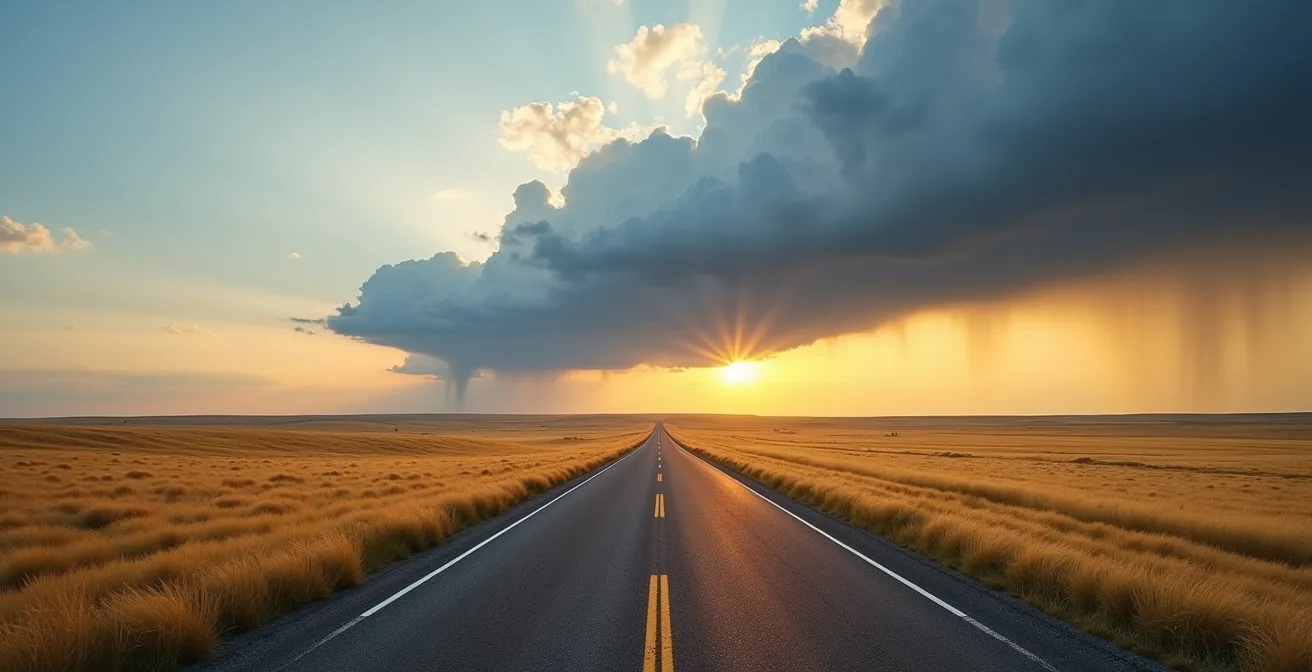
The drive across the Canadian Prairies isn’t an obstacle to be survived with good playlists; it’s a unique environmental experience to be embraced.
- The “emptiness” is actually a stage for Canada’s most dramatic weather and sunsets, a concept known as the “Living Sky.”
- “Monotony” disappears when you develop “landscape literacy”—learning to read the road for hidden stops, historical markers, and crucial safety cues.
Recommendation: Shift your mindset from ‘endurance’ to ‘immersion’. Plan for slowness, watch the sky, and treat the horizon as a destination, not a void.
Ask any Canadian about the Trans-Canada drive, and you’ll likely hear a groan when the conversation turns to the prairies. The 800-kilometre stretch across Saskatchewan, in particular, has a reputation for being a flat, featureless, and mind-numbingly monotonous test of endurance. The common advice is to load up on podcasts, drink enough coffee to stay wired, and just “get through it” as fast as you can. Many drivers see it as a blank space on the map between the lakes of Manitoba and the mountains of Alberta.
But what if that perception is entirely wrong? What if the key to this journey isn’t about distracting yourself from the landscape, but engaging with it more deeply? This guide is built on a different philosophy, one honed over countless cross-country trips. The secret to the prairie drive isn’t found in your playlist; it’s found in learning to read the road, the history, and the vast, dynamic sky. It requires developing a kind of “landscape literacy” that transforms the drive from a chore into an immersive experience.
Instead of surviving the drive, this article will show you how to embrace its unique character. We will explore the science behind its dramatic weather, the practicalities of navigating its vast distances safely, and the subtle beauty hidden in plain sight. You’ll learn to see the horizon not as an empty void, but as a canvas for some of the most spectacular natural phenomena in the country.
This article breaks down how to change your perspective and your preparation for the prairie drive. Follow along as we explore the secrets of the sky, the road, and the resilient spirit of this often-underestimated landscape.
Summary: Beyond the Horizon: A Guide to the Prairie Drive
- Why Are Prairie Sunsets and Storms More Dramatic Than Anywhere Else?
- Where to Stop Between Winnipeg and Calgary to Break the Monotony?
- The Danger of “Gas Math”: Why You Should Never Let Your Tank Drop Below Half?
- Driving Through a Prairie Supercell: What to Do If You See a Tornado?
- Canola Fields in Bloom: When Is the Best Time to See the “Yellow Sea”?
- Why Underestimating Driving Times Can Ruin Your Canadian Road Trip?
- Tire Shredder: How to Prepare Your Vehicle for the Road to the Arctic Ocean?
- The Vanishing Sentinels: Why 80% of Prairie Grain Elevators Have Disappeared?
Why Are Prairie Sunsets and Storms More Dramatic Than Anywhere Else?
The first rule of appreciating the prairie drive is simple: look up. Saskatchewan’s license plates famously declare it “The Land of Living Skies,” and this isn’t just marketing. The sky here is the main event, a vast, uninterrupted dome where weather plays out on a cinematic scale. The very “flatness” that many find boring is precisely what makes the sky so spectacular. With no mountains or significant hills to block the view, you have a front-row seat to a 360-degree horizon.
This unobstructed geography allows massive air systems to collide, creating the perfect conditions for towering cumulonimbus clouds, dramatic supercells, and thunderstorms that can be seen from over 100 kilometres away. The lack of terrain features means you can watch a storm’s entire lifecycle unfold. This powerful weather is not to be taken lightly; a national study found that 20% of fatal collisions in Canada involve environmental factors. Respect for the weather is a core part of prairie driving.
The same principle applies to sunsets. The immense, low horizon allows sunlight to travel through more of the atmosphere, scattering blue light and leaving behind the fiery reds, oranges, and purples that set the entire sky ablaze. Dust particles from farmland kicked up during the day can further enhance these colours, turning a simple sunset into a breathtaking spectacle. On the prairies, the sky isn’t just a backdrop; it’s an active, ever-changing character in your journey. Learning to watch it is the first step in your landscape literacy.
Where to Stop Between Winnipeg and Calgary to Break the Monotony?
The idea that there’s “nothing to see” between Winnipeg and Calgary comes from looking for the wrong things. The prairies don’t offer the instant gratification of a mountain peak, but their points of interest are rewarding for those willing to make a planned stop. Breaking the hypnotic rhythm of the road is essential for both safety and enjoyment, and the prairies are dotted with unique cultural and natural waypoints.
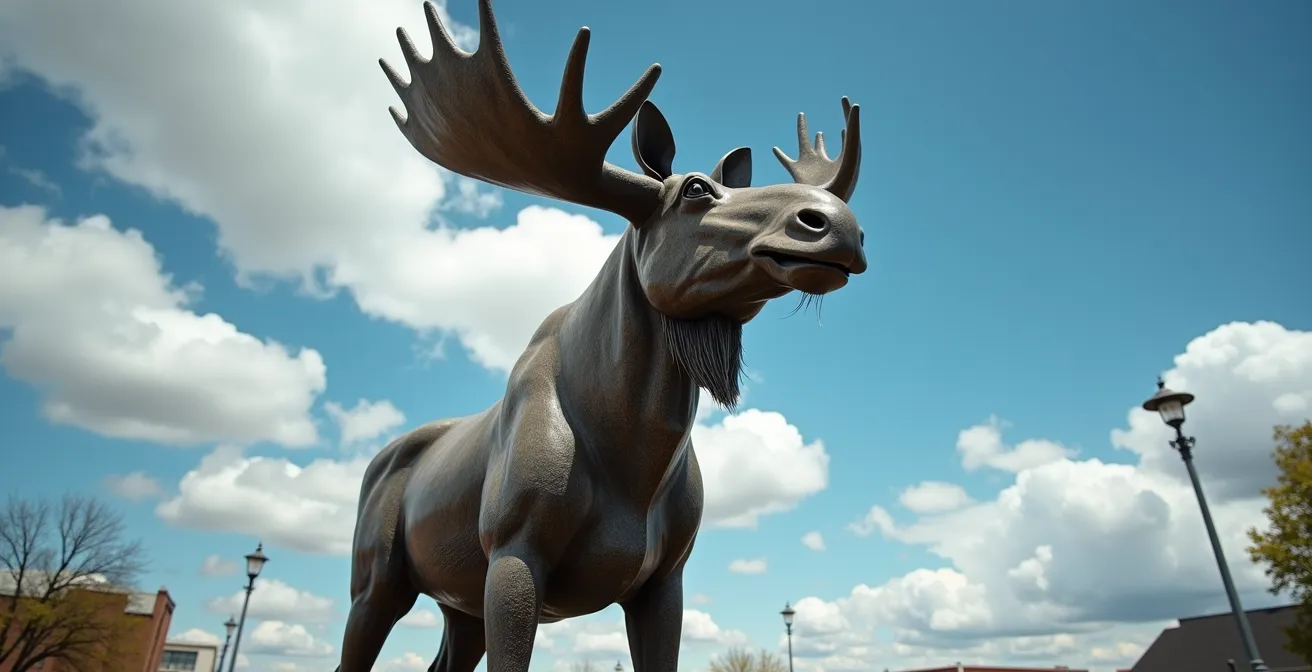
Of course, there are the iconic roadside attractions. Moose Jaw is home to Mac the Moose, a massive sculpture that stands as a beloved symbol of prairie kitsch and a perfect spot to stretch your legs. These giant monuments are more than just photo ops; they’re markers of community pride and welcome breaks in the vast landscape. They signal that you’ve arrived somewhere with a story.
Beyond the quirky giants, the real magic lies in the subtle diversions. As documented by travel experts, places like Grasslands National Park offer a profound sense of isolation and beauty. Sitting in one of Parks Canada’s red Adirondack chairs at the Ta Sunka Watógla viewpoint as the sun sets over the badlands is an unforgettable experience. The park’s West Block is home to sprawling prairie dog towns and herds of wild bison, reminders of the ecosystem that existed long before the highway. Even small towns, often overlooked, offer a glimpse into the heart of prairie life, with their historic buildings and genuine hospitality.
The Danger of “Gas Math”: Why You Should Never Let Your Tank Drop Below Half?
On most North American highways, letting your gas tank dip into the last quarter is a calculated risk. On the prairies, it’s a foolish gamble. The sheer distance between full-service towns, combined with the powerful prairie environment, makes fuel management a critical safety skill. The consequences of running out of gas here are far more severe than a simple phone call to a roadside assistance service. In winter, it can be life-threatening, as nearly 30% of car accidents in Canada occur on snowy or icy roads, often leading to closures and strandings.
The veteran prairie driver follows one simple rule: never let the tank drop below half. This isn’t just about the distance between gas stations, which can easily exceed 100-150 km. It’s also about combating the elements. A relentless prairie headwind can decimate your fuel efficiency, sometimes by as much as 30%. What your car’s range indicator promises in calm weather is a fantasy in a 60 km/h crosswind. A full tank provides a crucial buffer against this unpredictable variable.
Furthermore, many rural gas stations are “card-lock” only, designed for commercial trucks and inaccessible to the public, or they have limited hours, closing early in the evening. In a blizzard or after an accident, a road closure can leave you stranded for hours. In that scenario, a half-full tank of gas isn’t just for driving; it’s your only source of heat as you wait for the road to clear. Playing “gas math” is a game you can’t win against the prairies.
Driving Through a Prairie Supercell: What to Do If You See a Tornado?
The same conditions that create spectacular sunsets can also spawn some of the most violent weather in Canada: supercell thunderstorms and tornadoes. While an encounter is rare, knowing what to do is a vital part of your “landscape literacy.” The most dangerous mistake a driver can make is underestimating the storm’s power or assuming they can outrun it. As Public Safety Canada states in its official guidelines, this is a fatal miscalculation.
Don’t try to outrace a tornado. Tornadoes can move quickly and change direction with little to no warning. Drive to the nearest solid structure and take shelter immediately.
– Public Safety Canada, Official tornado preparedness guidelines
Your first line of defense is awareness. Pay attention to weather alerts from Environment Canada. Understanding the difference between a “watch” and a “warning” is crucial for making the right decision. A watch means conditions are favorable, so you should be extra vigilant. A warning means a tornado has been spotted or is imminent on radar, and you must take immediate action.
This table from Environment Canada clarifies the different alert levels and the actions required for each.
| Alert Type | Meaning | Required Action |
|---|---|---|
| Tornado Watch | Conditions favorable for tornado formation | Stay alert, monitor weather updates |
| Tornado Warning | Tornado spotted or imminent on radar | Take immediate shelter in sturdy building |
| Severe Thunderstorm Warning | Winds 130+ km/h or baseball-sized hail | Seek indoor shelter immediately |
If caught in a vehicle with a tornado approaching and no sturdy shelter nearby, the official advice is to get out of your car and lie flat in a ditch or the lowest-lying area possible, covering your head with your hands. A car can be easily tossed by tornadic winds. Preparedness transforms fear into calm, decisive action.
Canola Fields in Bloom: When Is the Best Time to See the “Yellow Sea”?
After discussing the hazards, it’s time to focus on one of the prairies’ most breathtaking rewards: the canola bloom. For a few short weeks in summer, the landscape transforms into a vibrant “Prairie Ocean” of brilliant yellow that stretches to the horizon. This isn’t just a patch of flowers; it’s an agricultural spectacle on a massive scale. Saskatchewan is the heart of Canada’s canola production, growing about 55% of the country’s total crop.
Timing this sight is key, as the flowering period only lasts about 14 to 21 days. For photographers and road-trippers aiming to witness this phenomenon, planning is everything. According to local photography experts who track the blooms, the peak bloom typically occurs in the last two weeks of July and the first week of August. This is when the fields are at their most intensely yellow. It’s a sight so stunning it can completely reframe your perception of the “monotonous” landscape.
One important thing to remember is that farmers rotate their crops annually. The field that was a sea of yellow one year might be a field of wheat or blue-blossomed flax the next. This means the exact location of the best fields changes every year, adding an element of discovery to the journey. When you find a good spot, always be respectful. These are working farms, so never enter a field without permission. Pull over safely on the side of the road and admire the view from a distance. The contrast of the yellow fields against the deep blue of the Living Sky is the quintessential prairie image.
Why Underestimating Driving Times Can Ruin Your Canadian Road Trip?
The single biggest mistake travelers make on the Trans-Canada Highway is trusting their GPS blindly. A 500-kilometre drive on the prairies is not the same as a 500-kilometre drive elsewhere. The seemingly straight, simple route lulls you into a false sense of security, but several factors unique to this region can and will derail your schedule if you don’t plan for them. Underestimating time here doesn’t just make you late; it leads to fatigue, rushed decisions, and a miserable experience.
The first factor is the fatigue factor. Driving for hours on end with an unchanging, distant horizon requires immense mental concentration. There are fewer turns, exits, or changes in scenery to keep your brain engaged, making “highway hypnosis” a real and present danger. This mental drain is far more taxing than navigating a winding road. You need to plan for more frequent stops than you think, not just for fuel, but for your own mental stamina.

The second factor is the prairie’s own pace. Summer is construction season, and a single lane closure on the Trans-Canada can create backups for kilometres. You also share the road with the agricultural lifeblood of the country. Getting stuck behind a wide-load combine harvester can easily add 30 minutes to your trip. These aren’t edge cases; they are predictable realities of a prairie summer drive. A realistic plan accounts for them from the start.
Your Action Plan: Realistic Prairie Driving Time Planning
- Buffer Time: Add a 20-30% time buffer for inevitable summer construction zones on the Trans-Canada Highway.
- Mandatory Stops: Account for delays from wide-load farm equipment, which can cause 30-minute hold-ups.
- Fatigue Management: Plan for more frequent breaks to combat the mental effort required on long, straight roads.
- Small Town Pace: Budget extra time when stopping in rural communities, as services operate at a more relaxed pace.
- Real-Time Conditions: Always check the Saskatchewan Highway Hotline for the latest road conditions before you depart.
Tire Shredder: How to Prepare Your Vehicle for the Road to the Arctic Ocean?
While the destination might not be the Arctic Ocean, preparing your vehicle for the prairies requires a similar mindset: assume the environment is harsh and self-sufficiency is key. The roads here have a unique character that can be tough on a vehicle. Many of the secondary highways branching off the Trans-Canada aren’t paved with smooth asphalt but with “chip seal,” a tar-and-gravel surface that is notorious for kicking up stones. This is where the “tire shredder” reputation comes from, as a flying rock can easily chip a windshield or damage a tire.
Your vehicle’s first line of defense is simple but crucial: distance. Keep a generous following distance, especially behind large trucks, to minimize the risk of being showered with gravel. Your windshield will thank you. Another surprising hazard is bug splatter. In early summer, the density of insects is so high that your windshield can become dangerously obscured in a very short time. It’s not a cosmetic issue; it’s a major visibility hazard. Make it a habit to clean your windshield thoroughly at every single stop, not just when you need fuel. Topping up your washer fluid is a must before you start the day.
Beyond that, your emergency kit needs to be prairie-specific. A standard “donut” spare tire is woefully inadequate. If you get a flat, the next service town could be over an hour away on a spare that’s only rated for 80 km/h. A full-size spare tire is the gold standard for prairie travel. A tire plug kit is also a wise, inexpensive addition that can turn a trip-ending puncture into a manageable repair. Finally, with vast cellular dead zones, a physical road map is not a nostalgic accessory; it’s an essential piece of backup navigation equipment.
Key Takeaways
- The sky is the main event: Shift your focus from the “boring” road to the “Living Sky” to appreciate the journey’s true drama.
- Preparation replaces fear: Understanding fuel management, weather alerts, and vehicle needs transforms anxiety into confident preparedness.
- The journey’s richness is in its subtlety: True enjoyment comes from developing “landscape literacy” and appreciating the small towns, historical markers, and natural wonders hidden in plain sight.
The Vanishing Sentinels: Why 80% of Prairie Grain Elevators Have Disappeared?
For generations of drivers, the first sign of civilization on the flat horizon was a cluster of tall, wooden grain elevators. These “prairie sentinels” were more than just agricultural buildings; they were crucial navigation beacons and psychological boosts. On a flat landscape, a distant elevator was visible from 30 to 50 kilometres away, serving as a non-digital GPS that confirmed a town—and a potential break—was near. They broke the monotony of the psychological horizon and gave a tangible sense of progress.
Today, many of these iconic structures are gone. The shift in the grain industry from hundreds of small, local wooden elevators to a handful of massive, centralized concrete terminals has fundamentally changed the prairie landscape. This transition explains the “ghost town” feeling of many small communities along the highway; the economic heart of the town has been relocated. While this consolidation is efficient for agriculture, it has removed the very landmarks that once guided and comforted travelers.
However, the story of the prairie sentinels is not entirely one of loss. Many communities have fought to preserve their elevators as historical landmarks. Well-preserved examples, like those in Val Marie or Hepburn, now welcome visitors, offering a tangible link to the region’s past. Seeking out these remaining sentinels adds a historical layer to your journey. They are no longer just signals of an approaching town; they are destinations in themselves, monuments to the agricultural history that shaped the very roads you travel on. Recognizing their importance is the final lesson in your prairie “landscape literacy.”
Frequently Asked Questions About Prairie Driving
What’s different about Saskatchewan’s ‘chip seal’ highways?
Many non-Trans-Canada highways use tar-and-gravel surfaces that increase risk of stone chips to windshields and paint. Keep a safe distance from trucks.
Why is bug splatter a serious hazard on prairie roads?
Early summer insect density can quickly coat windshields, dangerously impairing visibility. Clean your windshield at every gas stop, not just for fuel.
What emergency supplies are specific to prairie driving?
A full-size spare tire (not a donut), a tire plug kit, extra windshield washer fluid, and a physical road map for areas without cell service coverage are essential.