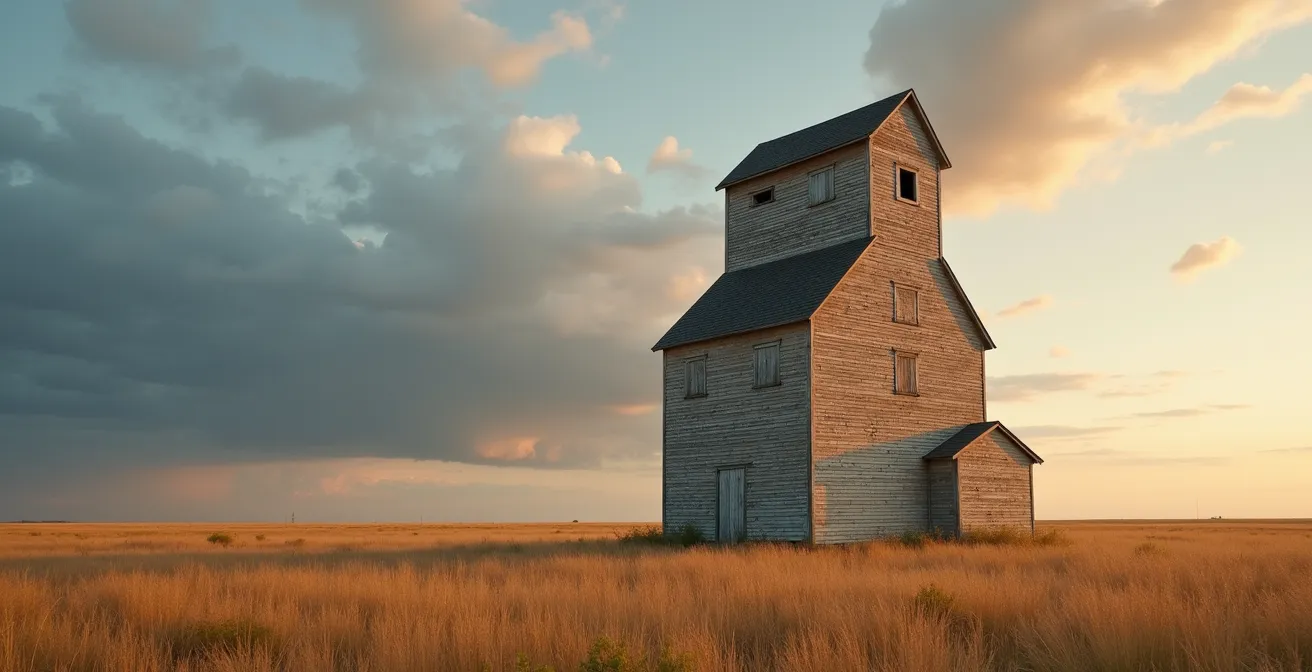
The disappearance of Canada’s grain elevators isn’t a simple story of old wood being replaced by new concrete; it was accelerated by a specific policy decision that dismantled a century-old system.
- The end of the Canadian Wheat Board’s monopoly in 2012 triggered massive private investment in large, centralized concrete terminals.
- This economic shift made smaller, local wooden elevators strategically obsolete, severing their role as community economic hubs.
Recommendation: To truly understand this change, view the remaining elevators not just as nostalgic relics, but as architectural evidence of a fundamental shift in Canada’s agricultural economy.
For anyone who has driven across the Canadian Prairies, the sight is unforgettable: a colossal wooden structure rising from the flat earth, a silent sentinel watching over the endless fields. These grain elevators, often called “Cathedrals of the Prairies,” are more than just buildings; they are monuments to a way of life, the economic heart of countless small towns. Yet, drive that same route today, and you’ll notice more and more gaps in the skyline. The sentinels are vanishing. It’s easy to assume this is just the inevitable march of progress—that old, inefficient wood is naturally replaced by modern, efficient concrete. This is the simple story, the one we tell ourselves.
But that story misses the crucial plot twist. While technological change played a role, the rapid disappearance of over 80% of these structures was not a gentle evolution. It was a seismic shift, triggered by specific political and economic decisions made far from the prairie fields themselves. The familiar narrative of simple obsolescence masks a more complex history of deregulation, corporate consolidation, and a deliberate move away from a localized, community-based agricultural model toward a system of centralized, industrial-scale infrastructure. This wasn’t just about building bigger bins; it was about redesigning the entire grain-handling network of Western Canada.
This article uncovers that hidden story. We will explore how these ingenious gravity-fed structures worked, but more importantly, we will pinpoint the exact moment the tide turned against them. By examining the end of the Canadian Wheat Board’s single-desk monopoly, we’ll see how policy changes in Ottawa sealed the fate of thousands of local elevators, and in turn, the small towns that depended on them. We’ll also look at what is being done to save the few that remain and how you, as a photographer or history enthusiast, can responsibly document this vanishing piece of Canadian heritage.
To fully grasp the scale of this transformation, we will break down the history, the mechanics, and the legacy of these prairie giants. The following sections will guide you from the preserved rows of Inglis to the economic boardrooms of Montreal, revealing the complete picture of this architectural and cultural loss.
Summary: The Vanishing Sentinels of the Prairies
- Inglis Grain Elevators: Is the Detour to See the Last “Row” Worth It?
- How Did Gravity-Fed Wooden Grain Elevators Actually Work?
- Wood vs. Concrete: How Modern Agribusiness Killed the Local Elevator?
- Trespassing Risks: How to Photograph Abandoned Elevators Legally?
- From Grain to Museum: Which Elevators Have Been Successfully Saved?
- Wide Angle vs. Telephoto: What Lens Is Essential for Canadian Landscapes?
- Beyond the Facades: What History Do the cobblestones of Saint-Paul Street Hide?
- Where to Stop Between Winnipeg and Calgary to Break the Monotony?
Inglis Grain Elevators: Is the Detour to See the Last “Row” Worth It?
Absolutely. To stand before the Inglis Grain Elevators in Manitoba is to witness a scene that has all but vanished from the Canadian landscape. This is not just one preserved elevator, but five elevators preserved in their original row formation, a powerful testament to the once-thriving competition and activity that defined prairie rail sidings. Designated a National Historic Site of Canada, the Inglis “row” offers a unique, tangible connection to the past. It’s a detour that moves beyond photography and becomes a historical pilgrimage.
Seeing them lined up, each representing a different grain company from a bygone era, you can almost hear the chugging of the locomotives and the rumble of farmers’ trucks. It’s here that the scale of the grain trade at a local level becomes viscerally clear. As historian Jane Ross notes, this site is exceptional precisely because the federal government stepped in to protect it, recognizing its value as a complete historical tableau. Unlike the lone, isolated elevators that dot the landscape, Inglis tells the story of an entire ecosystem.
The detour is worth it because it provides a crucial baseline. Before exploring the reasons for their decline, you see firsthand what was lost: not just a building, but a bustling commercial main street for rural communities. The slight curve of the track, the proximity of the structures, and the adjacent office and annex buildings all combine to create an immersive experience. It’s the perfect first stop for anyone trying to understand the legacy of these wooden sentinels, offering a profound sense of presence that a single, derelict elevator simply cannot convey.
How Did Gravity-Fed Wooden Grain Elevators Actually Work?
The genius of the classic wooden grain elevator lies in its elegant simplicity and powerful use of gravity. From the outside, it appears as a simple tall box, but inside, it’s a cleverly designed vertical factory. The process began when a farmer’s truck or wagon, heavy with grain, would pull into the drive shed. The front wheels were chocked, and a powered lift would hoist the front of the vehicle, causing the grain to pour out the back into a receiving pit below the floor, known as the “boot”.
From the boot, the real magic began. An endless belt equipped with a series of cups, called a “leg,” would scoop up the grain and carry it vertically to the very top of the elevator into the “cupola.” Here, the elevator agent, the master of the operation, would direct the flow. Using a rotating spout called the “distributor,” they could channel the grain down into one of several tall wooden bins for storage. This entire mechanical ballet was often powered by a single, immense diesel engine, whose rhythmic thumping was the heartbeat of the town during harvest. The process was a model of early automated engineering.
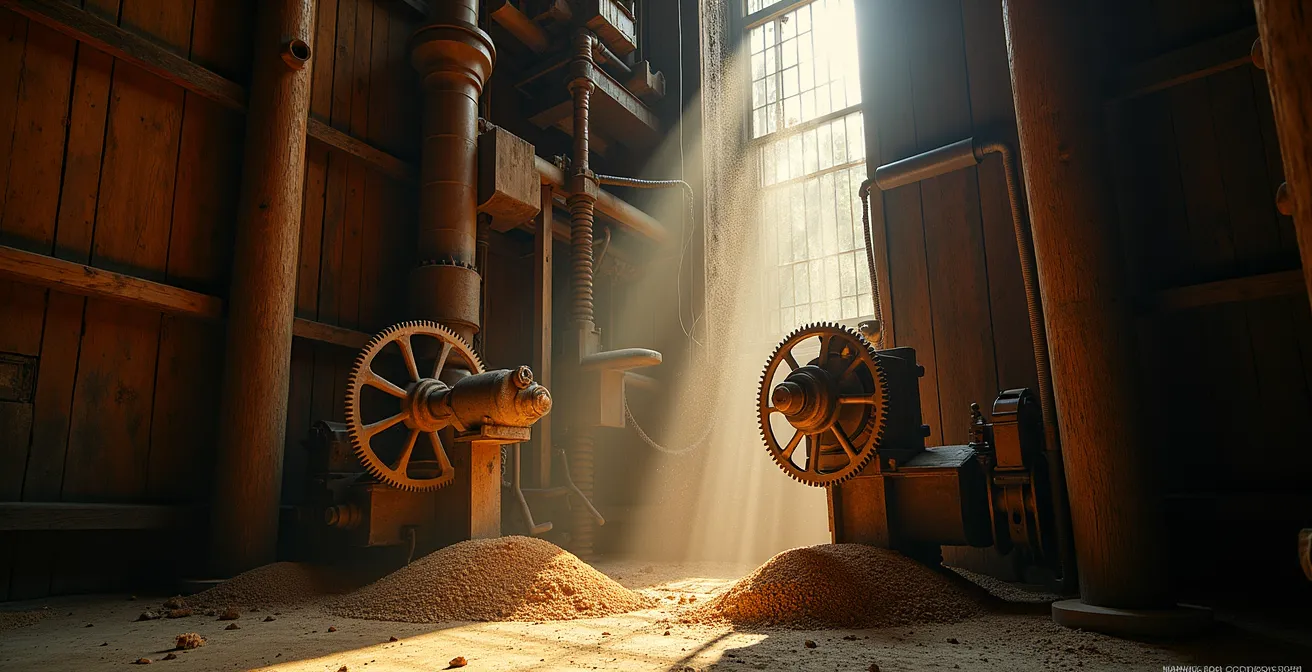
When it was time to ship the grain, gravity did the work once more. The agent opened a gate at the bottom of the correct bin, and the grain flowed down through a chute, was weighed, and then elevated by another spout directly into a waiting boxcar on the adjacent railway. The National Film Board’s 1981 documentary, Grain Elevator, brilliantly captured this daily routine in Wood Mountain, Saskatchewan, showcasing the intricate dance of machinery and human oversight. It highlights not just the mechanics but the deep expertise of the elevator agent, who tested grain for moisture and quality, maintained the powerful engine, and kept the entire operation running smoothly through dust and clamor.
Wood vs. Concrete: How Modern Agribusiness Killed the Local Elevator?
The shift from wood to concrete was not a simple upgrade; it was a fundamental restructuring of Canada’s grain industry, and a single date marks the tipping point: August 1, 2012, the day the Canadian Wheat Board’s (CWB) single-desk monopoly ended. For decades, the CWB controlled the sale and export of all wheat and barley from Western Canada, creating a stable, regulated system. This system supported a vast network of thousands of small, locally-owned wooden elevators spread across the Prairies. They were essential nodes in a distributed network.
With the dissolution of the CWB, the grain market was opened to private competition. This unleashed an unprecedented wave of capital investment from large agribusiness corporations. As Mark Hemmes, a grain transportation expert, stated, this led to “new elevators, increased storage and improvements to the efficiency of the port terminals.” The investment didn’t go into refurbishing the old wooden network; it went into building a new one. The model shifted from a decentralized web to a hub-and-spoke system of massive, high-throughput concrete inland terminals.
These new concrete giants could load a 150-car train in under a day, a task that would take a string of small wooden elevators weeks. Farmers could now haul their grain further to these central hubs, bypassing their local elevator entirely. The old wooden sentinels, designed for a different economic reality, were rendered strategically obsolete almost overnight. They weren’t just less efficient; they were incompatible with the new logistics of modern agribusiness. This shift had profound social consequences.
Case Study: Rural Saskatchewan After the CWB
A 2024 study on Saskatchewan farming communities revealed the stark social impact of this infrastructure change. Researchers found that the end of the CWB’s monopoly likely intensified inequalities between large and small farms. The pressure to deliver to distant, centralized terminals favored larger agricultural operations with greater hauling capacity. This hastened the consolidation of farmland and directly contributed to the economic decline and depopulation of smaller rural towns whose identity and economy were built around the local wooden elevator. The loss of the elevator was often the final nail in the coffin for a community’s general store, post office, and school.
Trespassing Risks: How to Photograph Abandoned Elevators Legally?
The allure of a decaying grain elevator, its paint peeling and windows broken, is powerful for any photographer. These structures exude a haunting beauty, but capturing it comes with a critical responsibility: respecting the law and property rights. The vast majority of these abandoned elevators, even those that appear completely derelict, are on private property. Stepping onto that land without permission constitutes trespassing, a finable offense under provincial laws across Canada.
The first rule of legal elevator photography is simple: shoot from public land. Roads, ditches, and public rights-of-way offer excellent vantage points for capturing these giants against the expansive prairie sky. A telephoto lens can bring you “closer” to the details without ever setting foot on the property. Always look for signage. “No Trespassing” signs are an unambiguous warning, but even without them, you should assume the land is private. Fences, even if dilapidated, are another clear boundary marker.
Beyond the legal risks, there are serious safety concerns. These are decaying industrial sites. Floors can be rotten, ladders are unstable, and the structures may contain hazardous materials or be home to wildlife. Entering one is not an act of adventurous exploration; it is a significant and unnecessary risk. The ethical dimension, often termed “ruin porn,” is also worth considering. The goal should be to document and honor these places, not to exploit their decay. If you are determined to get a closer shot, the only legal way is to seek permission from the landowner. This can be challenging, as tracking down the owner of a long-abandoned property can be difficult, but it is the only respectful and lawful approach for on-site photography.
From Grain to Museum: Which Elevators Have Been Successfully Saved?
While thousands of elevators have fallen to demolition, a dedicated few have been saved by passionate community groups, turning these symbols of a fading economy into beacons of heritage and tourism. These success stories show that preservation is possible, though it often requires immense effort and creative thinking. The models for success vary, demonstrating that there is no single path to saving a prairie sentinel. Some become museums, others community halls, and some are even integrated into the arts.
The key to successful preservation is almost always a combination of strong community will and a sustainable vision for the structure’s second life. It’s not enough to simply save the building; there must be a plan for its ongoing use and maintenance. This often involves transforming the elevator from a piece of industrial infrastructure into a cultural one. A prime example is the Canadian Grain Elevator Discovery Centre in Nanton, Alberta, where a row of elevators has been painstakingly restored and turned into an interactive museum that draws tourists off the main highway.
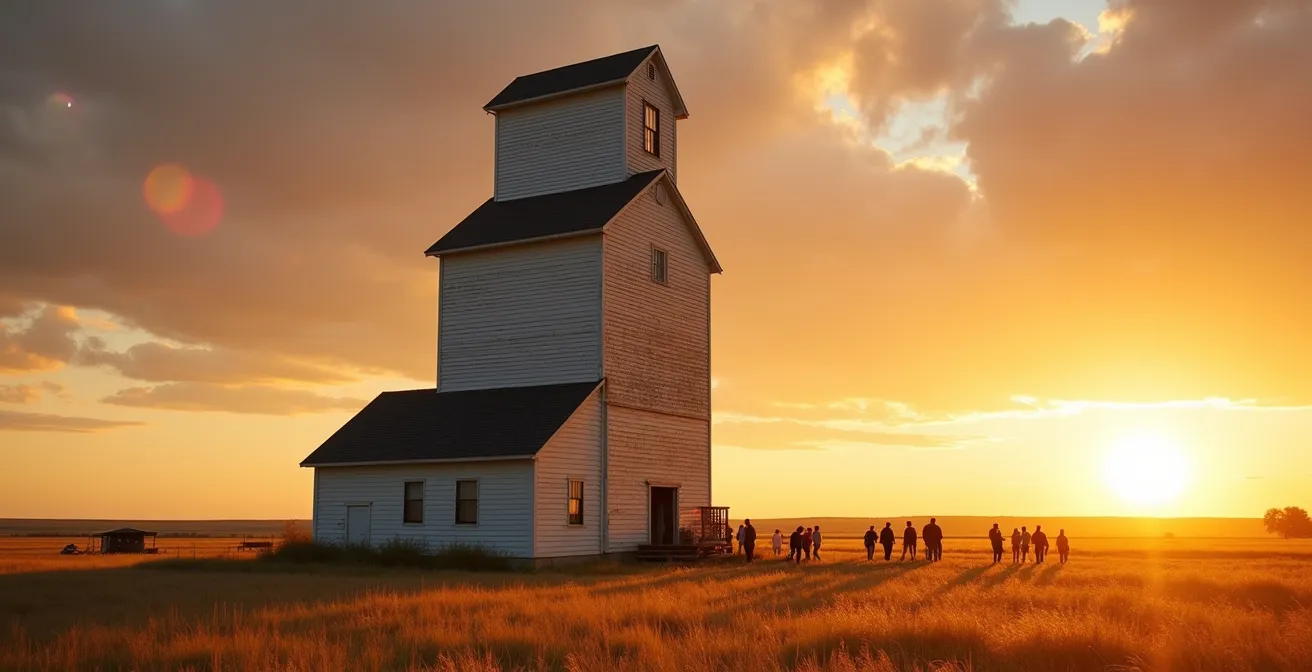
The following table, based on an analysis of successful preservation efforts, showcases different approaches taken across the Prairies. Each represents a community that saw a future for its past, successfully transforming an industrial relic into a vital local asset.
| Location | Preservation Model | Current Use | Key Success Factor |
|---|---|---|---|
| Nanton, AB | Community-driven museum | Canadian Grain Elevator Discovery Centre | 3D scanning for digital preservation |
| Val Marie, SK | Arts integration | Artist residency program | Adaptive reuse with cultural programming |
| Inglis, MB | Federal designation | National Historic Site | Government funding and protection |
Wide Angle vs. Telephoto: What Lens Is Essential for Canadian Landscapes?
When photographing Canada’s vast landscapes, especially the prairies dominated by grain elevators, the debate between wide-angle and telephoto lenses isn’t about which is “better,” but what story you want to tell. The choice of lens is your primary narrative tool. Neither is more essential than the other; rather, they are complementary, each offering a distinct perspective on the subject.
A wide-angle lens (e.g., 16-35mm) is the classic choice for emphasizing the scale of the environment. It allows you to place the grain elevator within its context, showing its relationship to the immense sky and the flat, endless horizon. This perspective captures the sense of isolation and dominance that makes these structures so iconic. It answers the question, “Where is this sentinel?” by showing it as a lone figure in a vast, empty canvas. This is the lens for capturing the epic, sweeping vistas that define the Prairies.
Conversely, a telephoto lens (e.g., 70-200mm or longer) allows for a more intimate and detailed story. It compresses the perspective and isolates the subject from its surroundings. This is the tool for focusing on the texture of decay: the peeling paint of a defunct cooperative’s logo, the weathered wood grain, or a bird’s nest tucked into a broken window. As photographers documenting Saskatchewan’s elevators have shown, a telephoto lens can transform a distant structure into a detailed study of history and decline. It moves beyond the grand landscape to ask, “What has this sentinel seen?” by focusing on the scars and details left by time.
Your Photographic Plan: Capturing the Full Story
- Establish the Scene: Start with a wide-angle lens from a distance to capture the elevator’s relationship with the land and sky.
- Isolate the Form: Use a mid-range zoom (around 50-70mm) to frame the elevator’s full architectural form without the distortion of a wide lens.
- Find the Details: Switch to a telephoto lens to hunt for compelling details—faded logos, textures, nesting birds, broken elements.
- Consider the Light: Photograph during the golden hours (sunrise and sunset) when the low-angle light reveals texture and creates dramatic shadows.
- Compose with Intent: Use leading lines from roads or railway tracks to guide the viewer’s eye to the elevator.
Beyond the Facades: What History Do the cobblestones of Saint-Paul Street Hide?
At first glance, a historic, cobblestoned street in Old Montreal seems worlds away from the dusty plains and wooden grain elevators of the West. Saint-Paul Street represents the heart of Canada’s old financial and commercial power, a place of stone buildings and bustling trade. Yet, to fully understand why so many prairie elevators now stand empty, one must look precisely to centers of power like this. The history hidden in Montreal’s cobblestones is one of centralized finance and distant decision-making that directly shaped the fate of the Prairies.
The connection is not one of architecture, but of influence. For much of the 20th century, the grain trade, its financing, and its logistics were controlled from the corporate headquarters and political offices of Eastern Canada. As one historical analysis from Road Stories aptly puts it, “The fate of a small prairie town’s elevator was often decided in boardrooms and political offices in Montreal and Ottawa.” The wooden elevator in rural Saskatchewan was the final link in a very long chain that began in the financial districts of the East.
This geographic and economic disconnect is central to the story. When the decision was made to dismantle the CWB and deregulate the market, those decisions weren’t made in the community halls of prairie towns. They were made in the same centers of power that have historically governed the nation’s economy. The subsequent flow of investment into massive, centralized concrete terminals was a logical outcome of a corporate mindset, headquartered far from the communities it would impact. The history of Saint-Paul Street, therefore, is a symbol of this distant, centralized control, a force that prioritized national-scale efficiency over local economic stability. To understand the prairie landscape, you must look beyond its facade and see the invisible economic lines stretching back east.
Key Takeaways
- The rapid decline of wooden grain elevators was not just natural obsolescence; it was greatly accelerated by the 2012 dissolution of the Canadian Wheat Board.
- The end of the CWB’s monopoly triggered a shift from a decentralized network of local elevators to a centralized system of large, corporate-owned concrete terminals.
- This policy-driven infrastructure change had profound socio-economic consequences, contributing to the decline of small prairie towns.
Where to Stop Between Winnipeg and Calgary to Break the Monotony?
The drive across the Trans-Canada Highway between Winnipeg and Calgary can feel like a long, monotonous stretch of flatland. But for the history buff or photographer, this corridor is a living museum of agricultural history. By turning off the main highway and following the old railway lines, the journey transforms into a fascinating “Grain Elevator Trail.” The monotony is broken not by dramatic landscapes, but by the punctuating presence of these towering sentinels, both restored and ruined.
This route is a journey through the very history we’ve discussed. You will see the thriving success stories, the lonely survivors, and the “ghosts”—concrete foundations where elevators once stood. Each stop tells a piece of the story. Visiting the Experimental Farm in Indian Head gives context to the agricultural innovation of the era, while exploring the tunnels of Moose Jaw reveals the critical role of the railway that served the elevators. This is not just a sightseeing tour; it is an active investigation into the rise and fall of a prairie icon.
The key is to embrace a slower pace of travel. Get off the four-lane highway and onto the two-lane provincial roads that shadow the CP and CN rail lines. Many of the most interesting and photogenic elevators are found in small towns just a few kilometers off the beaten path. Using a map to trace the old rail lines is the best way to discover these hidden gems. The journey itself becomes the destination, with each town offering a new clue in the story of the vanishing sentinels.
Now that you understand the forces that shaped this landscape, the next logical step is to witness it for yourself. Plan a route, pack your camera, and go find the stories that these vanishing sentinels are waiting to tell.