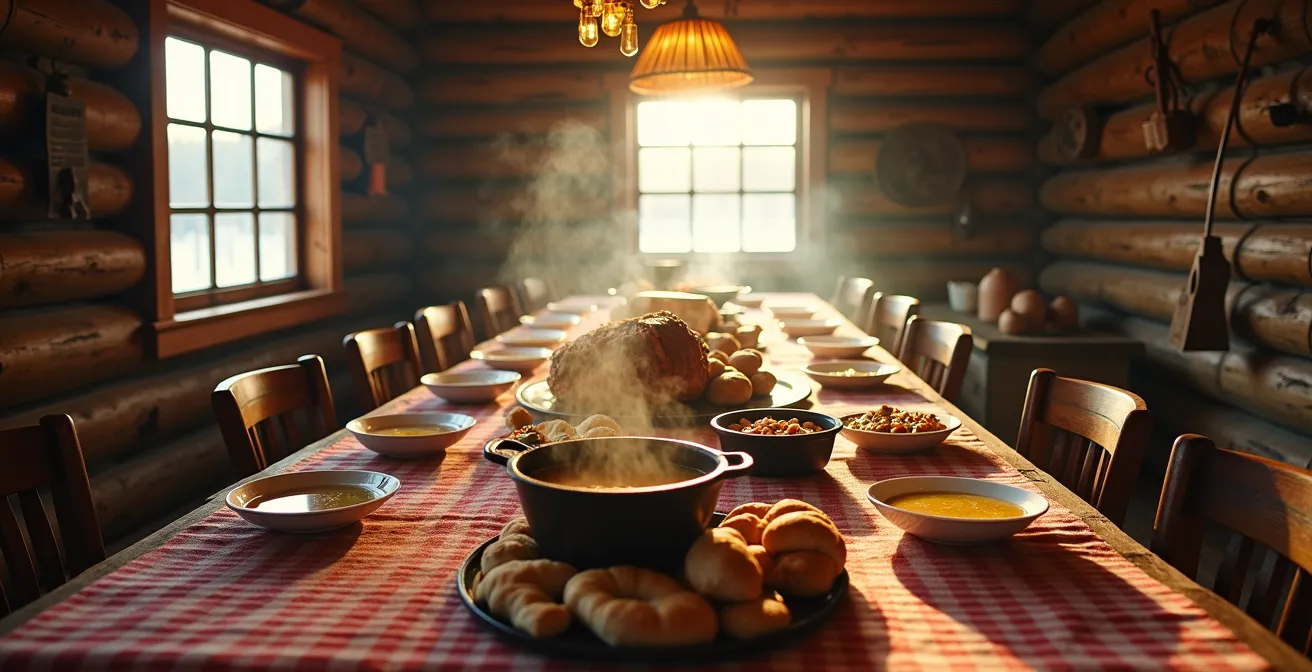
The Quebec sugar shack meal isn’t just heavy; it’s a calculated culinary blueprint for surviving the harsh 19th-century “sugaring-off” season.
- Each dish represents a form of “caloric engineering,” designed to refuel workers after intense manual labour in the cold.
- The menu is a testament to “peasant ingenuity,” where resourcefulness and a nose-to-tail ethos ensured nothing was wasted.
Recommendation: View your plate not as a random collection of dishes, but as a delicious history lesson in Québécois resilience and celebration.
Ah, my friend, you’ve arrived at a Quebec sugar shack, a cabane à sucre, and the long wooden table groans under the weight of the feast. You see bowls of golden pea soup, a massive maple-glazed ham, fluffy omelettes, baked beans, and crispy pork rinds. Your first thought, as a curious food lover, might be, “My goodness, this is heavy! And why does every sugar shack serve the exact same thing?” It’s a fair question. Many will simply tell you “it’s tradition,” but that’s only half the story. The real answer is far more fascinating.
This meal you’re about to enjoy isn’t a menu created by a modern chef. It is a living culinary archive, a gastronomic time capsule from a time when life in rural Quebec was dictated by the seasons and sheer physical hardship. The “sugaring-off” in late winter was an intense, laborious period. Tapping hundreds of maple trees, hauling buckets of sap through the snow, and boiling it down for hours over a wood fire was back-breaking work. This feast wasn’t just a celebration; it was a necessity. It was caloric engineering designed to replenish thousands of calories burned each day in the frozen maple groves.
Forget the idea of a quaint brunch. What you’re experiencing is the food of survival, of resourcefulness, and of the joyous relief that came when the hard work was finally done. Every single dish on that table has a purpose and a story rooted in the peasant ingenuity of our ancestors. It’s a story of salt-curing to preserve meat through the winter, of using dried legumes as a hearty staple, and of course, of glorifying the first agricultural product of the year: fresh maple syrup, or as we call it, liquid gold.
In this guide, we will decode the sugar shack experience, from the music that fills the air to the mysterious etiquette of ordering. We’ll explore why the food is what it is, and by the end, you won’t just see a heavy meal—you’ll see a plate full of Québécois history.
Let’s pull up a chair and explore this delicious tradition together. The following summary breaks down the key elements of the sugar shack experience we’re about to unravel.
Summary: Decoding the Cabane à Sucre Experience
- Maple Taffy on Snow: How to Roll the Perfect Stick Without Making a Mess?
- Spoons and Fiddles: Why Is Live Folk Music Part of the Dining Experience?
- Commercial vs. Family-Run: Which Cabane à Sucre Offers the Best Atmosphere?
- The “Oreilles de Crisse”: What Are Deep-Fried Pork Jowls and How to Eat Them?
- BYOB Etiquette: Can You Bring Alcohol to a Traditional Sugar Shack?
- Menu Anxiety: How to Order Food When the Menu Is Only in French?
- Why “Grade A” Doesn’t Mean “Better”: Decoding the Flavor Profiles
- The Difference Between a $15 Poutine and a $6 Tourist Trap Poutine
Maple Taffy on Snow: How to Roll the Perfect Stick Without Making a Mess?
No sugar shack meal is complete without its grand finale: la tire sur la neige, or maple taffy on snow. This isn’t just dessert; it’s a moment of pure, sticky magic. The process looks simple—hot maple syrup poured onto a trough of fresh, clean snow—but mastering the perfect roll is an art form. The secret is all in the temperature and timing. The syrup must be boiled to a precise point, just before it crystallizes into sugar. It’s a delicate science, especially when you consider that it takes 40 liters of sap to produce just one liter of syrup. That liquid poured on the snow is precious indeed!
When the hot syrup hits the cold snow, it instantly begins to set. The key is to wait just a few seconds for it to firm up, but not so long that it becomes brittle. You’re looking for a consistency that is chewy and pliable. Then, with a popsicle stick held flat, you press it into one end of the syrup strip and begin to roll, twisting your wrist as you go. Don’t try to lift it too early! Let the snow act as your work surface, rolling the taffy onto the stick until you have a perfect, glistening amber lollipop. A little bit of mess is part of the fun, but a gentle, steady rolling motion is your best bet for a clean finish. For those wanting to perfect their technique, here is a simple plan of action.
Your Action Plan: Rolling the Perfect Maple Taffy
- Wait for the maple syrup to be boiled to the perfect temperature by the sugar shack staff.
- Watch as they pour the hot syrup in thin lines on the fresh, clean snow.
- Let the liquid syrup set and cool for a few seconds in the snow until it’s no longer runny.
- Use a popsicle stick, pressing it firmly at one end of the taffy strip.
- Twist your wrist gently while rolling the stick along the syrup line to create a perfect lollipop shape.
Spoons and Fiddles: Why Is Live Folk Music Part of the Dining Experience?
As you’re digging into your meal, you’ll likely hear it: the lively, infectious sound of a fiddle striking up a tune, the rhythmic tapping of feet, and the unique clacking of wooden spoons. This isn’t background noise; it’s the very heartbeat of the cabane à sucre. The music is as essential to the experience as the maple syrup itself, a direct link to the celebratory gatherings, or veillées, that marked the end of the sugaring-off season. After weeks of hard labour, families and neighbours would gather to play music, dance, and share stories. The food refueled the body, and the music refueled the soul.
The style of music is a unique Québécois folk tradition. As the Visit Quebec Tourism Board aptly describes it, this is a truly immersive sound. Their guide to the experience notes:
Fiddles, accordions, and spoons (yes, spoons!) come together to create a festive atmosphere that’ll have you clapping, stomping, and maybe even joining in on a gigue.
– Visit Quebec Tourism Board, The Quebec Sugar Shack Experience and Traditional Music
This musical tradition was revitalized and popularized by bands that took these old kitchen-party sounds to the world stage. They established the quintessential sound of Québécois folk, characterized by specific instruments and a unique performance style.
Case Study: The Influence of La Bottine Souriante
Founded in 1976, the band La Bottine Souriante is arguably the most famous group to lead Quebec’s folk music revival. According to a profile from the University of Washington’s Canadian Studies Center, this super-group set the template for modern Quebec traditional bands. Their sound is built on the fiddle and accordion, a deep repertoire of traditional call-and-response songs (chansons à réponse), and the distinctive French-Canadian seated foot-tapping called la podorythmie. Having performed for decades, their influence shaped the festive, high-energy music you hear in sugar shacks across Quebec today.
Commercial vs. Family-Run: Which Cabane à Sucre Offers the Best Atmosphere?
Once you decide to partake in this tradition, you’ll face a choice: do you go to a large, commercial sugar shack or a small, family-run operation? There is no single “best” answer, as they offer vastly different experiences. The right one for you depends entirely on what you’re seeking. The large commercial shacks, often located closer to major cities like Montreal, are entertainment hubs. They can seat hundreds of guests and often supplement the meal with activities like sleigh rides, petting zoos, and elaborate entertainment shows. They are fantastic for families with young children and those looking for a lively, festival-like atmosphere.
On the other hand, the smaller, family-run cabanes offer a completely different kind of magic. Tucked away in regions like Charlevoix or the Eastern Townships, these establishments provide an intimate and deeply authentic experience. Here, you’re not just a customer; you’re a guest. The dining rooms are cozy, the recipes have been passed down through generations, and you might even find yourself chatting with the very person who tapped the trees and boiled the syrup. The focus is less on spectacle and more on the food and the warm, communal feeling of a traditional family gathering.

The table below, based on information from tourism resources like MTL.org, breaks down the key differences to help you choose the atmosphere that best suits your desired sugar shack adventure.
| Aspect | Commercial Sugar Shacks | Family-Run Sugar Shacks |
|---|---|---|
| Size | Large dining halls (100+ guests) | Cozy, smaller cabins (20-50 guests) |
| Activities | Petting zoos, sleigh rides, entertainment shows | Maple forest walks, traditional music sessions |
| Atmosphere | Family-friendly entertainment hub | Intimate, authentic experience |
| Booking | Often fully booked on weekends | May require advance reservations |
| Location | Montérégie region (accessible) | Charlevoix, Beauce, Eastern Townships |
The “Oreilles de Crisse”: What Are Deep-Fried Pork Jowls and How to Eat Them?
Among the many dishes on the table, one often raises the most eyebrows: the oreilles de crisse. The name literally translates to “Christ’s ears,” a colourful Québécois expletive from the lumberjack era supposedly uttered when a piece of hot fat spit from the fire. But what are they? Simply put, they are deep-fried, salted pork jowls or rinds. And before you hesitate, you must try them. They are crispy, salty, and wonderfully addictive—the perfect foil to the sweetness of the maple-drenched dishes.
More importantly, the oreilles de crisse are the ultimate symbol of the peasant ingenuity that defines this meal. In a time before refrigeration, the pig was a vital source of sustenance through the long winter. Every single part of the animal was used, and this “nose-to-tail” ethos was born of pure necessity. The jowls, being fatty, were rendered down, and the crispy bits left over became a cherished delicacy. They are a direct taste of our ancestors’ resourcefulness.
As one Quebec chef noted when explaining their importance, these crispy morsels are central to the entire philosophy of sugar shack cooking. This perspective highlights their historical weight:
These crispy, deep-fried pork jowls called ‘Christ’s Ears’ are salty, crunchy, and utterly addictive. They were a way to use every part of the pig, ensuring nothing went to waste during lean times. Today, they remain an essential part of the sugar shack experience, representing Quebec’s resourceful cooking philosophy born from necessity.
– Quebec Chef’s Perspective, Quebec City Tourism
So, how should you eat them? There are no wrong answers, but here are some of the most traditional ways to enjoy them:
- Eat them plain as a crispy, salty side dish, much like bacon.
- Crumble them over your bowl of pea soup for a wonderful textural crunch.
- Create a makeshift sweet-and-salty sandwich by drizzling maple syrup over them.
- Pair them with the maple-glazed baked beans (fèves au lard).
- Save a few to nibble on between courses as a salty palate cleanser.
BYOB Etiquette: Can You Bring Alcohol to a Traditional Sugar Shack?
A common question for first-time visitors revolves around alcohol. While the meal is the main event, many Québécois enjoy pairing it with a good drink. So, can you bring your own? The answer is a classic “it depends.” Many of the smaller, more traditional family-run sugar shacks operate on a BYOB (Bring Your Own Bottle) or, as you’ll see it signed in French, “Apportez Votre Vin” policy. This is a cherished tradition that adds to the informal, communal atmosphere of the meal. These establishments don’t have a liquor license, so they welcome guests to bring their own beer or wine.
However, larger commercial shacks are often fully licensed and have their own bars, meaning you cannot bring your own alcohol. The most important rule of BYOB etiquette is to always check in advance. A quick look at the sugar shack’s website or a phone call will clarify their policy. If you are visiting a BYOB-friendly place, there are a few unwritten rules to follow to be a good guest. It’s all about being considerate and embracing the local customs.
To navigate the situation gracefully, keep these guidelines in mind:
- First and foremost, confirm the establishment has a BYOB policy before you visit.
- Look for signs at the entrance that say “Apportez Votre Vin.”
- A good rule of thumb is to bring one or two standard bottles of wine per couple or small group.
- For a truly local pairing, consider bringing an ice cider (cidre de glace), a spectacular Quebec dessert wine that pairs beautifully with the meal.
- At communal tables, it’s a friendly gesture to offer a small glass to your neighbours.
- Be aware that some places might charge a small corkage fee, though many do not.
Menu Anxiety: How to Order Food When the Menu Is Only in French?
For a tourist, especially one who doesn’t speak French, facing a menu can be daunting. But here is the most wonderful secret of the traditional sugar shack: you don’t have to order! The vast majority of authentic cabanes à sucre operate on a menu fixe (fixed menu) system, and the food is served à volonté (all-you-can-eat). This beautifully simple system eliminates any language barrier or ordering anxiety. You simply sit down, and the feast begins to arrive at your table, served family-style in large, shareable platters and bowls.
This system is another relic of the meal’s history as a communal celebration. It wasn’t about individual choices; it was about sharing the bounty together. The fixed menu typically includes the cornerstones of the tradition, each one a simple, hearty dish made from ingredients readily available on the farm or preserved from the fall harvest.
The typical fixed menu you’ll encounter includes:
- Soupe aux pois: A thick, comforting yellow pea soup, often flavoured with a ham hock.
- Fèves au lard: Baked beans slow-cooked with pork and, of course, maple syrup.
- Jambon à l’érable: The centerpiece maple-cured ham, salty and sweet.
- Oreilles de crisse: Those essential crispy fried pork rinds.
- Omelette or Scrambled Eggs: A fluffy omelette, often soufflé-like, cooked in a large pan and served in squares. It provides protein and a lighter texture.
- Potatoes: Usually roasted or fried.
- Desserts: Followed by tarte au sucre (sugar pie), crêpes with maple syrup, and finally, the maple taffy on snow.
So, relax! There’s no need to stumble through a menu. The experience is designed for you to simply arrive, sit, and let the history of Quebec cuisine be served to you, one delicious platter at a time.
Why “Grade A” Doesn’t Mean “Better”: Decoding the Flavor Profiles
At the sugar shack, you’ll find pitchers of maple syrup on the table, and you might see different types for sale at the boutique. This is where many visitors get confused by the grading system. In the past, grades like “Grade A” and “Grade B” led people to believe one was superior. The system has since been updated to be more descriptive, focusing on colour and flavour profile. The most important thing to know is that no grade is inherently “better” than another; they are simply different, each with its own perfect use.
A wonderful analogy used by Quebec tourism experts is to compare it to another well-loved agricultural product. As Visit Québec City Tourism explains in their guide, “Maple syrup is similar to olive oil as there are various grades and colours of maple syrup. From light golden yellow which has a subtle sweetness to dark earthy amber with a richer taste.” Just as you would use a delicate extra virgin olive oil for a salad and a more robust one for cooking, different maple syrups are suited for different foods.

The grade of the syrup is determined by when the sap is harvested. Early season sap is light and delicate, while late-season sap is dark and robust because of natural changes in the tree. The modern Canadian grading system makes this much clearer.
Here is a breakdown of the current system, helping you decode what’s in the pitcher on your table or what to buy as a souvenir.
| New Grade Name | Color | Taste Profile | Best Use at Sugar Shack |
|---|---|---|---|
| Golden/Delicate | Light golden yellow | Subtle sweetness, vanilla notes | Delicate pancakes, light crepes |
| Amber/Rich | Medium amber | Rich maple flavor, balanced | Drizzling over eggs, general use |
| Dark/Robust | Dark amber | Stronger taste, caramel notes | Ham glaze, baked beans |
| Very Dark/Strong | Very dark | Intense, woody, smoky notes | Pairing with salty meats |
Key Takeaways
- The traditional sugar shack meal is a “culinary archive,” with every heavy dish designed as high-calorie fuel for the intense labour of the sugaring-off season.
- Authenticity is found in both the food and the atmosphere; from the nose-to-tail philosophy of oreilles de crisse to the communal joy of live folk music.
- Understanding the context transforms the meal from a heavy feast into a rich lesson in Québécois history, resourcefulness, and celebration.
The Difference Between a $15 Poutine and a $6 Tourist Trap Poutine
While not a traditional 19th-century sugar shack dish, poutine has become a symbol of Quebec cuisine, and you’ll often find it on modern or commercial shack menus. You’ll also see it everywhere from high-end restaurants to street-side stands, with prices varying wildly. This begs the question: what is the difference between a cheap, $6 poutine and a more expensive $15 one? The answer, my friend, lies in the integrity of three simple ingredients: fries, cheese, and gravy.
A “tourist trap” poutine cuts corners. It often uses frozen, pre-cut fries, a powdered gravy mix, and, most criminally, shredded mozzarella instead of proper cheese curds. The result is a soggy, bland imitation. A true, authentic poutine, worth every penny, is a carefully constructed harmony of textures and flavours. It’s another example of simple, honest “peasant food” done right. The fries must be double-fried for a crispy exterior and a fluffy interior. The gravy must be a rich, flavourful sauce brune, typically chicken- or veal-based. And most importantly, the cheese must be fresh cheese curds, which should “squeak” against your teeth as a sign of their freshness.
At a good sugar shack, you might even find a unique twist, like a gravy infused with maple or a poutine topped with pulled ham. To ensure you’re getting the real deal, whether at a shack or in the city, here is a quality checklist to keep in mind.
- Check for the “squeak test”: fresh cheese curds should squeak against your teeth.
- Verify the gravy is a brown chicken-or-veal-based ‘sauce brune’, not a pale, translucent powder mix.
- Ensure the fries are double-fried, giving them a crispy exterior and soft interior.
- At sugar shacks, look for creative variations like a maple-infused gravy as a sign of a unique, quality twist.
- Be wary of poutine in major tourist-heavy zones, where frozen, mass-produced ingredients are more likely to be used.
So, the next time you sit down at that long wooden table, you’ll see more than just a meal. You’ll see the story of a people, a history of survival, and the sweet celebration of spring’s arrival. To truly connect with this heritage, the next logical step is to experience it for yourself, armed with this newfound appreciation for every dish on your plate.