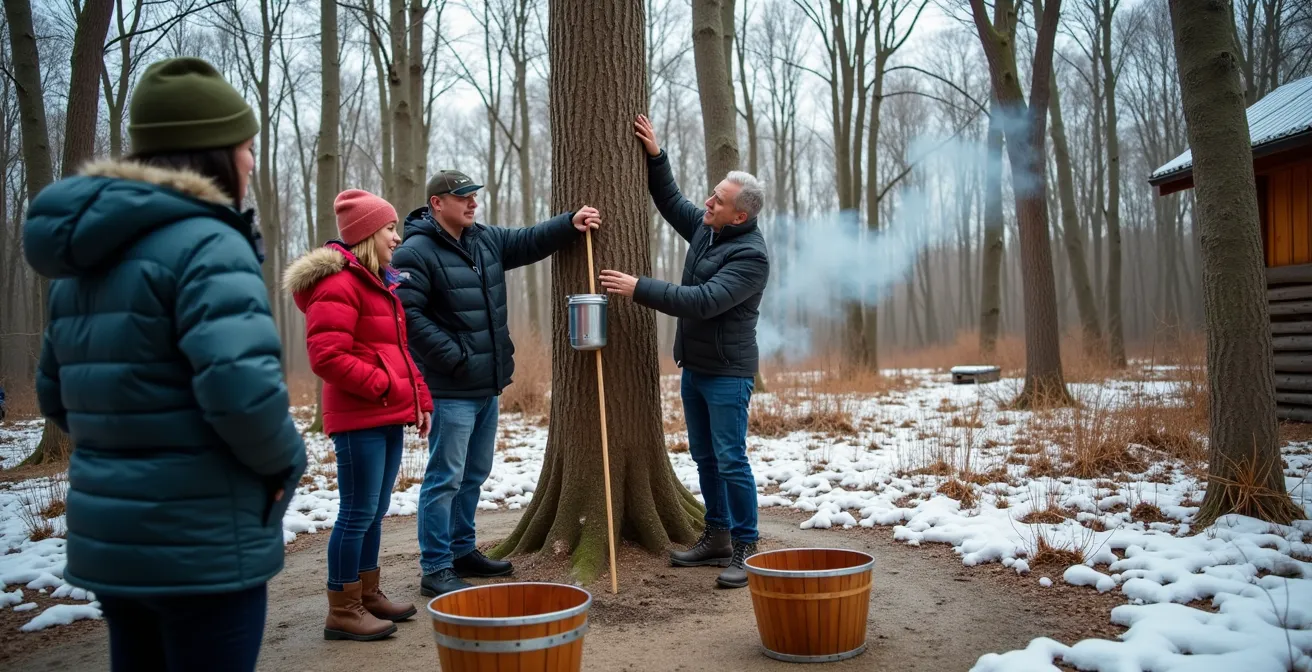
The most authentic sugar shack visit goes far beyond the tasting room; it involves getting your boots muddy and actively participating in the harvest.
- Most “tours” are passive demonstrations, but true hands-on experiences are available if you know what to ask for.
- The harvest is a short, intense period dictated by the “freeze-thaw” cycle, making timing and proper gear critical for any visitor.
Recommendation: To find a genuine experience, call small to mid-sized farms in advance and ask specifically about helping to check sap lines or empty buckets, not just about the meal.
Every spring, families across Canada get excited about visiting a sugar shack, or “cabane à sucre.” The classic image is a cozy cabin, the smell of a wood fire, and a plate of pancakes swimming in fresh maple syrup. And of course, the maple taffy rolled on snow is a tradition we all cherish. But for many families, especially those with curious kids, a question starts to bubble up: is that all there is? Can we do more than just eat? Can we see where the magic really happens, out there among the trees?
As someone who runs a maple farm, I hear this question a lot. Families want a real connection to their food and a genuine farm experience. They’re tired of being passive observers behind a rope. They want to feel the cold air, hear the drip of the sap, and understand the immense work that goes into every single bottle of syrup. The good news is, you absolutely can participate. But it’s not always as simple as just showing up. It requires a bit of planning and a willingness to embrace what we call “mud season.”
This guide is your inside look from the other side of the farm gate. We’ll move past the postcard image of the sugar shack and talk about the real logistics of the harvest. We’ll cover everything from the technology we use in the forest and the science that makes the sap run, to why your choice of footwear is the most important decision you’ll make. We’ll explore the rich history of this practice and what it truly takes to transform watery sap into liquid gold. By the end, you’ll know exactly how to find an experience that lets your family become part of the harvest, not just a spectator.
To help you plan your authentic maple adventure, this article breaks down the key aspects of a real working sugar bush. From the forest floor to the evaporator, here’s what you need to know.
Summary: Your Guide to a Hands-On Maple Harvest
- Buckets vs. Tubes: How Has the Collection Technology Changed the Forest Look?
- The Evaporator Room: How Many Liters of Sap Make One Liter of Syrup?
- Mud Season: Why You Need Waterproof Boots to Visit a Real Sugar Bush?
- Maple Water: What Are the Health Benefits of Drinking Raw Sap?
- Sugar Bush Ecology: Which Animals Wake Up When the Sap Starts Flowing?
- The Freeze-Thaw Cycle: Why Does Sap Only Run for a Few Weeks in Spring?
- Canola Fields in Bloom: When Is the Best Time to See the “Yellow Sea”?
- The Traditional Meal: Why Is Pea Soup and Ham Essential to the Sugar Shack Experience?
Buckets vs. Tubes: How Has the Collection Technology Changed the Forest Look?
When you picture a maple harvest, you probably imagine metal buckets hanging from trees. That’s the traditional method, and it’s still a beautiful sight. For visitors, bucket collection offers the most satisfying hands-on work. There’s nothing quite like walking through the woods, lifting the lid on a bucket, and seeing the clear, fresh sap that has collected. Some farms that use this method will let guests help carry the full buckets to a central collection tank. It’s heavy work, but incredibly rewarding.
However, on most commercial farms in Canada, you’re more likely to see a vast web of blue lines stretching from tree to tree. This is the modern tubing system. These lines use gravity and sometimes a gentle vacuum to pull sap directly from thousands of trees to the sugar house. While it changes the look of the forest, it’s far more efficient and sanitary. For visitors, this means participation is different. You won’t be carrying buckets, but you can tour the intricate network of tubes and learn how we check the lines for leaks and ensure a steady flow.
Many sugar bushes in Québec use a hybrid model, keeping some buckets near the sugar shack for demonstrations and tourist participation, while using tubing in the larger forest. This gives you the best of both worlds: a chance to see the technology that makes large-scale production possible and the opportunity to engage with the traditional method. Regardless of the system, you can often taste the raw sap directly from the source, which is a unique and refreshing experience.
The Evaporator Room: How Many Liters of Sap Make One Liter of Syrup?
The heart of any sugar shack is the evaporator room. This is where the real transformation happens, and the air is thick with sweet steam. The fundamental challenge of making maple syrup is simple: you have to get rid of a lot of water. Maple sap is only about 2-3% sugar; the rest is water. To turn it into syrup, which must be at least 66% sugar, we have to boil it for hours.
The magic number that every maple producer knows is 40 to 1. On average, it takes 40 litres of raw sap to produce just one single litre of pure maple syrup. When visitors hear this, they suddenly understand why real maple syrup is a premium product. It’s an incredibly energy- and labour-intensive process. Seeing the massive, steaming evaporator in person truly puts that ratio into perspective. It is this massive scale of production that makes Canada a global leader, with some provinces like Quebec producing about 70% of the world’s supply.
While safety regulations mean you can’t get too close to the boiling liquid, most farms have viewing areas. Modern operations often use a process called reverse osmosis to remove a portion of the water *before* the sap even enters the evaporator. This saves time and fuel, but the final finishing process still happens in the evaporator to develop the rich flavour and amber colour. The table below shows the key differences.
| Traditional Method | Modern Method | Tourist Access |
|---|---|---|
| Wood-fired evaporator | Reverse osmosis + evaporator | Viewing only |
| 40-50 gallons sap = 1 gallon syrup | More efficient with RO pre-treatment | Behind glass for safety |
| Full boiling process | Partial water removal before boiling | Tasting stations available |
Mud Season: Why You Need Waterproof Boots to Visit a Real Sugar Bush?
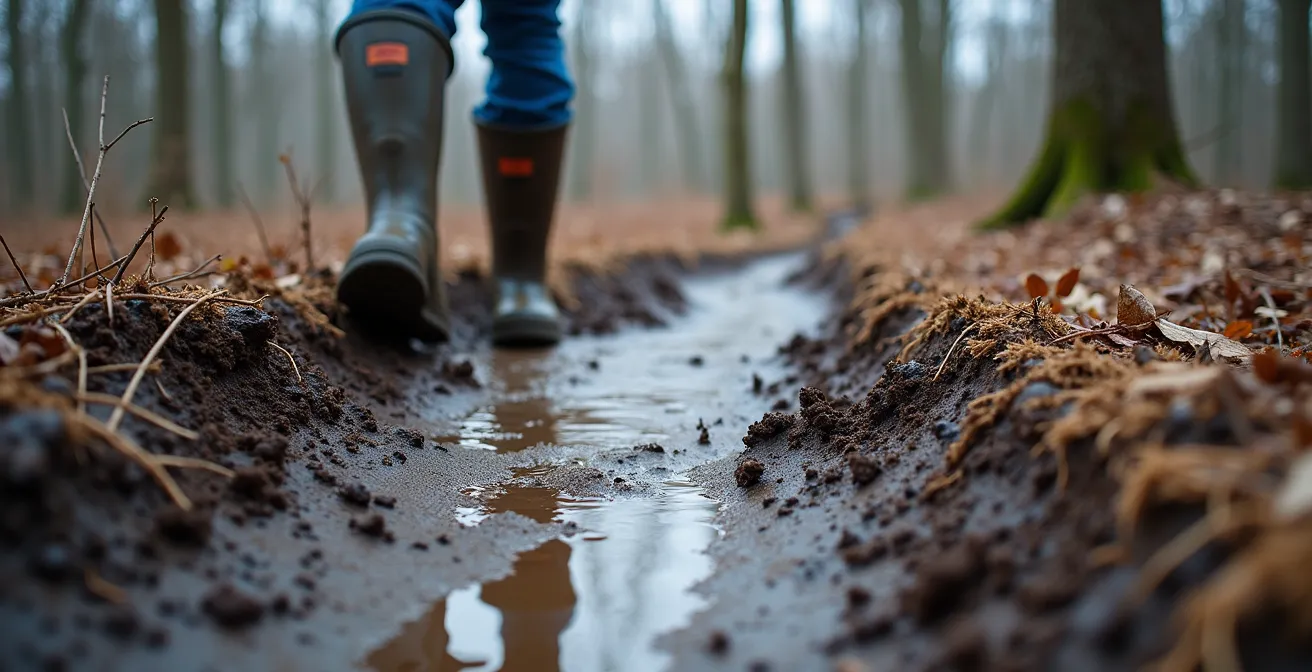
Here is the most important piece of advice I can give any family planning a visit: forget your fashion sense and embrace the mud. The maple harvest doesn’t happen in a picturesque, snowy wonderland or on a sunny summer day. It happens during a chaotic, messy, and wet time of year that we call “mud season.” The same freeze-thaw cycle that makes the sap run also turns our forests and farm lanes into a sea of mud, slush, and melting snow.
This is not an exaggeration. The trails in the sugar bush are natural and uneven. You will encounter deep puddles, slippery ice patches, and plenty of mud. Trying to navigate this in running shoes or casual footwear will lead to cold, wet feet and a miserable experience. High, waterproof boots (like rubber boots or “wellies”) are not just recommended; they are essential. They are the official uniform of the sugar bush.
This “mud season reality” is the clearest sign that you’re on a real working farm, not a theme park. It’s part of the authentic experience. The mud is a reminder that the harvest is tied directly to the rhythms of nature and the changing seasons. So, dress in layers for unpredictable spring weather and, most importantly, put on the right boots. It will free you to explore the forest, check the sap lines, and fully immerse yourself in the experience without worrying about the mess.
Checklist: Gearing Up for Your Sugar Bush Visit
- Footwear Check: Confirm everyone has high, waterproof boots. Do not rely on “water-resistant” hiking shoes.
- Clothing Layers: Dress in layers you can remove—a warm base, a fleece or sweater, and a waterproof/windproof outer shell.
- Accessibility Inquiry: If you have mobility concerns, call the farm ahead to ask about trail conditions and accessibility, as most working trails are not suitable for wheelchairs.
- Extra Gear: Pack extra socks and pants for the kids (and maybe adults!) for the car ride home. You’ll be glad you did.
- Attitude Adjustment: Prepare to embrace the mud! See it as part of the authentic charm, not an inconvenience.
Maple Water: What Are the Health Benefits of Drinking Raw Sap?
Long before we boiled it into syrup, the people of this land drank the sap straight from the tree. This “maple water” was the first fresh, sweet drink of the spring after a long winter. While most sugar shacks today focus on the French-Canadian culinary traditions, it’s crucial to remember that maple production predates European settlement by centuries. Indigenous peoples were the original maple producers, and they taught the first settlers how to harvest this amazing resource.
As Bronwyn Johns, a member of the Mohawk Nation, explains, the discovery of maple sap is part of their creation stories, a gift from the natural world. For many Indigenous producers today, the harvest is a deeply spiritual and cultural practice that connects them to their ancestors and the land. As First Nations maple producer Mitchell Horne beautifully puts it:
My earliest memories are of my grandfather teaching my brother and me to harvest maple syrup. When I start tapping, every step I take, he is always with me.
– Mitchell Horne, First Nations maple producer, Kahnawà:ke
Tasting raw sap is a way to connect with this ancient history. It’s not intensely sweet like syrup; it’s a light, refreshing liquid with a subtle hint of woodsy sweetness. Beyond its historical significance, maple water is also known for its health benefits. It’s naturally hydrating and contains over 46 bioactive compounds, including minerals, electrolytes, and antioxidants. It’s a natural, unprocessed tonic that the forest provides for a few short weeks each year. When you visit a farm, be sure to ask if you can taste it. It’s the purest expression of the maple tree.
Sugar Bush Ecology: Which Animals Wake Up When the Sap Starts Flowing?
The sugar bush is more than just a collection of trees; it’s a living ecosystem. The start of the sap flow is a signal that the entire forest is waking up from winter. You are not the only one interested in the sweet sap! As a visitor, one of the joys is observing this spring awakening. You’ll hear the calls of birds returning from the south, like robins and chickadees, who are often very active in the maple groves.
The most common creature you might see is the red squirrel. They are notorious for chewing on our sap lines, trying to get a sweet drink. While they can be a bit of a nuisance for producers, they are a natural part of the ecosystem and an original harvester of sap. In Indigenous stories, it was watching a squirrel drink from a broken maple branch that first taught people about this sweet resource. You might also see tracks in the mud or snow belonging to deer, raccoons, and porcupines, all of whom are becoming more active.
This rich biodiversity is a sign of a healthy forest. A well-managed sugar bush isn’t a monoculture; it supports a wide range of plant and animal life. The scale of these forests is immense, especially in the heart of maple country. For instance, in Quebec, which produces an astounding 92% of Canada’s maple syrup, these sugar bushes are vast ecological zones. Paying attention to the wildlife adds another layer to your visit, reminding you that the harvest is a partnership with a dynamic, living environment.

The Freeze-Thaw Cycle: Why Does Sap Only Run for a Few Weeks in Spring?
The entire maple harvest is dictated by the weather. It’s a short, frantic season that can last anywhere from three to six weeks, and we can’t control when it starts or ends. The magic ingredient is the freeze-thaw cycle. For sap to flow, we need specific weather conditions: nighttime temperatures that drop below freezing, followed by daytime temperatures that rise above freezing. This temperature fluctuation creates pressure inside the tree, which forces the sap to move.
During the cold night (below 0°C), the tree draws water up from the ground into its trunk and branches. As the sun warms the tree during the day (above 0°C), the gases and liquid inside expand, building up pressure. If a tree has been tapped, this pressure pushes the watery sap out of the tap hole. If the nights don’t get cold enough, or the days don’t get warm enough, the flow stops. This is why the season is so unpredictable; a sudden warm spell can end it overnight.
The ideal temperature window for a good sap run is when nights are around -5°C and days are around +5°C. A study on maple season timing confirms that an ideal window between -5°C and +5°C is required for the sap to flow properly. This “sugaring off” period typically happens between late February and early April in most parts of Canada. Understanding this natural mechanism makes you appreciate the harvest not as a simple agricultural process, but as a fleeting gift from the forest, available only when nature’s precise conditions are met.
Canola Fields in Bloom: When Is the Best Time to See the “Yellow Sea”?
When people think of Canadian agriculture, they often picture the vast, brilliant yellow canola fields of the Prairie provinces. This “yellow sea” is an iconic summer sight, typically blooming in July and August. It’s a beautiful spectacle and a major part of Canada’s agricultural identity, but it belongs to a completely different season and region than the maple harvest.
The maple harvest is the first agricultural event of the year in Eastern Canada. It happens in the stark, muddy forests of early spring, long before most other crops have even been planted. While the canola fields represent the open, sunny expanse of summer, the sugar bush represents the intimate, enclosed awakening of the eastern woodlands after winter. There is no overlap between the two.
Understanding this contrast is important for any visitor. The timing and setting are completely different. If you’re coming to Canada for the maple experience, you’re visiting in March or April. If you want to see the canola fields, you’ll need to plan a trip to a province like Saskatchewan or Alberta in the middle of summer. Each is a unique and wonderful Canadian experience, but they are worlds apart on the calendar.
Key Takeaways
- True participation means asking farms about helping with buckets or lines, not just booking a meal.
- The 40-to-1 sap-to-syrup ratio is the core reason for the process’s intensity and the product’s value.
- Proper gear is non-negotiable: waterproof boots are essential to enjoy the muddy reality of a working sugar bush.
The Traditional Meal: Why Is Pea Soup and Ham Essential to the Sugar Shack Experience?
After a morning of exploring the muddy sugar bush, there is no better reward than the traditional sugar shack meal. This isn’t a light meal; it’s a hearty, rib-sticking feast designed to refuel you after working in the cold. And yes, nearly every single dish has a connection to maple syrup. The menu is a cornerstone of French-Canadian heritage, featuring dishes that have been served for generations.
Two of the most essential items are the habitant pea soup and the maple-glazed ham. The pea soup is a thick, savoury soup made from yellow split peas, often flavoured with a ham hock. It’s the perfect starter to warm you up. The ham, baked slowly and basted with maple syrup, is the centrepiece of the meal. Its salty, savoury flavour is the perfect counterpoint to the sweetness of the syrup.
But the meal doesn’t stop there. You can expect to see oreilles de crisse (crispy fried pork rinds), baked beans (fèves au lard), omelettes, sausages, and tourtière (meat pie), all served with a pitcher of maple syrup on the table to be poured generously over everything. As noted by culinary travel experts, this tradition is deeply ingrained in Québécois culture.
Maple syrup is a key ingredient in many traditional French-Canadian dishes, including maple-glazed ham, sugar pie (tarte au sucre), and tourtière (meat pie). The sweet, rich flavour of maple syrup adds depth and complexity to these dishes, distinguishing them as quintessential Québécois fare.
– Brightspark Travel, Canada’s Maple Harvest Guide
This meal is more than just food; it’s a celebration of the end of winter and the bounty of the harvest. It brings families and communities together. Sharing this meal is the final, essential step in a truly complete sugar bush experience.
Now that you know what to look for in a real hands-on maple experience, the next step is to start planning. Reach out to local farms, ask the right questions, and get ready for an unforgettable—and probably muddy—family adventure. We look forward to sharing our harvest with you.