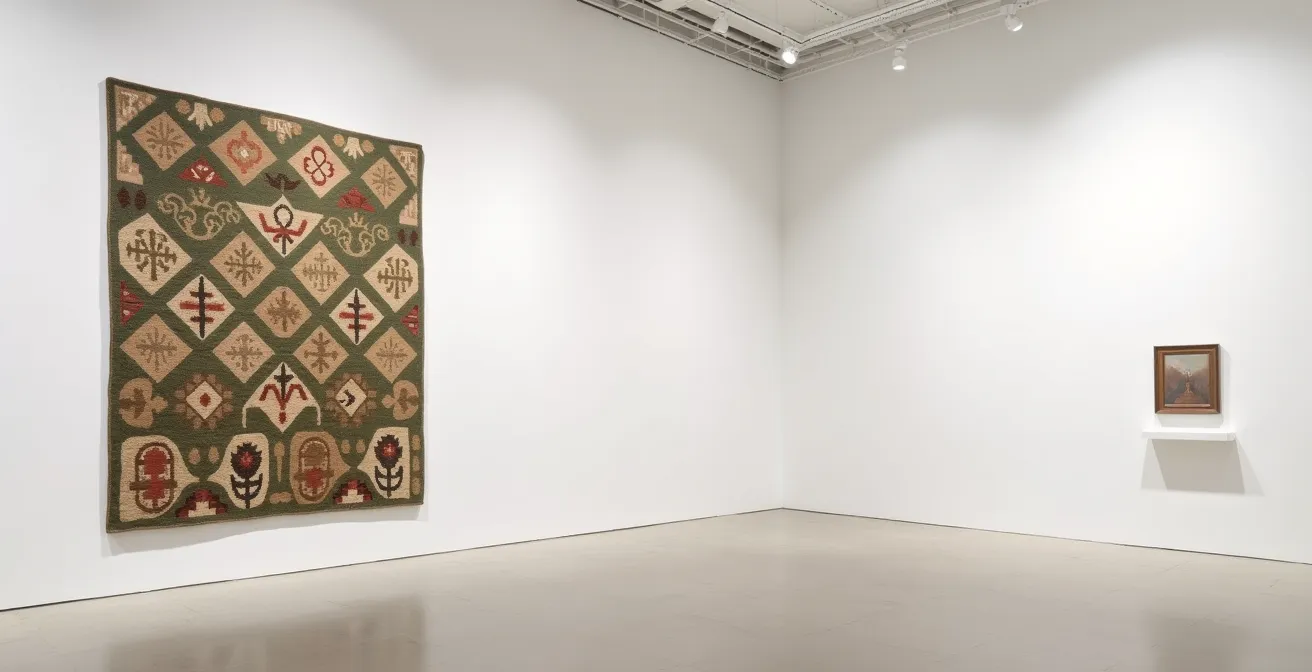
Contrary to what the humble materials suggest, the high value of a Maritime hooked rug comes not from its components but from the immense, concentrated labor and cultural history woven into its very fabric.
- The craft transforms discarded clothing (“rags”) into a durable, artistic asset through hundreds of hours of skilled, manual work.
- Distinct patterns are not just decorative; they are symbols of community identity (Acadian vs. Scottish) and historical resilience, adding significant cultural capital.
Recommendation: When you see a high price tag on a hooked rug in a place like Cheticamp, look past the wool and see the investment in a tangible piece of Canadian heritage, validated by museums and art markets.
Standing in a gallery in Cheticamp or a small studio along the Nova Scotia coast, a visitor is often struck by a simple question: why does a hooked rug, a seemingly rustic craft, carry a price tag of thousands of dollars? The immediate answer often points to tradition or folk art, but this only scratches the surface. Many traditional crafts exist, yet few have ascended from humble floor coverings to coveted, high-value art pieces with such authority. The common understanding is that this was a “craft of poverty,” born of necessity and using whatever scraps were on hand.
But this is precisely where the misunderstanding of its value begins. The key to its worth is not in the materials but in their transfiguration. The true value proposition of a Maritime hooked rug lies in a powerful combination of three factors often overlooked: the sheer density of skilled human labor, the deep cultural capital embedded in its patterns, and a critical shift in perception that elevated it from the floor to the gallery wall. This is not just a story of a craft’s survival, but of its deliberate elevation into a recognized heritage asset.
This guide will walk you through an appraiser’s perspective on this transformation. We will dissect how discarded rags became artistic riches, explore the cultural significance of community patterns, understand the laborious technique that justifies the cost, and trace the moment these mats became recognized as art. By the end, you will not just see a rug; you will see a story of labor, identity, and resilience, fully understanding its place as a high-value piece of Canadian history.
Summary: The Journey of the Hooked Rug from Floor Mat to Fine Art
- Rags to Riches: How Historic Rugs Were Made from Old Clothing?
- Acadian vs. Scottish: How Do Rug Patterns Differ by Community?
- The Hooking Motion: Is It Harder Than Knitting or Crochet?
- Floor or Wall: When Should a Hooked Rug Be Hung Instead of Walked On?
- The Rug Hooking Museum: Is It Worth the Drive to Hubbards?
- The “Boutonné” Technique: How Do Weavers Create the Raised Patterns?
- Where Does Your Money Go? How Tourism Saves Crumbling Lighthouses?
- Barn Quilts: How to Follow the Textile Trail Through Rural Canadian Landscapes?
Rags to Riches: How Historic Rugs Were Made from Old Clothing?
From an appraiser’s viewpoint, the most compelling value narrative begins with the materials themselves. The story of the hooked rug is one of profound transformation. While antique pieces can command prices anywhere from $375 to over $100,000 at auction, their origins are deceptively humble. Historically, these rugs were not made from pristine bolts of wool but from the remnants of a family’s life: worn-out coats, threadbare blankets, and old clothing. These materials, having no other economic value, were painstakingly cut into thin strips called “worms.”
This origin is central to understanding the rug’s worth. As Halifax Public Libraries notes, “It was considered a craft of poverty born out of necessity, making use of fabric scraps and discarded materials to create rugs that were both beautiful and practical.” The genius of the craft lies in this alchemy. The value is not in the material cost—which was effectively zero—but in the immense labor value added to it. A maker invested hundreds of hours of skilled, manual effort to turn worthless scraps into a durable and artistic object that would warm a home for decades. This act of “making something from nothing” is the foundational layer of its value.
The backing material was often repurposed burlap or feed sacks, stretched taut on a wooden frame. Each loop of fabric was pulled through the weave of the burlap with a simple hook. The result was a dense, durable textile where the final product’s worth was a direct measure of the time, skill, and artistic vision of its creator, not the cost of its parts. It is a pure testament to human ingenuity and the will to create beauty and comfort from scarcity.
Acadian vs. Scottish: How Do Rug Patterns Differ by Community?
Beyond the labor involved, a significant portion of a hooked rug’s value is derived from its cultural capital. The patterns and motifs are not merely decorative; they are a visual language that communicates identity, heritage, and a sense of place. In the Canadian Maritimes, the two most prominent cultural influences in rug hooking are the Acadian and Scottish communities, and their styles are distinct.
Acadian rugs, particularly from the Chéticamp area of Nova Scotia, are renowned for their floral motifs, scrolls, and often, a central medallion. The colour palette tends to be softer, with subtle shading creating a painterly, almost delicate effect. The famous Acadian star is a recurring and powerful symbol. Scottish-influenced rugs, by contrast, often feature more geometric patterns, plaids, and bold, graphic representations of animals or maritime life. Their colour choices are typically stronger and more contrasting. These stylistic differences are a direct reflection of the distinct cultural aesthetics of the communities that created them.
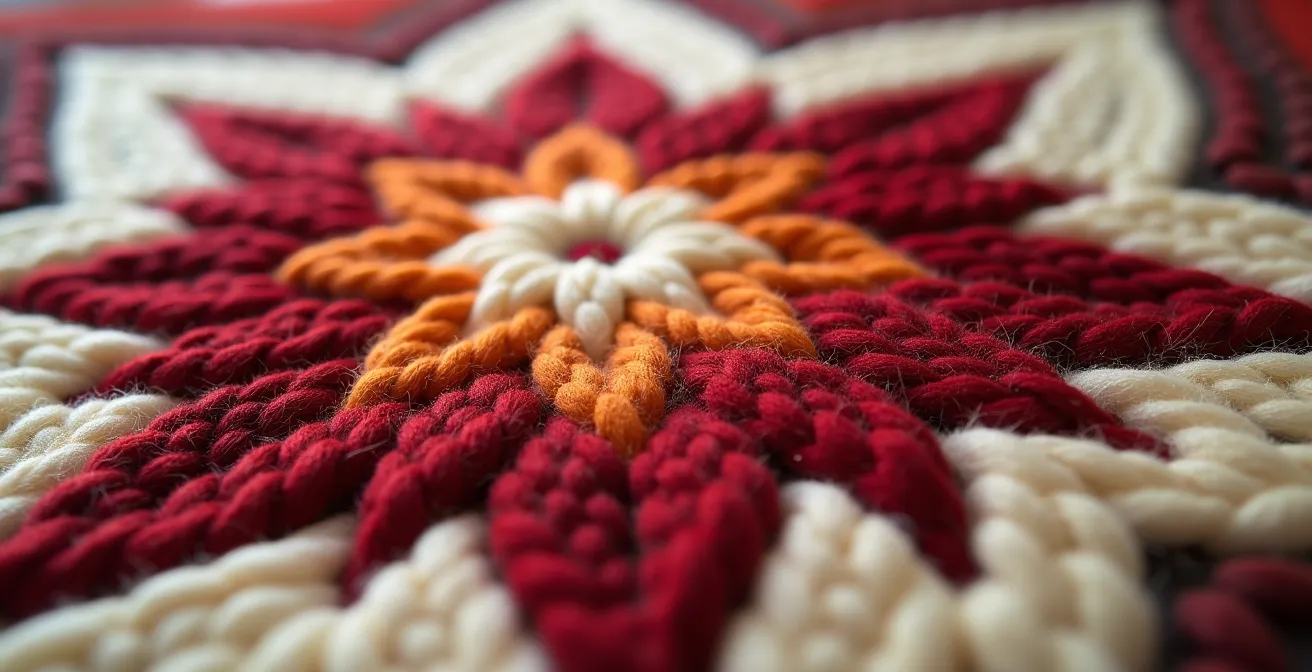
This is where the appraiser’s eye looks for provenance and story. A rug with a clear Acadian star or a classic Scottish thistle is more than a floor covering; it’s a historical document. As Laura Sanchini, a curator at the Canadian Museum of History, states, the craft’s significance goes deep.
It’s tied to women’s history. It’s a symbol of resilience.
– Laura Sanchini, Curator at Canadian Museum of History, quoted in Chatelaine
This resilience is woven directly into the patterns. For a collector, owning a rug from a specific tradition is owning a piece of that community’s story of survival and cultural expression in the New World. This narrative adds an intangible but very real value that far exceeds the sum of its wool loops.
The Hooking Motion: Is It Harder Than Knitting or Crochet?
To the uninitiated, rug hooking might seem mechanically simple, but this perception belies a technique that is physically demanding and requires immense patience and precision. Unlike knitting or crochet, which create fabric from a continuous strand of yarn, rug hooking involves pulling thousands of individual loops through a stiff backing. This fundamental difference is crucial to understanding the labor-intensive nature of the craft. The question isn’t just whether it’s “harder,” but what kind of skill it demands.
The process requires coordinating both hands in a rhythmic but strenuous motion. One hand, underneath the frame, feeds a strip of wool to the hook. The other hand, holding the hook, pierces the burlap from above, catches the strip, and pulls a loop to the surface. This is repeated thousands of times. Sheila Stewart, a studio owner, describes the grip: “You hold the hook in your palm… grasping the narrow base between her thumb and fingers so that only the three-centimetre steel end was visible.” This precise, repetitive motion can put strain on the hands, wrists, and shoulders, making the creation of a large rug a significant physical undertaking.
The skill lies in consistency. An expert hooker pulls each loop to the exact same height, creating a uniform, plush pile. The loops must be packed tightly enough to hold each other in place, ensuring the rug is durable and the design is clear. Achieving this level of evenness across a large surface takes years of practice. Therefore, while a beginner can learn the basic motion relatively quickly, mastering it to produce a high-quality, valuable piece is a long-term commitment. This significant investment of time and the development of specialized physical skill are primary drivers of the final cost, a fact recognized by the more than 700 members of the Rug Hooking Guild of Nova Scotia and its international affiliates who work to preserve this demanding art form.
Floor or Wall: When Should a Hooked Rug Be Hung Instead of Walked On?
The final, decisive factor in the transformation of hooked rugs into high-value objects was the physical act of lifting them off the floor and placing them on the wall. This shift represents the moment the object’s primary function changed from utilitarian to aesthetic. For an appraiser, this transition is a key marker in an object’s history, signaling its acceptance as true art. A piece intended for the floor is subject to wear, spills, and dirt; a piece on the wall is preserved, admired, and judged on its artistic merit.
This crucial shift in perception wasn’t accidental. It was a conscious decision by collectors, curators, and the artists themselves. The historical turning point is clear, as noted by industry experts.
It was in the 1970’s that the former floor coverings became increasingly displayed as tapestries on walls.
– Matt Camron, Matt Camron Rugs & Tapestries
Once a rug is framed or hung, its value changes. It is no longer a “mat” but a “textile painting.” Its condition is preserved, allowing the intricate details and colours to be appreciated without the threat of foot traffic. This elevation directly impacts its market value. For example, a well-preserved folk art hooked rug from the early 20th century, treated as a piece of wall art, might have a retail value of $800 or more, whereas its value as a used floor rug would be significantly lower. The decision to hang a rug is a declaration of its worth. Generally, any rug with significant age, delicate materials (like silk), fine workmanship, or important provenance should be considered for wall display to protect it as a heritage asset.
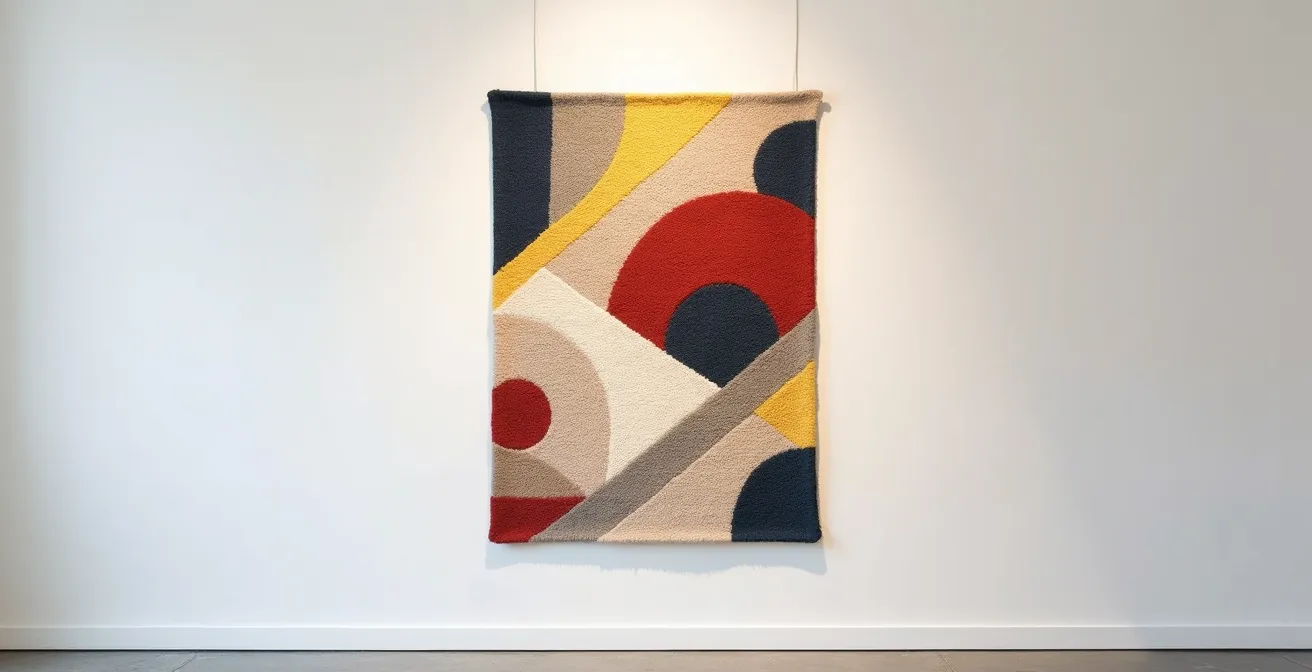
Today, contemporary artists often create pieces exclusively intended for walls, further cementing the craft’s status in the fine art world. The question is no longer just about preservation; it’s about presentation and acknowledging the rug as a focal point of artistic expression.
The Rug Hooking Museum: Is It Worth the Drive to Hubbards?
For any visitor to Nova Scotia seeking to truly understand the value and history of hooked rugs, a trip to the Hooked Rug Museum of North America in Hubbards is not just worthwhile—it’s essential. The existence of a dedicated museum is perhaps the ultimate validation of a craft’s importance. It provides context, showcases excellence, and solidifies the art form’s place in cultural history. A visit answers the “why is it so expensive?” question by showing, not just telling.
The museum itself is an affordable and accessible experience, with general admission costing only $7.00. For this modest price, you gain access to a curated collection that traces the entire history of rug hooking, from its humble origins to its status as contemporary fine art. You can see firsthand the “rags to riches” story, examine the intricate patterns of different communities, and marvel at the sheer labour evident in every piece. The museum often features special exhibits, including the work of legendary artists and modern masters, providing a comprehensive overview that no single gallery can offer.
More than just a collection of artifacts, the museum and the surrounding “textile trail” of studios offer a living, breathing experience of the craft. It places the art form within a larger ecosystem of creativity and commerce that defines this region of Canada. To make the most of a day dedicated to this art form, one can follow a well-trodden path through the heart of Nova Scotia’s rug hooking country.
Your Action Plan: A Maritime Textile Trail Day Trip
- Start in Amherst: Begin your day at Deanne Fitzpatrick’s celebrated studio for a morning workshop or to view contemporary interpretations of the craft.
- Drive to Mahone Bay: Head south for lunch at a local spot like The Biscuit Eater Cafe & Books before visiting nearby studios.
- Explore Mahone Bay’s Studios: Visit Encompassing Designs, known for traditional patterns, and Spruce Top Rug Hooking Studio to see the fine art approach of Carol Harvey-Clark.
- End at the Museum: Conclude your tour at the Hooked Rug Museum of North America in Hubbards to place everything you’ve seen in historical context.
- Reflect and Appreciate: With a full day’s context, you can now understand the deep value behind the craft and perhaps even select a small piece as a meaningful souvenir.
The “Boutonné” Technique: How Do Weavers Create the Raised Patterns?
Within the world of high-value hooked rugs, certain techniques signal an elevated level of skill and artistry, and none more so than those practiced in Chéticamp. As noted in The Canadian Encyclopedia, “The fine workmanship of the rugs of Chéticamp, NS, is also legendary.” This legendary status is built upon a mastery of specific techniques, most notably the ability to create varied textures and raised patterns that give the rugs a three-dimensional, sculptural quality.
The most famous of these is the “boutonné” or button stitch, which creates small, raised knobs of wool on the surface. Unlike standard hooking where loops are pulled to a uniform height, the boutonné technique involves pulling a much longer loop and then using the hook to wrap or knot it upon itself, creating a tight, bobble-like texture. This is an incredibly time-consuming process that requires exceptional dexterity. It’s often used to create the centers of flowers or to add textural highlights to a design, making the finished piece far more dynamic and tactile.
This high level of skill is epitomized by the work of Elizabeth LeFort, Chéticamp’s most famous artist. Her mastery of shading and texture elevated the craft to international acclaim. The existence of a dedicated museum, Les Trois Pignons, featuring her work is a testament to her impact. LeFort’s rugs, showcasing her incredible skill, were so highly regarded that they were presented as official Canadian gifts to dignitaries at Buckingham Palace and the White House. This act of diplomatic gifting is the ultimate market validation, confirming that a Chéticamp rug is not just a craft item, but a work of art worthy of representing the nation on the world stage. The presence of techniques like boutonné is a key indicator for an appraiser that a piece possesses this higher level of artistic and monetary value.
Where Does Your Money Go? How Tourism Saves Crumbling Lighthouses?
While the title suggests lighthouses, the principle applies directly to the preservation of another Maritime icon: the heritage craft of rug hooking. When you purchase a high-value hooked rug, your money does more than acquire an object; it becomes a direct investment in sustaining a “crumbling” or endangered cultural practice. This financial support flows through a vital ecosystem, ensuring that the skills, stories, and communities behind the craft do not fade away.
A key moment in this economic story came when the art form gained external validation. As curator Laura Sanchini explained to Chatelaine magazine, “When works from the area started gaining attention from Manhattan art lovers, prices—and esteem—quickly skyrocketed…” This interest from a major art market like New York did two things: it injected significant cash into the local economy and, just as importantly, it confirmed the art form’s value to the world and to the makers themselves. Suddenly, a traditional skill had a viable, and even lucrative, commercial outlet. Your purchase continues this legacy of market validation, telling artists that their intense labor is valued.
Furthermore, the funds support crucial community infrastructure. Organizations like the Rug Hooking Guild of Nova Scotia (RHGNS) are often non-profits dedicated to education and preservation. Formed in 1979, the RHGNS is a community hub that runs workshops, maintains standards, and fosters a network from beginners to masters. This guild, and others like it, are the lifeblood of the craft, ensuring skills are passed down to new generations. A portion of the money from rug sales, workshops, and tourism feeds back into these organizations, funding their schools and events. So, when you buy a rug, you are not just supporting an individual artist; you are helping to fund the entire cultural infrastructure that keeps this unique Canadian art form alive and flourishing for years to come.
Key takeaways
- The value of a hooked rug is in its immense labor and skill, not its material cost.
- Distinct patterns represent the cultural capital and historical identity of communities like the Acadians and Scots.
- The craft’s elevation from floor covering to wall art in the 1970s was a critical turning point in its valuation as fine art.
Barn Quilts: How to Follow the Textile Trail Through Rural Canadian Landscapes?
While barn quilts represent one form of textile art that adorns rural landscapes, the true, immersive textile trail in the Maritimes is the one you follow from studio to studio, meeting the artists and seeing the hooked rugs come to life. This journey through the region’s creative heartland is the best way to cap your understanding of the craft. It allows you to connect the history and techniques you’ve learned with the living, breathing art community of today.
Following this “rug hooking trail” allows you to see the diversity of the craft firsthand. You can witness the contemporary, spa-like atmosphere of Deanne Fitzpatrick’s studio in Amherst, contrast it with the traditional focus at Encompassing Designs in Mahone Bay, and then see the fine art approach at Spruce Top Studio nearby. Each stop adds another layer to your appreciation. This journey culminates in places like the Hooked Rug Museum in Hubbards or the Trois Pignons museum in Chéticamp, which house the legacy of masters like Elizabeth LeFort.
To help navigate this rich landscape, the following table provides a snapshot of key destinations along this unofficial but essential Maritime textile trail. It acts as a guide for any visitor wanting to experience the full spectrum of this unique Canadian art form.
| Location | Studio/Museum | Specialty | Notable Features |
|---|---|---|---|
| Amherst, NS | Deanne Fitzpatrick Studio | Contemporary Maritime style | Spa retreats, workshops |
| Mahone Bay, NS | Encompassing Designs | Traditional patterns & dyed wool | Bus tour destination, wide selection |
| Mahone Bay, NS | Spruce Top Studio | Fine art approach | Carol Harvey Clark’s iconic work |
| Hubbards, NS | Hooked Rug Museum | Historical collection | Workshops, market, tax-free shopping |
| Cheticamp, NS | Trois Pignons Museum | Acadian tradition | Elizabeth LeFort collection |
Exploring these locations provides the final piece of the puzzle. You see the community, you feel the passion, and you understand that these are not just objects, but the products of a vibrant and enduring culture.
Now, when you encounter a masterpiece in a Nova Scotian gallery, you can see it with an appraiser’s eye. You can recognize the hours of labor, the echoes of cultural identity in its patterns, and its rightful place as a celebrated piece of Canadian art history. The most rewarding next step is to experience this world for yourself by visiting the studios and museums that serve as guardians of this precious craft.