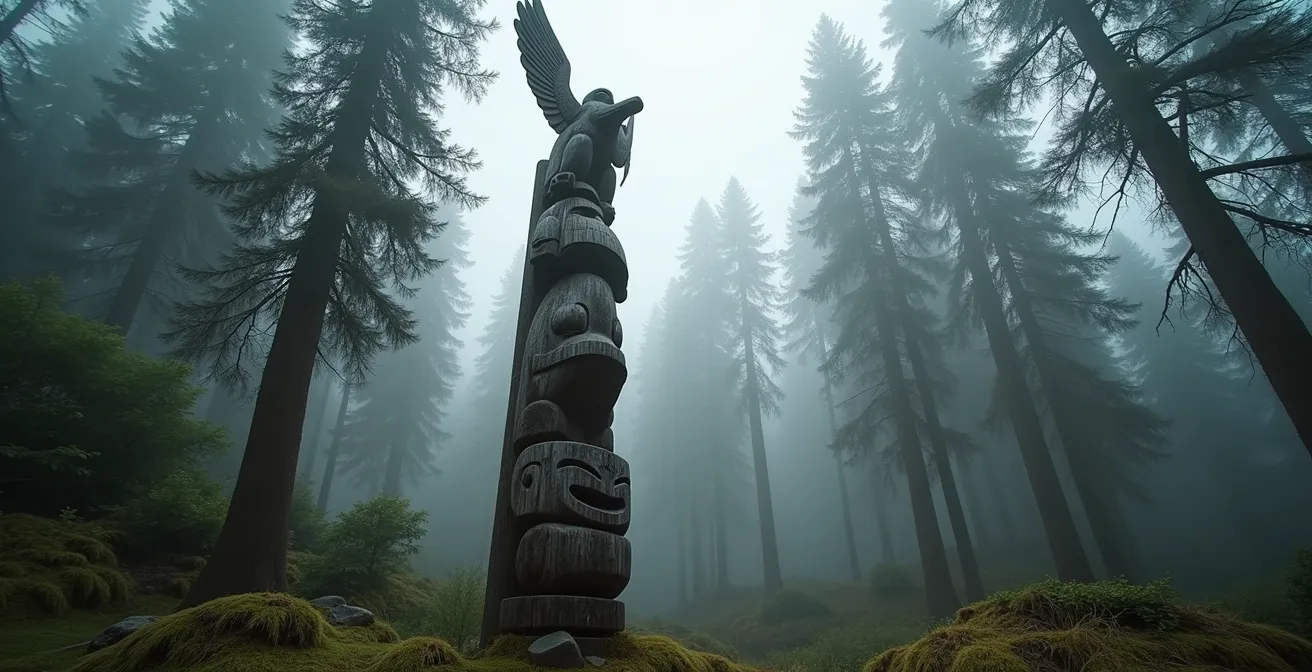
Contrary to popular belief, understanding a totem pole is not about memorizing a dictionary of animal meanings; it’s about learning to read a complex visual grammar of lineage, rights, and history.
- The position and interaction of figures (the figural syntax) reveal the narrative, not just the figures themselves.
- Poles serve diverse functions: some are tombs (mortuary), others are legal documents (heraldic), and some are memorials.
Recommendation: Instead of asking “What does the raven mean?”, start by asking “What is this pole’s job?” to begin a more meaningful interpretation.
Standing in the cool, damp air of Stanley Park or the misty quiet of Haida Gwaii, it’s impossible not to feel a sense of awe. A monumental cedar pole, covered in a cascade of interlocking figures, reaches for the sky. The immediate impulse for many visitors is to try and decipher it like a rebus puzzle: “the eagle means this, the bear means that.” This approach, however, often misses the forest for the trees. While crests and figures are significant, they are merely the vocabulary of a much more sophisticated language. The true meaning lies not in a simple list of symbols, but in the pole’s visual grammar—the way figures are stacked, interact, and are stylized tells a story of lineage, legal rights, historical events, and even cosmic order.
These poles are not interchangeable decorations. They are deeply contextual, functioning as everything from public announcements of status to solemn grave markers. To truly read a pole is to move beyond identification and toward interpretation. It requires understanding the pole’s function, the artist’s stylistic tradition, and the profound historical forces that have shaped this living art form. This guide is designed to shift your perspective, equipping you not with a dictionary of meanings, but with the foundational questions needed to appreciate these powerful cultural documents as the complex, layered narratives they are.
In the sections that follow, we will explore the different functions of totem poles, the history of their suppression and survival, the distinct artistic styles of various First Nations, and the deep, symbiotic relationship between the carvers and the Western Red Cedar from which these monuments are born.
Summary: A Deeper Look into the Significance of Totem Poles
- Mortuary vs. Heraldic: Why Not All Totem Poles Are About Ancestry?
- The Potlatch Ban: How Did the Tradition Survive Being Illegal for 60 Years?
- Haida vs. Coast Salish: Can You Spot the Difference in Carving Styles?
- To Rot or Restore: Why Some Poles Are Left to Decay Naturally?
- Modern Carvers: How Long Does It Take to Carve a 20-Foot Pole Today?
- Bark Stripping: How to Harvest Cedar Bark Without Killing the Tree?
- Stanley Park vs. Queen Elizabeth Park: Which Offers Better Native Flora?
- Softwood Properties: Why Is Cedar Easier to Carve Than Oak or Maple?
Mortuary vs. Heraldic: Why Not All Totem Poles Are About Ancestry?
A common misconception is that all totem poles are primarily memorials to ancestors. While many are, this is only one piece of a more complex picture. Poles serve distinct, specialized functions, and understanding a pole’s purpose is the first step in reading its story. The two most prominent categories are mortuary poles and heraldic poles. The ancient village of SGang Gwaay in Haida Gwaii, a UNESCO World Heritage site, provides a powerful example of this distinction. Here, the haunting landscape is dominated by mortuary poles that served a direct funerary purpose.
As documented by Parks Canada, these poles were essentially tombs. A box containing the remains of a high-ranking individual was placed in a cavity at the top of the pole. The carvings below weren’t just decoration; they were crests of the deceased, acting as a testament to their identity and lineage. Today, a visitor to SGang Gwaay can still see the powerful remnants of this practice, where 32 memorial and mortuary poles stand among house ruins, silent witnesses to a once-thriving society. This is in stark contrast to the tall, freestanding poles one might see in a museum or at a site like Stanley Park.
Many of those are heraldic poles. These are public declarations, functioning like a European coat of arms combined with a legal deed. They proclaim a family’s status, rights, territories, and access to specific resources. They often tell the origin stories of a clan, recounting supernatural encounters and key historical events that established their claims. So, while a mortuary pole is a personal monument to the dead, a heraldic pole is a public document of a family’s living history and legal standing in the community. One is a memorial, the other a proclamation.
The Potlatch Ban: How Did the Tradition Survive Being Illegal for 60 Years?
The potlatch, a ceremonial feast involving property distribution and the affirmation of status, was the central socio-political institution for which many heraldic poles were raised. It was the venue where lineages were validated and history was publicly performed. In 1885, the Canadian government, viewing the potlatch as anti-capitalist and a barrier to assimilation, outlawed the practice. This ban, which lasted until 1951, was a devastating blow to Northwest Coast cultures, driving traditions underground and threatening the very context for creating monumental art.
The enforcement was severe. At the infamous 1921 Cranmer Potlatch on Village Island, authorities made their intent clear. According to records from the U’mista Cultural Centre, which now houses much of the confiscated regalia, 45 people were arrested, with 20 individuals sentenced to prison. Over 300 cubic feet of priceless ceremonial masks, blankets, and other treasures were confiscated, with a paltry compensation of $1,485 offered in return. This act was not just a seizure of property; it was an attempt to erase a cultural identity.
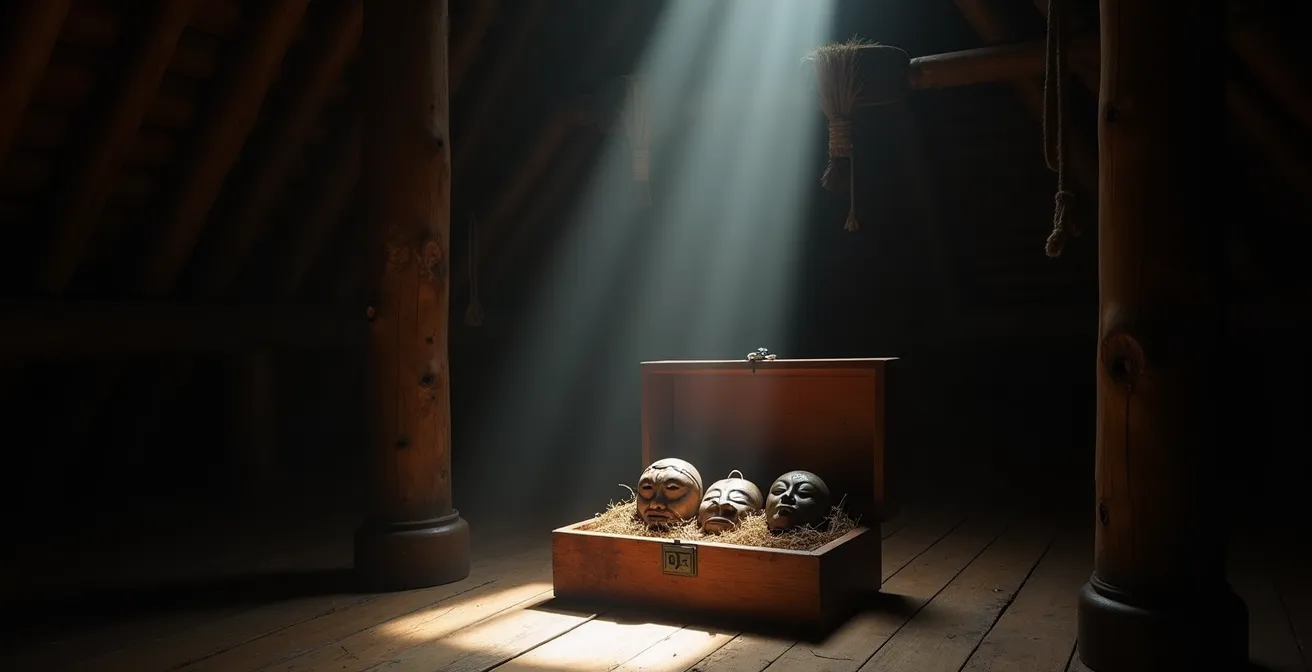
Despite the immense pressure, the tradition did not die. It survived through acts of incredible courage and secrecy. Ceremonies were held in remote locations, away from the eyes of Indian Agents. Priceless regalia, like the masks shown in the image, were hidden in cedar boxes and buried. Families and elders continued to pass down songs, dances, and stories in secret, ensuring that the knowledge was not lost. As Barb Cranmer, a Kwakwaka’wakw filmmaker, recalled of her family’s experience:
When they were brought to Oakalla Prison in 1922, it was humiliating and degrading for our people. Granny talks about the only reason she wasn’t sent to jail was because my mum was six months old, but her older sister went to jail. And when she got down there, they stripped them and hosed them down, like there was something wrong with them.
– Barb Cranmer, Living Tradition, The Kwakwaka’wakw Potlatch
This resilience ensured that when the ban was finally lifted, the cultural framework for carving and raising poles, though wounded, remained intact. The poles you see today are not just art; they are symbols of a tradition that refused to be extinguished.
Haida vs. Coast Salish: Can You Spot the Difference in Carving Styles?
Just as there are different languages across Europe, there are distinct artistic “languages” among the First Nations of the Pacific Northwest. A visitor to Stanley Park, which is located on the traditional territory of the Musqueam, Squamish, and Tsleil-Waututh Nations (Coast Salish peoples), can see a curated collection of poles from various nations. This provides a unique opportunity to learn to spot stylistic differences. The Haida of Haida Gwaii and the Coast Salish peoples of the Lower Mainland have particularly distinct carving traditions.
Haida art is often characterized by its powerful, continuous, and deeply carved formlines. These are the primary curvilinear lines that structure the design. Figures are often tightly integrated, flowing into one another in a complex, shallow-relief composition that covers the entire surface of the pole. The result is a dense, dynamic visual field. In contrast, Coast Salish art, particularly in their monumental house posts, often features more distinct, separated elements. The figures can appear more isolated and less integrated, with clearer breaks between them.
This comparative table, drawing on research from institutions like UBC, breaks down some of the general characteristics. It is important to remember these are stylistic tendencies, not rigid rules, as artists have always innovated and influenced one another.
| Feature | Haida Style | Coast Salish Style |
|---|---|---|
| Pole Height | Often over 100 feet tall | Typically house posts rather than standalone poles |
| Design Integration | Closely intertwined figures with shallow relief | More distinct, separated elements |
| Line Breaks | Continuous flowing forms | Clear separations between figures |
| Primary Locations | Haida Gwaii islands | Lower Fraser Valley |
| Notable Artists | Bill Reid, Robert Davidson | Susan Point |
As UBC’s Indigenous Foundations project notes, the collection in Stanley Park is an “open-air museum.” It includes not only Haida and Coast Salish work but also poles from the Kwakwaka’wakw, Nisga’a, and Nuu-chah-nulth traditions. Learning to recognize the deep-set eyes and strong formlines of a Haida pole versus the bold, often more geometric forms of a Salish piece is the beginning of developing visual literacy.
To Rot or Restore: Why Some Poles Are Left to Decay Naturally?
For a visitor from a Western culture, steeped in the preservationist ethic of museums, the sight of a magnificent, ancient totem pole slowly being reclaimed by moss and rain can be jarring. The instinct is to ask, “Why isn’t someone saving it?” This question, however, overlooks a profound philosophical perspective embedded in many Northwest Coast cultures: the idea that a totem pole, carved from a once-living tree, has a natural life cycle of its own.
This approach is most visible at the sacred site of SGang Gwaay. The Haida have made a conscious decision to let the poles there return to the earth. This is not neglect; it is a deeply held belief. The pole is born from the forest, and it is right and proper that it should return to the forest, completing its journey. It is a powerful statement about the impermanence of all things and the cyclical nature of life and death. As one observer noted:
The Haida people have decided to let the totem poles of SGang Gwaay decay naturally. Other than cleaning out debris and brush which might grow on them, no efforts are made to preserve them as they believe that totem poles have a natural life like a human. It is estimated that the totem poles may only be around for another 10 years.
– Atlas Obscura, Totems of Haida Gwaii Documentation
This philosophy doesn’t mean that no intervention ever occurs. The decision to restore, replicate, or let a pole decay is complex and varies by nation, community, and the specific pole’s history. Sometimes, a pole of immense historical or communal importance may be stabilized to prolong its life. For instance, UNESCO reports that even at SGang Gwaay, in 1995 and 1997, five poles were straightened and stabilized to prevent imminent collapse. More commonly, a decaying pole might be lowered and a new one carved and raised in its place, renewing the story and the tradition for a new generation. This constant renewal is, in itself, a form of preservation—not of the object, but of the culture, skills, and stories it represents.
Modern Carvers: How Long Does It Take to Carve a 20-Foot Pole Today?
The carving of totem poles is not a lost art or a relic of the past; it is a vibrant, living tradition. Today, master carvers like Robert Davidson, Jaalen Edenshaw, and many others continue to create monumental works that are both deeply traditional and powerfully contemporary. While the timeline for carving a pole varies greatly depending on its size, complexity, and the size of the carving team, a 20-foot pole can easily take several months to a year of dedicated work from log to raising.
The process combines modern tools with age-old techniques. While chainsaws are now used for the initial roughing out of the major forms, the intricate and subtle finishing work is still done with traditional tools like the adze and curved knives. This allows for the precise, flowing lines and detailed expressions that define the art form. The process is as much a spiritual undertaking as it is a physical one, often beginning with a ceremony to honour the spirit of the tree being harvested.
Case Study: The Gwaii Haanas Legacy Pole
A powerful example of modern pole carving is the 42-foot Gwaii Haanas Legacy Pole, raised in 2013. As noted in The Canadian Encyclopedia, this was the first monumental pole raised in the protected Gwaii Haanas territory in over 130 years. Supervised by carver Jaalen Edenshaw, the pole commemorates the groundbreaking Gwaii Haanas Agreement between the Haida Nation and the Government of Canada. This pole is not just art; it is a political document in wood, symbolizing a new era of co-operative management and respect.
For those curious about the tangible steps involved, the modern process follows a clear, culturally significant path. It is a fusion of artistry, engineering, and profound ceremony.
Action Plan: The Modern Totem Pole Carving Process
- Selection and Harvest: A suitable Western Red Cedar is identified. Before harvest, a ceremony of gratitude is often performed to honour the tree’s spirit.
- Debarking and Roughing Out: The bark is stripped, and the basic shapes of the figures are blocked out, often using chainsaws for efficiency.
- Detailed Carving: The true artistry emerges as carvers use traditional adzes, chisels, and specialized curved knives to refine the figures and create the intricate formline details.
- Finishing and Painting: The pole is sanded and, depending on the commission, painted. Traditional pigments (black, red, turquoise) or modern acrylics may be used to highlight specific features.
- The Raising Ceremony: The final and most crucial step. The community gathers to raise the pole, an event filled with song, dance, and speeches that imbue the pole with its spirit and publicly validate the stories it tells.
Bark Stripping: How to Harvest Cedar Bark Without Killing the Tree?
Before one can even consider a technique like bark stripping for weaving or other uses, it is essential to understand the sacred and central role of the Western Red Cedar (Thuja plicata) in Northwest Coast cultures. It is not merely a resource; it is revered as the “tree of life.” This single species provided the material for nearly every aspect of life: houses, canoes, clothing, baskets, tools, and the monumental poles that define the artistic tradition. The relationship is one of profound reciprocity and respect.
This reverence is the starting point for any harvest. A carver or weaver does not simply take from the forest. The selection of a tree is a careful process, and its felling is preceded by ceremony. This deep respect is articulated by Roy Henry Vickers, a renowned artist of Tsimshian and Haida ancestry, who explains the worldview that animates this relationship:
Before a cedar tree is harvested for a totem pole, many coastal First Nations communities will perform a ceremony of gratitude and respect in honour of the tree. Several trees may be inspected before a particular tree is chosen for its beauty and character. According to Roy Henry Vickers, an artist of Tsimshian and Haida ancestry, ‘each tree is like a human being; it has its own personality and uniqueness.’
– Roy Henry Vickers, Indigenous Foundations UBC
This perspective fundamentally shapes the act of harvesting. While the title asks about a specific technique, the more profound answer lies in the principle of sustainable and respectful use that has guided First Nations for millennia. When harvesting bark for weaving, for example, it is traditionally done in vertical strips from mature trees in a way that allows the tree to heal and continue to thrive. The goal is never to kill the tree, but to accept a gift it is offering. The choice of cedar for poles is also practical; its natural rot resistance allows it to endure for a century or more in the damp Pacific climate, giving longevity to the stories and lineages carved upon it.
Stanley Park vs. Queen Elizabeth Park: Which Offers Better Native Flora?
While a botanical comparison of native flora in Vancouver’s parks is a valid exercise, a more profound story of the land is told through the monumental art situated within Stanley Park. The collection of totem poles at Brockton Point, though not on their original ancestral sites, serves as a crucial gateway for millions of visitors to engage with the rich artistic traditions of the Pacific Northwest. It’s an outdoor gallery on the unceded territories of the Musqueam, Squamish, and Tsleil-Waututh peoples.
The collection is intentionally diverse, featuring poles from nations up and down the coast, including Haida, Kwakwaka’wakw, and Nisga’a, alongside Salish works. This curation allows for direct comparison and learning, making it an invaluable educational site. It transforms the park from a simple recreational space into a place of cultural dialogue. However, it’s vital to remember that these poles are far from their original homes. They are ambassadors, but their presence in Vancouver is also tied to a complex history of collection, relocation, and the colonial forces that depopulated their ancestral villages.
For example, the stunning, isolated poles of SGang Gwaay exist as they do because the village was tragically abandoned. At its peak, the village of Ninstints (as it was also known) was home to around 300 people. Following devastating smallpox epidemics that swept the coast in the 19th century, historical records indicate that by the 1880s, the population had been reduced to fewer than 30 individuals, leading to the village’s eventual abandonment. The art left behind became a silent monument to this history. The poles in Stanley Park, in contrast, are loud with the chatter of tourists, a different but equally important context. One site speaks to history and memory, the other to education and cross-cultural encounter.
Key Takeaways
- Totem poles are not a single entity; they serve distinct functions as mortuary monuments, heraldic legal documents, and memorials.
- The visual style is not uniform; Haida, Coast Salish, and other First Nations have unique artistic languages recognizable by their structure, formline, and composition.
- The tradition is not a relic but a living, resilient art form that survived a 60-year government ban and is actively practiced by modern carvers today.
Softwood Properties: Why Is Cedar Easier to Carve Than Oak or Maple?
The choice of Western Red Cedar for nearly all Northwest Coast monumental carving is no accident. It is a decision born of deep material knowledge, where the physical properties of the wood align perfectly with the artistic and environmental demands of the tradition. While hardwoods like oak or maple are strong, they are also dense, heavy, and difficult to work. Cedar, a softwood, offers a unique combination of workability and durability that makes it the ideal medium.
The primary advantage of cedar is that it is straight-grained and easy to carve. This allows artists to achieve the fluid, curvilinear formlines and intricate details that are hallmarks of the style. The wood yields to the carver’s tools—the adze, the chisel, the curved knife—in a way that dense hardwoods do not. It facilitates a conversation between the artist and the material, rather than a battle. This workability is complemented by another, even more critical property: its exceptional resistance to decay.
The Haida have always thrived on the wealth of both the sea and the forest. Shellfish and salmon were staple foods. Giant Western red cedars were the raw material of ocean-going canoes, vast post and plank houses, and great poles bearing both symbols of family history and, holding inside, the bones of ancestors.
– Parks Canada, SGang Gwaay Heritage Site Documentation
As Parks Canada notes, cedar was the foundation of the entire material culture. For outdoor sculptures like totem poles, exposed to the relentless rain of the Pacific Northwest, this is paramount. The wood is rich in natural oils and compounds (thujaplicins) that act as fungicides, preventing the rot that would quickly destroy other types of wood. This natural preservative quality means a cedar pole can stand for a century or more, carrying its stories through multiple human generations. It is this perfect marriage of being soft enough to shape but strong enough to endure that makes Western Red Cedar the one and only choice for these magnificent monuments.
By shifting your focus from a simple “what does it mean” to a more nuanced “how does it work,” you begin to see the poles not as static objects, but as dynamic documents. They are a testament to artistic genius, historical resilience, and a profound connection to the natural world. The next time you stand before one, you will be equipped to begin a much richer conversation with the stories it tells.