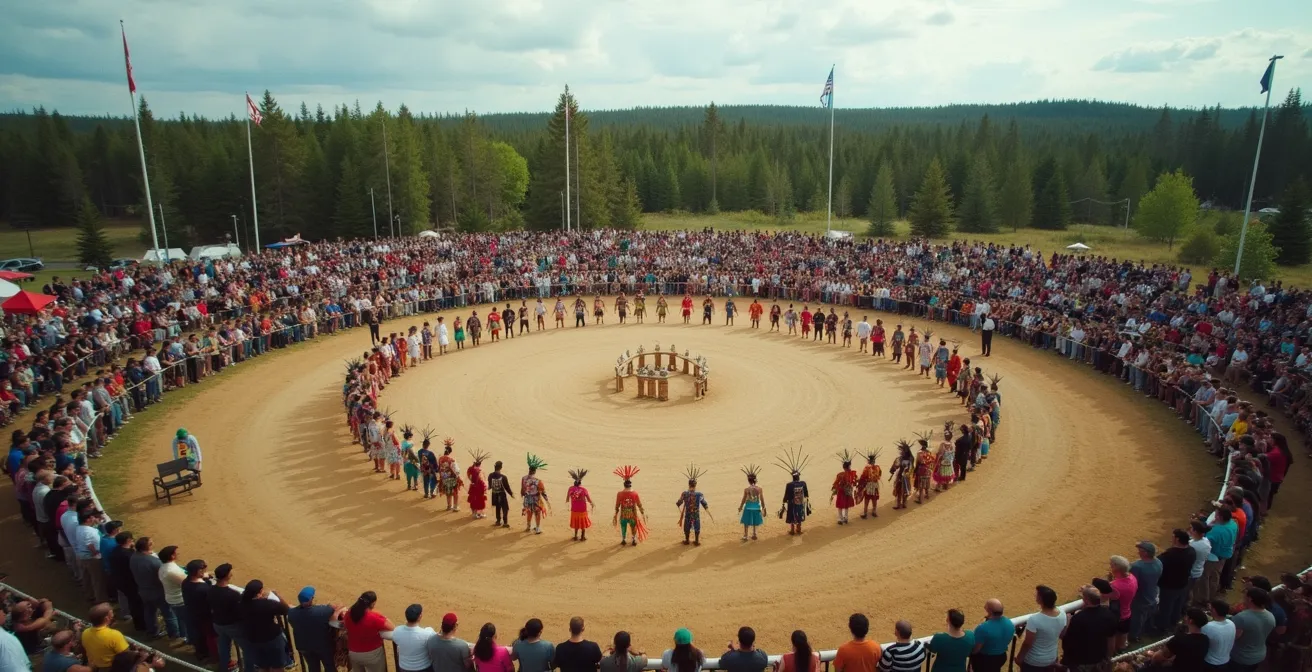
The fear of committing a cultural faux pas shouldn’t stop you from experiencing a Powwow; the key is shifting from memorizing rules to understanding the cultural logic behind them.
- Regalia is not a costume; it’s a collection of sacred, earned items with deep spiritual significance.
- The Master of Ceremonies (MC) is your primary guide. Their instructions override everything else.
- Your presence and support can be a genuine act of reciprocity and reconciliation when done respectfully.
Recommendation: Attend with an open heart and mind, listen more than you speak, and see every protocol as an invitation to learn, not a barrier.
The pulsing sound of the drum, the vibrant colours of dancers moving in unison, the smell of sage and sweetgrass in the air—attending a Powwow is a powerful and immersive cultural experience. Yet for many non-Indigenous people, a genuine desire to attend is often mixed with a deep-seated anxiety: “What if I do something wrong? What if I accidentally offend someone?” This fear is understandable, but it shouldn’t be a barrier. As a cultural liaison, my role is to welcome you and provide the clarity needed to move past that fear.
Many online guides will give you a simple list of “dos and don’ts.” They’ll tell you to be respectful, to ask before taking photos, and not to touch a dancer’s outfit. While this advice is correct, it’s incomplete. It tells you the “what” but completely misses the “why.” Without understanding the cultural logic, these rules can feel like walking on eggshells, turning a joyful celebration into a stressful test you’re afraid to fail. This guide is different. We will go beyond the surface-level rules to explore the history, spirituality, and values that inform them.
By understanding the profound meaning behind why an eagle feather is sacred, why you must stand when the drum enters the circle, and how your souvenir purchase can be an act of economic reconciliation, you transform from a timid observer into a respectful and welcome participant. This is not about memorizing a list of prohibitions; it’s about learning to see the event through a lens of cultural appreciation. You’ll learn to listen for the MC’s cues, recognize when you are invited to join a dance, and engage with artists in a way that honours their heritage. Ultimately, your respectful presence is not only welcomed—it’s a vital part of the cultural exchange that Powwows celebrate.
To help you navigate this experience with confidence, this guide is structured around the common questions and situations you will encounter. We will explore the protocol for everything from personal interactions to ceremonial moments, ensuring you have the context needed to act with respect and understanding.
Summary: A Guide to Respectful Powwow Participation
- Touching the Feathers: Why You Must Never Touch a Dancer’s Outfit Without Permission?
- The MC’s Instructions: When Is Photography Strictly Prohibited at a Ceremony?
- Intertribal Dances: How to Know When You Are Invited to Join the Circle?
- Supporting Artists: How to Ensure Your Souvenir Money Goes to the Creator?
- Standing for the Drum: Why You Must Stand During the Opening Ceremony?
- First Nations Heritage: How to Visit Northern Communities Respectfully?
- The Potlatch Ban: How Did the Tradition Survive Being Illegal for 60 Years?
- Indigenous Tourism BC: How Your Visit Directly Supports Community Revitalization?
Touching the Feathers: Why You Must Never Touch a Dancer’s Outfit Without Permission?
One of the most fundamental rules at a Powwow is to never touch a dancer’s regalia. This isn’t about keeping a “costume” clean; it’s about respecting items of deep spiritual and personal significance. The term “regalia” is used instead of “costume” because these are not outfits for a performance. Each piece, from the beadwork to the bells, tells a story and is often a sacred item. Many elements are gifts, passed down through generations, or created with prayer and ceremony. They are a physical representation of a dancer’s spirit, family, and community journey.
Of all the items, eagle feathers are the most sacred. In many Indigenous cultures, the eagle is a messenger to the Creator, and its feathers are a symbol of the highest honour and respect. They are not simply decorative; they are earned. As one cultural guide explains, eagle feathers are sacred items that Indigenous people earn through ceremony in recognition of the work they do to support their communities. In Canada, this spiritual significance is also reflected in law. The possession of eagle feathers is legally restricted to Indigenous peoples under the Migratory Birds Convention Act, underscoring their protected status.
If a feather falls to the ground during a dance, a specific ceremony must be performed to retrieve it. Do not pick it up. Quietly inform the nearest staff member, Arena Director, or the MC. The best way to show your appreciation for a dancer’s beautiful regalia is to compliment them from a respectful distance when they are outside the dance circle. A simple, “Your regalia is stunning,” is a welcome and respectful gesture.
The MC’s Instructions: When Is Photography Strictly Prohibited at a Ceremony?
The single most important person for a visitor to pay attention to is the Master of Ceremonies, or MC. The MC is not just an announcer; they are the conductor of the entire event, a storyteller, a comedian, and your primary guide to protocol. If you are ever unsure of what to do—when to stand, when to sit, whether you can take a photo, or if it’s okay to clap—your first action should always be to listen to the MC. Their instructions supersede any general rule you may have read. They will guide the audience through the day, explaining the significance of different dances and songs.
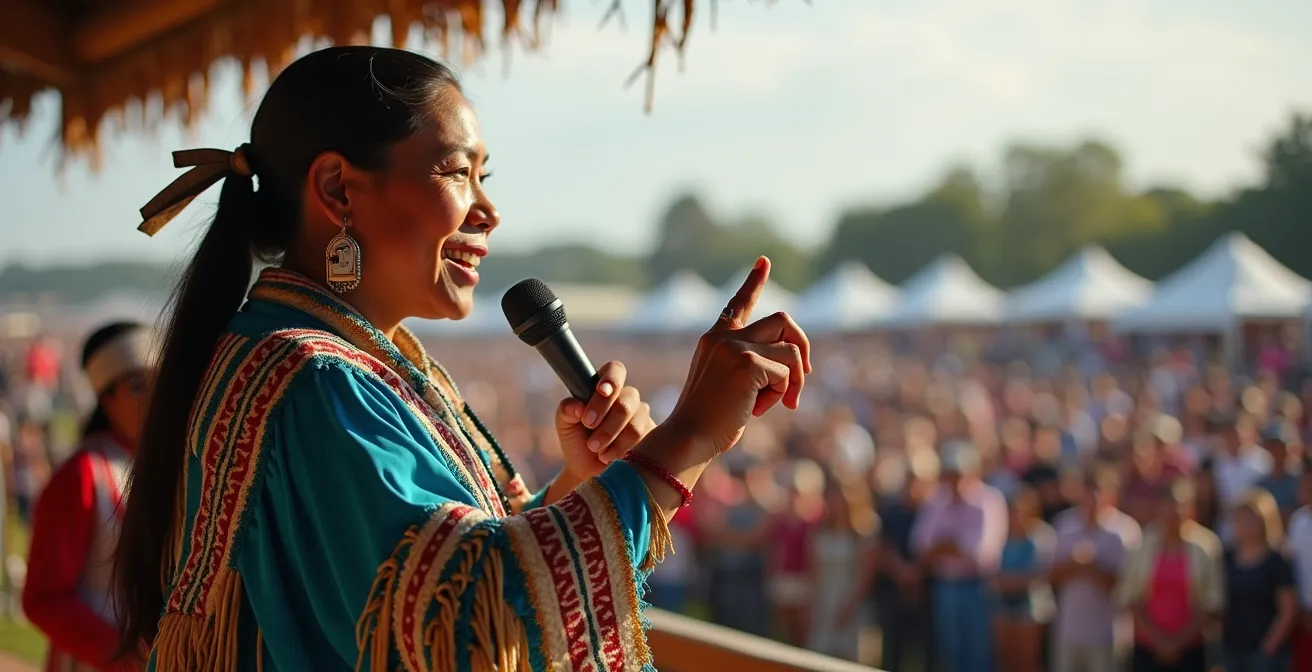
Photography is a particularly sensitive area where the MC’s guidance is crucial. While photos are often welcome during general dances, there are specific moments when they are strictly forbidden. As the Grand Valley State University Powwow Committee notes, the Emcee will clearly announce if photography is not allowed during certain parts of the event. These moments often include:
- Prayers and Invocations: These are times of deep spiritual connection.
- Memorial Songs: These honour community members who have passed away.
- Healing Ceremonies: These are intensely personal and sacred moments for participants.
- Certain Honour Songs: Specific songs may be designated as private.
Even when photography is permitted, always be discreet. Never use flash, as it is distracting and disrespectful to both dancers and the drum. Always ask for permission before taking a close-up photo of an individual, especially children. Introduce yourself and explain why you’d like the photo. A little courtesy goes a long way in showing respect.
Intertribal Dances: How to Know When You Are Invited to Join the Circle?
For many visitors, one of the most memorable and moving parts of a Powwow is the Intertribal dance. This is where the cultural logic of the event shifts from observation to participation. An Intertribal is exactly what it sounds like: a dance for everyone, including non-Indigenous visitors. It is a powerful gesture of inclusivity and welcome. However, knowing the right time to join is key. The signal is always given by the MC, who will make an announcement such as, “This is an Intertribal, everyone is welcome in the circle!” This is your explicit invitation.
When you enter the dance arena, always move in a clockwise direction, following the flow of the other dancers. Don’t worry about having fancy footwork. A simple two-step, in time with the heartbeat of the drum, is all that is needed. The goal is not performance, but participation and showing respect for the drum, the songs, and the community. As one first-time visitor shared after joining in, “Pow Wows demonstrate palpable inclusivity, welcoming participants from all walks of life.” This shared experience of moving together to the sound of the drum creates a powerful sense of connection.
Some tips for participating:
- Wear comfortable shoes.
- If you have children, keep them close to you and ensure they dance respectfully, not running or shouting.
- It’s best to wear modest, everyday clothing. You are a guest, not part of the performance.
- Smile! This is a joyful and celebratory event.
Joining an Intertribal dance is a beautiful way to show your respect and appreciation. It’s an opportunity to feel the energy of the community and the power of the drum in a very personal way.
Supporting Artists: How to Ensure Your Souvenir Money Goes to the Creator?
Powwows are vibrant marketplaces where you can find stunning, handcrafted art, from intricate beadwork and jewelry to carvings and clothing. Purchasing an item is one of the most direct ways you can practice reciprocity—a core Indigenous value of giving back—and support artists and their families. However, it’s crucial to ensure your money is going to an authentic Indigenous creator, not a reseller of mass-produced imitations. Fake “Indigenous-style” art is a significant problem that undermines the economic and cultural well-being of artists.
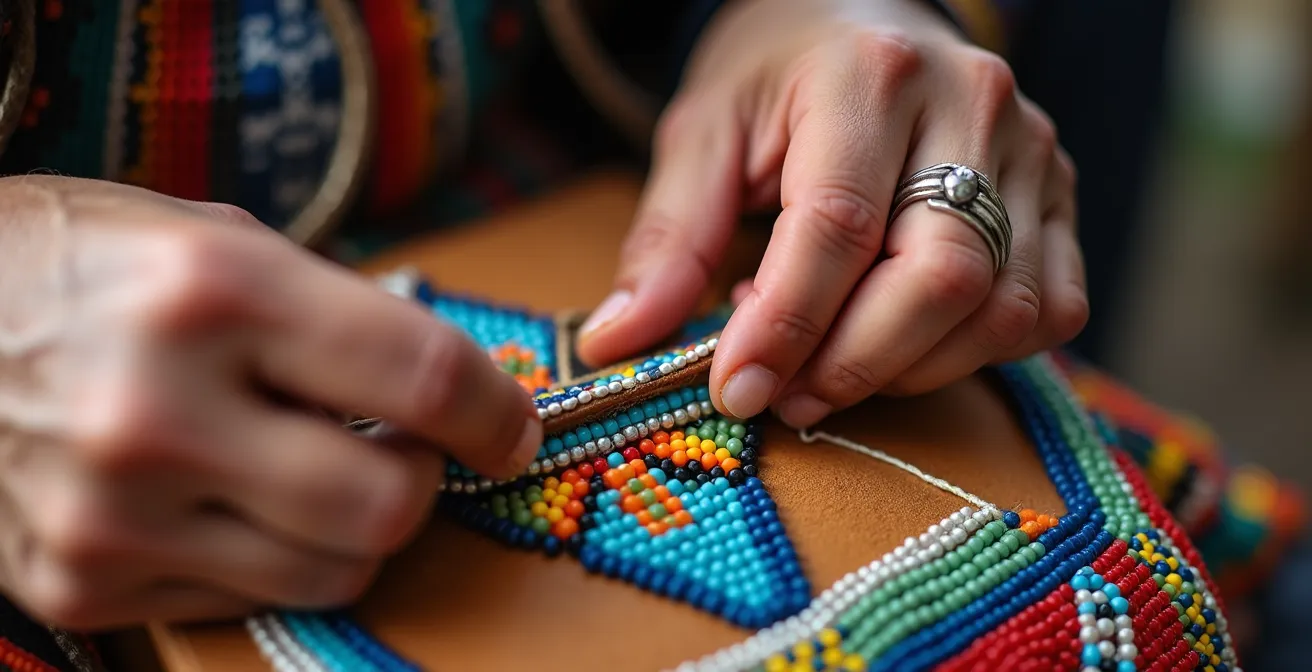
The best way to verify authenticity is to engage directly with the vendor. Ask them about their Nation, the story behind their work, the materials they used, and the techniques they employed. Authentic artists are proud of their heritage and happy to share it. Be wary of vendors who are evasive or can’t answer these questions. Look for signs of mass production, such as “Made in China” stickers or large quantities of identical items. True handcrafted art is unique. To help combat fraud, organizations have stepped up. The Indigenous Arts Collective of Canada, for example, represents over 500 verified Indigenous artists, providing a platform for consumers to connect with authentic creators.
Your purchase is more than a transaction; it is an investment in the continuation of culture. It helps an artist feed their family, buy materials for their next creation, and pass their knowledge on to the next generation.
Your Action Plan for: Supporting Authentic Artists
- Ask the artist directly about their Nation and the story behind their work; authentic artists are proud to share their heritage.
- Look for ‘Made in China’ or mass production stickers, which indicate non-authentic items.
- Check if the vendor is listed with a verification system like the Indigenous Arts Collective of Canada (IACC).
- Be wary of identical items in large quantities; authentic Indigenous art is typically unique or made in small batches.
- Support vendors who can explain the traditional techniques and materials used in their creations.
Standing for the Drum: Why You Must Stand During the Opening Ceremony?
The drum is not just an instrument; it is the heartbeat of the Powwow and the heartbeat of the Nation. It is considered a sacred entity with its own spirit, and it is treated with the utmost respect. This reverence is most visible during specific ceremonial moments when the entire arena, including spectators, is required to stand. If you are able to, you must stand and remove your hat during these times. It is the equivalent of standing for a national anthem.
The most important of these moments is the Grand Entry. This is the official start of the Powwow, a grand procession that brings the spirit and purpose of the gathering into the circle. It is led by Indigenous veterans carrying Eagle Staffs and flags. In the Canadian context, you will often see the Canadian flag carried alongside the flags of First Nations, the United States, and the POW/MIA flag. This procession honours the sovereignty of Indigenous nations and the service of their veterans in the Canadian and American armed forces. The Grand Entry is followed by a Flag Song, an Honour Song, and an invocation or prayer from an Elder.
You must remain standing for this entire opening sequence. In addition to the Grand Entry, you should also stand for:
- Flag Songs and the retirement of the flags at the end of the day.
- Veterans’ Songs, to honour all who have served.
- Memorial Songs, to honour community members who have passed on.
- Closing Prayers.
The MC will always announce these moments. If you are unable to stand due to age or disability, it is understood and respected for you to remain seated quietly.
First Nations Heritage: How to Visit Northern Communities Respectfully?
The principles of respect learned at a Powwow are an excellent foundation for any interaction with Indigenous communities, but it’s important to recognize that visiting a remote community requires a different level of protocol. A Powwow is a public event designed to welcome visitors. A remote First Nations or Inuit community is not. As the Indigenous Tourism Association of Canada firmly states, many of these are private communities with their own governance structures, not tourist destinations open to the public. Unannounced visits are a serious breach of protocol.
If you have a legitimate reason to visit, such as being invited or for work, the first step is always to contact the Band or Hamlet council office well in advance. Do not simply show up. When you do visit, it is customary to bring a host gift. Tobacco is a traditional offering used in ceremony, but small gifts of food or other useful items are also appreciated. However, never bring alcohol unless you have been specifically asked to do so, as many communities are dry.
Hiring a local Indigenous guide or visiting a designated cultural centre is the best way to ensure your visit is respectful and that your economic contribution benefits the community directly. Be mindful that resources like food, water, and fuel can be limited and expensive in the North, so plan to be as self-sufficient as possible. Above all, approach your visit with humility and a desire to learn. You are a guest in someone’s home, and the onus is on you to behave with grace and respect for their laws and customs.
The Potlatch Ban: How Did the Tradition Survive Being Illegal for 60 Years?
To fully grasp why cultural protocols are so vital and fiercely protected today, it is essential to understand that they are not just ancient traditions—they are acts of survival and resilience. There is no clearer example of this in Canada than the story of the Potlatch. The Potlatch is a complex ceremony practiced by Nations on the Pacific Coast, involving feasting, dancing, and the redistribution of wealth to affirm status and social order. It is the living embodiment of their governance and legal systems.
Seeing this powerful cultural institution as a threat to its assimilationist policies, the Canadian government enacted the Potlatch Ban, making the ceremony illegal from 1885 to 1951. As detailed in historical accounts of this period, the Indian Act was used to legislate Indigenous culture out of existence. During these 66 years, holding a Potlatch was a criminal act, punishable by imprisonment. Government agents confiscated priceless regalia, masks, and other ceremonial items, many of which ended up in museums around the world.
The Underground Survival of the Potlatch (1885-1951)
Despite the immense risk, the ceremonies went underground. Families hid their sacred regalia in caves and attics, passing down songs and dances in secret. Chiefs and Elders continued to host Potlatches disguised as other events, ensuring the cultural knowledge was not lost. The fight to maintain these traditions in the face of state-sanctioned oppression is a testament to the incredible strength and resilience of Indigenous peoples. The revival of the Potlatch today represents a cornerstone of cultural and political revitalization in British Columbia.
Understanding this history of active suppression changes how we see a Powwow. Every dance, every song, and every piece of regalia is a victory. They are a living history, a defiant and joyful declaration that the culture has survived and is thriving. This is why protocol matters so much—it is a way of honouring that struggle and celebrating that survival.
Key Takeaways
- Shift Your Mindset: View Powwow protocol not as a list of restrictions, but as a guide to understanding a rich cultural logic based on respect, reciprocity, and relationships.
- The MC is Your Guide: The Master of Ceremonies is your most important resource. Listen to their instructions for when to stand, sit, and whether photography is appropriate.
- Participate Respectfully: Your presence is welcome. Joining an Intertribal dance or purchasing authentic art are powerful ways to engage and show support for the community.
Indigenous Tourism BC: How Your Visit Directly Supports Community Revitalization?
Your journey to understanding and respect doesn’t end when the Powwow is over. By making conscious choices as a visitor, you can play a direct role in supporting the revitalization of Indigenous cultures across Canada. Organizations like Indigenous Tourism BC are at the forefront of this movement, fostering businesses that are not only economically viable but also culturally rooted. When you choose to support an Indigenous-owned tourism business, you are participating in a modern form of reciprocity that contributes directly to community well-being.
In British Columbia, there are over 480 Indigenous tourism businesses, from wilderness tour operators to cultural centres and art galleries. The revenue generated by these enterprises provides a powerful tool for self-determination. It funds language immersion programs for children, land-based healing initiatives that address intergenerational trauma from residential schools, and creates meaningful employment that allows youth to stay in their home communities. This work is a direct response to the Truth and Reconciliation Commission’s Calls to Action, using tourism as a vehicle for economic and cultural reconciliation.
The Squamish Lil’wat Cultural Centre Impact
A prime example is the Squamish Lil’wat Cultural Centre in Whistler. The revenue generated from visitors directly funds youth mentorship programs and language revitalization classes for the Squamish and Lil’wat Nations. It is a self-sustaining model where tourism becomes a tool to strengthen and celebrate the very culture that visitors come to learn about, creating a virtuous cycle of economic and cultural benefit.
By attending a Powwow with an open heart, buying art from the creator, or booking a tour with an Indigenous guide, you are doing more than just being a tourist. You are becoming an ally and a partner in the vibrant and ongoing process of cultural revitalization.
Now, armed with this deeper understanding, the next logical step is to experience it for yourself. Seek out a local Powwow in your area, attend with confidence and humility, and become part of this beautiful and living celebration of culture.