Visiting Old Montreal isn’t about avoiding tourist traps; it’s about developing the critical eye to dismantle them.
- Authentic poutine is defined by the “squeak” of its cheese curds, not its price tag or proximity to a landmark.
- Genuine souvenirs carry official artisan seals and verifiable authenticity tags—details most shops hope you’ll overlook.
Recommendation: Focus on verifiable ‘Authenticity Markers’ in everything from food to crafts to experience the real Quebec, not a commercialized replica.
The moment you step onto the cobblestones of Place Jacques-Cartier, you are a target. You are met with a barrage of colourful signs, aggressive hosts promising “the best poutine,” and shelves overflowing with maple-leaf-stamped trinkets. The average travel guide tells you what to see, but it rarely tells you how to see. It gives you lists, not a lens. The prevailing wisdom is to simply “avoid the tourist traps,” a piece of advice as vague as it is unhelpful for a first-time visitor standing in the very heart of the trap itself.
This is not that kind of guide. This is an intervention. As a critic dedicated to preserving gastronomic and cultural integrity, my goal is not to give you a map of “safe” restaurants. It is to arm you with a toolkit of critical analysis. We will move beyond the superficial and conduct a form of cultural forensics. The real soul of Quebec isn’t found in a perfectly curated photo opportunity; it’s in the distinct squeak of a fresh cheese curd, the subtle imperfections of a hand-knitted tuque, and the layered history buried just inches beneath your feet.
Forget what you’ve been told about simply looking for where the locals go. Instead, you will learn to identify the specific markers of authenticity that separate genuine craftsmanship from the “heritage veneer” designed to part you from your money. We will deconstruct everything from a plate of poutine to a light show in a sacred basilica, transforming you from a passive tourist into a discerning connoisseur. This is your training manual for experiencing the true, unvarnished character of Old Montreal.
This guide provides a structured approach to analyzing the authenticity of your Old Montreal experience. We will dissect common tourist encounters and provide you with the critical tools to make informed choices at every turn.
Summary: A Critic’s Guide to Navigating Old Montreal’s Authenticity Maze
- The Difference Between a $15 Poutine and a $6 Tourist Trap Poutine
- Beyond the Facades: What History Do the cobblestones of Saint-Paul Street Hide?
- Notre-Dame Basilica: Is the AURA Light Show Respectful of the Heritage?
- Made in Quebec vs. Made in China: How to Spot Real Souvenirs in the Old Port?
- Winter in Old Montreal: Is It Worth Visiting When It’s -20°C?
- Menu Anxiety: How to Order Food When the Menu Is Only in French?
- Maple Taffy on Snow: How to Roll the Perfect Stick Without Making a Mess?
- How to Walk from Peel to Place-des-Arts Without Stepping Outside in Winter?
The Difference Between a $15 Poutine and a $6 Tourist Trap Poutine
Poutine is the litmus test of a Quebec kitchen, and most establishments in Old Montreal will fail it spectacularly. The price difference between a genuine article and a tourist-grade imitation is not just about profit margins; it’s a reflection of ingredients, technique, and respect for the dish. A low price is often a red flag, signaling frozen fries, powdered gravy, and refrigerated, non-squeaky cheese. A high price, however, is no guarantee of quality. True gastronomic integrity is found in the details, not the dollar amount.
The gold standard, exemplified by institutions like La Banquise (though located outside the old city), is built on a trinity of quality: fresh, room-temperature Quebec cheese curds that “squeak” when you bite them; a rich, peppery, and dark ‘sauce brune’ that is never watery; and double-fried potatoes that remain crisp under the heat of the gravy. The tourist trap version is a soggy, bland insult. To avoid it, you must perform culinary forensics on the spot. Don’t be shy; your palate’s dignity is at stake.
Action Plan: Auditing a Potential Tourist Trap Restaurant
- Menu Scan: Look for laminated, multi-language menus with pictures for every item. Are “tourist combos” or “table d’hôte du touriste” prominently featured? This is a sign they cater to convenience, not quality.
- Ambiance Check: Is the decor a caricature of “Quebecois” (e.g., excessive plaid, fake maple buckets)? Is the music generic pop instead of local or French artists? Authenticity is a feeling, not a costume.
- The Poutine Litmus Test: Ask your server directly if the cheese curds are fresh from the day and if they squeak. Observe the gravy on other tables—is it dark and rich, or thin and pale?
- The Host’s Pitch: Are staff on the street aggressively trying to lure you in? A confident restaurant with a loyal local following doesn’t need to beg for customers.
- Local-to-Tourist Ratio: Glance inside. Do you see a mix of patrons speaking French, or is it exclusively groups of tourists with cameras and maps? An absence of locals is the ultimate red flag.
Mastering this quick audit is your first step toward eating with intention. It allows you to bypass the establishments that see you as a walking wallet and find the hidden gems that take pride in their product. This critical approach is the foundation of an authentic experience.
Beyond the Facades: What History Do the cobblestones of Saint-Paul Street Hide?
The allure of Old Montreal is inseparable from its architecture. The stone facades and winding streets feel like a European transplant. But this “Heritage Veneer” can be deceptive. Many buildings that appear to be preserved relics of New France are, in reality, shells housing souvenir shops and fast-food chains. To truly connect with the area’s past, you must look beyond the storefronts and consider the very ground you walk on. Saint-Paul Street, for instance, is more than just a picturesque walkway; it’s an artifact.
Historical records show that Saint-Paul Street’s earliest cobblestones date back to 1672, making it one of the city’s oldest and most vital arteries for centuries. This wasn’t a tourist promenade; it was the city’s commercial and social heart. The layers of history are literal. As the Montreal Tourism Board notes in its architecture guide, a single building on this street might have been a fur trading post, then a Victorian-era bank, and now a restaurant. The story is in the evolution, not just the origin.
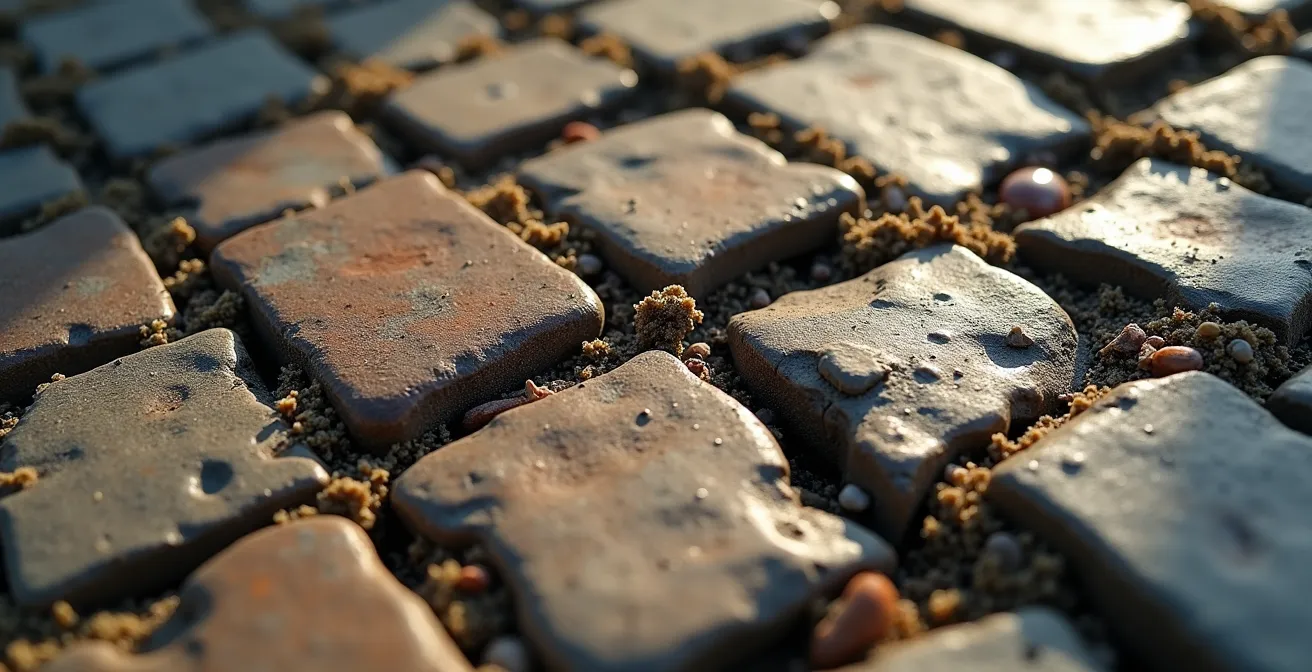
This visualization of archaeological layers is a powerful metaphor. Beneath the polished cobblestones trod by millions lies a complex tapestry of Indigenous history, colonial trade, industrial growth, and modern commerce. The real history isn’t always in the plaques on the walls; it’s in the foundations, the repurposed materials, and the ghosts of the businesses that once stood there. Engaging with this requires looking past the surface and asking, “What was this building before it was a souvenir shop?” That question is the key to unlocking a deeper, more meaningful connection to the place.
Notre-Dame Basilica: Is the AURA Light Show Respectful of the Heritage?
The Notre-Dame Basilica is an undeniable masterpiece of Gothic Revival architecture. Its soaring vaults, intricate woodwork, and deep blue and gold hues are designed to inspire awe. For generations, that awe was derived from its sacred function and the masterful craftsmanship illuminated by daylight filtering through stained glass. Today, thousands of visitors experience it through AURA, a high-tech multimedia spectacle of light and sound. This presents a critical question: does this modern interpretation enhance or diminish the basilica’s heritage?
There is no simple answer. At a height of nearly 97 meters (318 feet), making it one of Montreal’s most imposing landmarks, the basilica has always been a stage for the sublime. The debate hinges on the method of storytelling. A purist might argue that the building’s own architectural language is profound enough and that projection mapping, no matter how beautiful, is a distraction from the sacred space. An advocate for AURA would counter that it uses modern tools to achieve the same goal as medieval artisans: to create a transcendent experience that tells a story and evokes powerful emotions in the viewer.
The following table, based on an analysis of the experience, breaks down this tension between traditional and modern interpretations of a sacred space.
| Medieval Stained Glass | AURA Light Show |
|---|---|
| Used light and color to tell biblical stories | Uses projection technology for storytelling |
| Created awe through craftsmanship | Creates awe through digital artistry |
| Limited by daylight hours | Operates in evening for maximum impact |
| Static imagery | Dynamic, evolving visuals |
Ultimately, judging AURA is a personal, critical act. It is not disrespectful by default. The key is to enter with awareness. Acknowledge that you are witnessing a contemporary artistic performance *within* a historic monument, not a traditional religious service. By framing it this way, you can appreciate the digital artistry for what it is without feeling it has violated the space’s original sanctity. It’s a dialogue between past and present, and you are the arbiter of its success.
Made in Quebec vs. Made in China: How to Spot Real Souvenirs in the Old Port?
The souvenir shops of the Old Port are a minefield of inauthenticity. For every genuinely crafted local item, there are a dozen mass-produced trinkets with a maple leaf slapped on them. Distinguishing between them requires you to become an inspector of goods, looking for specific, verifiable Authenticity Markers. The average tourist buys on impulse; the discerning traveler buys on evidence. Your mission is to find that evidence.
The government and artisan guilds of Quebec have created systems to certify local craftsmanship, but these seals and tags are often subtle. Shops filled with low-quality goods rely on you not knowing what to look for. For example, a real piece of Inuit soapstone carving will often have the artist’s name or an official “Igloo Tag” sticker, guaranteeing it’s an authentic, artist-compensated piece. A cheap imitation will have none. Likewise, authentic maple syrup is graded for quality by the PPAQ (Quebec Maple Syrup Producers); a bottle without this grading is suspect. These markers are your best defense against the tide of imported knock-offs.
If your goal is to find genuinely local products, you must often leave the primary tourist zone. As an example, the Jean-Talon Market is easily the best place to find fresh produce and locally sourced foodie finds. While it requires a metro ride, it serves as a crucial point of contrast: it is a place built for locals first, where authenticity is the baseline, not the exception. The experience of seeing producers selling their own goods directly informs your eye for what’s real when you return to the Old Port.
Your Checklist for Authentic Quebec Souvenirs
- Look for the Seal: Search for the official Conseil des métiers d’art du Québec seal, the primary certification for high-quality local artisans.
- Check Sculpture Tags: For Inuit soapstone sculptures, find the artist’s name or the “Igloo Tag” sticker. Its absence is a major red flag.
- Verify Maple Grades: Examine maple syrup bottles for the official grading marks from the PPAQ (Quebec Maple Syrup Producers).
- Examine the Details: In hand-knitted items or other textiles, look for the slight imperfections and variations that distinguish them from uniform, machine-made products.
By using this checklist, you transform shopping from a passive activity into an active investigation. Every purchase becomes a statement in support of local culture and craftsmanship.
Winter in Old Montreal: Is It Worth Visiting When It’s -20°C?
Let’s be blunt: winter in Montreal is not for the faint of heart. With average January temperatures hovering around a biting -7°C (19°F), and frequent dips far lower, the cold is a serious, physically demanding reality. Many will tell you to visit in the summer, and for comfort, they are correct. But to dismiss a winter visit is to miss an experience of profound, almost magical beauty that is arguably more authentic than the bustling summer crowds.
The question is not whether it’s cold—it is—but whether the reward is worth the challenge. When a fresh blanket of snow covers the cobblestones and the gas lamps cast a warm, golden glow against the deep blue of the twilight sky, Old Montreal transforms. The crowds thin out, the noise recedes, and the historic character of the district emerges with stark clarity. The transactional nature of the summer tourist season gives way to a more contemplative, resilient atmosphere. This is the city as Montrealers know it. To experience it is to earn it.

Visiting in winter is a deliberate choice. It requires preparation: thermal layers, proper boots, and a willingness to embrace the elements. But the payoff is access to a different city. It’s the joy of ducking into a cozy bistro for a hot bowl of soup, the sound of your boots crunching on fresh snow, and seeing the city’s iconic architecture defined by light and shadow rather than obscured by crowds. It is an experience of quiet beauty and shared endurance. While summer offers ease, winter offers character. For the discerning traveler, the choice is clear.
Menu Anxiety: How to Order Food When the Menu Is Only in French?
Walking into a small, authentic bistro in Old Montreal only to be confronted with a menu entirely in French can be intimidating. This “menu anxiety” causes many visitors to retreat to the safety of establishments that offer Anglicized, tourist-friendly menus—and, often, inferior food. This is a critical error. A French-only menu is not a barrier; it is a positive Authenticity Marker. It signals that the restaurant caters primarily to a local, Francophone clientele that values traditional cuisine. Your goal is not to flee, but to engage.
The first step is to reframe the situation. You are not an inconvenience; you are a guest showing interest in their culture. Most staff in Montreal are bilingual and will be happy to help, but the courtesy of trying first in French goes a long way. A simple, polite opening can make all the difference. As one local food tour guide suggests, starting with a humble admission is key. It shows respect and immediately puts the server in the role of a helpful expert, not a frustrated translator.
Bonjour, excusez-moi, mon français n’est pas très bon. Pouvez-vous m’aider avec le menu?
– Local Montreal Food Tours Guide, Practical French Phrases for Tourists
This simple phrase is your passport to a better meal. It transforms a moment of potential embarrassment into a positive cultural exchange. It opens the door for the server to explain the dishes, recommend specials, and guide you toward a truly local experience. By embracing this small moment of vulnerability, you gain access to the very authenticity you came to find, bypassing the tourist traps that rely on linguistic convenience to serve you mediocrity.
Key Takeaways
- Authenticity is not a location, but a set of verifiable markers you must learn to identify.
- Question everything: a high price does not guarantee quality, and a “historic” label does not guarantee genuine heritage.
- Embrace discomfort, whether it’s the winter cold or a French-only menu, as it is often the gateway to the most memorable and genuine experiences.
Maple Taffy on Snow: How to Roll the Perfect Stick Without Making a Mess?
Even the simplest of Quebecois pleasures, ‘tire d’érable sur la neige’ (maple taffy on snow), has a technique. In the tourist-heavy areas of Old Montreal, you’ll see countless people making a sticky, unraveling mess of their taffy. They roll it haphazardly, creating a loose cylinder that drips and falls apart. This is the amateur’s way. The professional’s way—the local’s way—is a simple but crucial technique that results in a perfectly tight, clean, and satisfying treat. It’s a small detail, but mastering it is another step away from being a mere tourist.
The secret is not in the speed of your rolling, but in a single, counter-intuitive turn. The standard method of simply rolling the stick forward along the strip of hot syrup creates a loose coil. The proper technique involves a 90-degree twist that locks the syrup into a tight ball. For a truly authentic experience, one might visit a traditional sugar shack like Sucrerie de la Montagne, a designated Québécois Heritage Site, where this process is an art form. But even at a simple street cart, you can apply this expert technique yourself.
Follow these steps to demonstrate your local knowledge and avoid a sticky disaster:
- Step 1: Press the stick flat. Begin by pressing your popsicle stick flat into the very start of the hot syrup strip on the snow trough.
- Step 2: Secure the base. Roll it forward just one full turn to create a secure anchor for the rest of the syrup.
- Step 3: Make the 90-degree twist. This is the most critical step. Turn the stick 90 degrees so it is perpendicular to the snow, pointing upwards.
- Step 4: Continue rolling. Keep the stick in this perpendicular position and continue rolling it along the strip of syrup. This motion gathers the taffy into a tight, dense ball rather than a loose log.
This small adjustment makes all the difference. It’s a subtle piece of local knowledge that separates those who are “in the know” from the crowd, allowing you to enjoy your treat with the clean efficiency of a true Montrealer.
How to Walk from Peel to Place-des-Arts Without Stepping Outside in Winter?
The final piece of your critic’s toolkit is the ultimate insider knowledge for surviving a Montreal winter: the RÉSO, or the “underground city.” This network of interconnected tunnels, shopping centers, and metro stations is more than a convenience; it’s a parallel city that allows life to function normally even when the streets are buried in snow and the temperature is brutal. Knowing how to navigate even a small section of it is a definitive sign that you have graduated from tourist to savvy traveler. A classic, practical route is the indoor walk from Peel metro to the Place-des-Arts performance complex.
This isn’t a single, straight tunnel, but a maze-like path through the basements of major commercial centers. Without a plan, you will get lost. The signage can be confusing, and it’s easy to get disoriented in the endless corridors and food courts. However, with a few key landmarks, the journey becomes a fascinating exploration of the city’s hidden infrastructure. You are not just avoiding the cold; you are experiencing a unique aspect of Montreal’s urban design, a testament to the city’s adaptation to its harsh climate.
To successfully navigate this essential winter route, follow this step-by-step guide:
- Enter at Peel Station: Start by entering the system via the Cours Mont-Royal shopping center, which is directly connected to the Peel Metro station.
- Follow Signs to McGill: From Cours Mont-Royal, follow the underground signs pointing towards the McGill Metro station. You will pass through a series of connected passages.
- Navigate the Eaton Centre: You will emerge into the vast Eaton Centre. Use the large Uniqlo store as your main landmark; it marks the approximate halfway point of your journey.
- Head Towards Place Ville Marie: Continue following the underground signage, now looking for directions to Place Ville Marie.
- Final Stretch to Place-des-Arts: As you approach the exit near the iconic “Ring” sculpture at Place Ville Marie, you will see the final signs directing you through the last tunnels to the Place-des-Arts complex.
By mastering this route, you’ve done more than just stay warm. You have unlocked a fundamental secret of Montreal life. You have learned to move through the city on its own terms, using the infrastructure that locals depend on every winter. It is the ultimate practical application of moving beyond the surface and engaging with the city’s true, functional character.
Frequently Asked Questions About Quebec Cuisine
What is ‘Tourtière’?
A traditional meat pie, essential to holiday celebrations in Quebec but often served year-round in restaurants. Authentic versions are typically made with minced pork, veal, or beef, and seasoned with spices like cinnamon and cloves.
What are ‘Cretons’?
A rich, savory pork spread, similar in texture to French rillettes but uniquely spiced. It is a staple of a traditional Quebec breakfast, typically served cold on toast.
What is ‘Mijoté’?
This refers to a slow-simmered stew. A ‘mijoté’ can feature various meats or beans and is cooked for several hours to develop exceptionally deep and rich flavors, representing the heart of Quebecois comfort food.