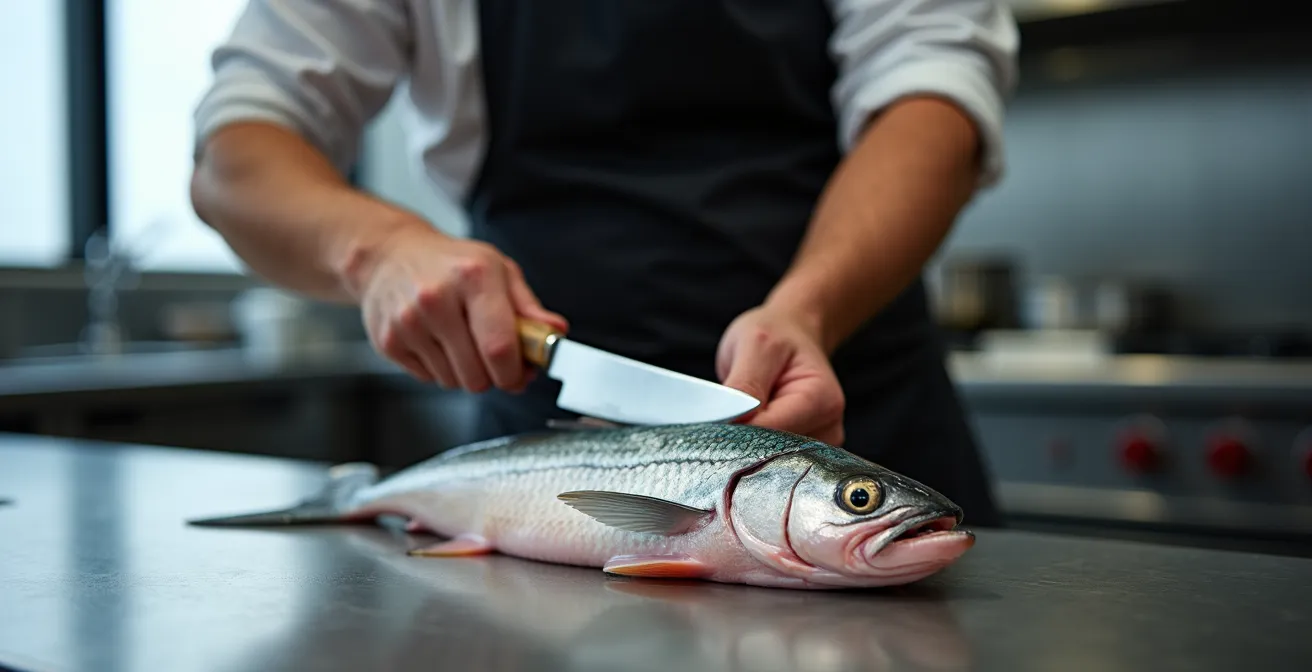
The rise of modern Inuit cuisine in Canada is not just a food trend; it’s a masterclass in systemic innovation and cultural resilience.
- Chefs are blending ancient knowledge with modern techniques to make “country food” safe, consistent, and accessible.
- This movement is driven by solving immense logistical challenges and creating new economic opportunities in the North.
Recommendation: To truly appreciate this culinary renaissance, look beyond the plate to the intricate systems of training, supply, and creativity that make it possible.
For the curious culinary traveler, the Canadian North has long been a place of mystique, its traditional foods often framed as exotic, extreme, or inaccessible. The narrative usually stops at lists of ingredients like seal, caribou, and maqtaaq, painting a picture of a static culinary history. This vision, however, misses the most exciting story in Canadian food today: a dynamic and sophisticated reinvention of Inuit cuisine, driven by a new generation of chefs, educators, and innovators.
This isn’t merely about putting old ingredients on new plates. It’s about building a sustainable and proud culinary future from the ground up. The real story lies not in the “what,” but in the “how.” How are ancient tools like the ulu finding a place in professional kitchens? How are chefs creating “accessible authenticity” through fusion dishes that welcome newcomers? And most critically, how are they overcoming the monumental logistical hurdles of the Arctic to build a new definition of freshness and local sourcing?
The answer is a story of culinary sovereignty in action. It’s a movement that tackles food security, cultural transmission, and economic development all at once. This article explores the systems behind the sizzle, revealing the intricate dance of tradition and innovation that is putting modern Inuit food on the global map. We will deconstruct the techniques, the logistics, and the philosophies that are shaping a truly unique and resilient Canadian cuisine.
This guide delves into the key facets of this culinary movement. From the revival of traditional tools to the complex economics of food in the North, you’ll discover the innovation happening both on the land and in the kitchen.
Summary: The Reinvention of Traditional Inuit Food
- The Ulu Knife: How Modern Chefs Are Utilizing Ancient Tools in Professional Kitchens?
- Arctic Tacos: How Fusion Cuisine Is Making Country Food Accessible to Tourists?
- The Logistics of Freshness: How Do Chefs in Nunavut Get Fresh Vegetables?
- Culinary Schools in the North: Where Are the New Inuit Chefs Being Trained?
- Fermented Walrus: How Chefs Are Making High-Risk Traditional Foods Safe for Menus?
- Kensington Market: How to Eat Your Way Through the World for Under $20 CAD?
- What Does Seal Meat Taste Like? Decoding the Iron-Rich Flavor Profile
- Hands-On Cooking: Where Can You Learn to Make Bannock or Tourtière in Canada?
The Ulu Knife: How Modern Chefs Are Utilizing Ancient Tools in Professional Kitchens?
The modernization of Inuit cuisine isn’t about abandoning the past; it’s about integrating it with precision and purpose. No tool embodies this philosophy more than the ulu, the traditional all-purpose knife used by Inuit women for centuries. Far from a museum piece, the ulu is experiencing a renaissance as a vital instrument in contemporary professional kitchens. Its unique curved blade and rocking motion offer unparalleled efficiency for tasks like mincing herbs, filleting fish, and thinly slicing frozen meats—techniques central to both traditional and modern preparations.
This revival is not accidental. It’s the result of a conscious effort of knowledge bridging, connecting the wisdom of elders with the formal training of a modern kitchen brigade. The most compelling evidence of this is happening within educational institutions. For instance, the culinary arts program at Nunavut Arctic College has formally incorporated the ulu into its curriculum. Here, proficiency with this ancient tool is not a quaint elective but a mandatory technical skill, ensuring that the next generation of Inuit chefs masters its use alongside classic French knife skills. This institutional support guarantees that traditional expertise is preserved, respected, and passed on in a professional setting.
This trend extends beyond the classroom and into the country’s most celebrated Indigenous restaurants. The fact that three prominent Indigenous chefs in Canada—Rich Francis, Shane Chartrand, and Christa Bruneau-Guenther—actively incorporate traditional tools into their contemporary cuisine demonstrates that this is a widespread and serious culinary movement. For these chefs, using an ulu is a declaration of identity and a testament to the enduring efficiency and relevance of ancestral technology in the demanding environment of a modern professional kitchen.
Arctic Tacos: How Fusion Cuisine Is Making Country Food Accessible to Tourists?
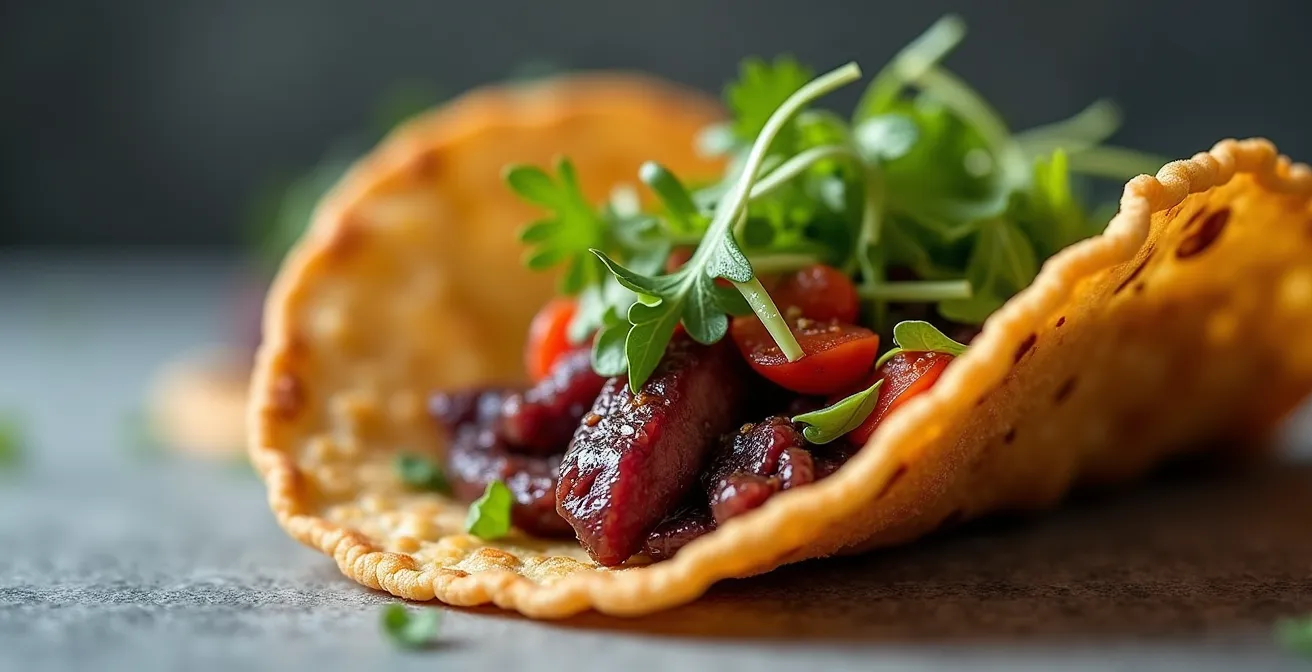
For many travelers, the idea of trying “country food” like seal or caribou can be intimidating. This is where the genius of fusion cuisine comes in, creating a welcoming bridge for curious palates. By presenting traditional ingredients in familiar formats, chefs are crafting a form of accessible authenticity. Perhaps the most brilliant example of this is the “Arctic taco,” which typically uses a piece of fluffy, fried bannock as a shell, filled with savoury meats like pulled caribou or seared seal. It’s a dish that is at once uniquely Northern and universally understood.
This approach masterfully demystifies country food, removing barriers of unfamiliarity without compromising the integrity of the core ingredients. The bannock taco, also known as an Indian taco, is a celebrated dish across many Indigenous nations in North America, but its Arctic iteration gives it a distinct terroir. Other examples of this creative blending are emerging across Canada, such as Arctic char sushi rolls that combine Japanese technique with Northern fish, or bison burgers served on wild rice buns. These dishes aren’t gimmicks; they are thoughtful culinary introductions.
As Malaya Qaunirq Chapman, host of the Nunavummi Mamarijavut cooking show, beautifully articulates, this movement is about genuine connection, not pretension.
We don’t need to use big fancy words and big fancy cooking methods to really showcase the beauty of where we come from.
– Malaya Qaunirq Chapman, Host of Nunavummi Mamarijavut cooking show
This philosophy is key. The goal isn’t to disguise the food, but to present it in a way that invites conversation and enjoyment. A taco is a friendly handshake, an invitation to taste the true flavours of the North in a form that feels both exciting and comfortable.
The Logistics of Freshness: How Do Chefs in Nunavut Get Fresh Vegetables?
In the south, “fresh and local” is a lifestyle choice. In Nunavut, it’s a monumental challenge that requires true logistical artistry. The short growing season and permafrost make conventional agriculture nearly impossible, meaning most fresh produce must be flown in at exorbitant costs. This reality is set against a backdrop of widespread food insecurity; a 2014 report revealed that nearly 70% of all households in Nunavut struggle to obtain nutritious and affordable food. This context elevates the work of local chefs from a culinary pursuit to an act of community resilience.
So, how do they get “fresh” ingredients? The answer is a multi-pronged strategy. First, there’s a growing movement towards innovative local solutions like community greenhouses and hydroponic container farms, which can provide a limited but vital supply of greens and vegetables year-round. Second, chefs are redefining “fresh” by embracing the terroir of the tundra. They are masters of foraging, harvesting wild edibles like Arctic sorrel, tundra berries, and mountain avens during the brief summer and preserving them for winter. This is not just about survival; it’s about capturing the unique, subtle flavours of the land.
Finally, they navigate the complex and expensive supply chain for imported goods. The staggering cost difference between imported foods and locally harvested country food is a major economic driver behind the modern Inuit culinary movement, as it creates a powerful incentive to rely on the land. The following table illustrates the harsh economic reality of food access in the Arctic.
| Food Type | Cost | Availability | Nutritional Value |
|---|---|---|---|
| Country Food (seal, caribou) | Hunting costs only | Seasonal, weather-dependent | High protein, vitamins, omega-3 |
| Imported hamburger | $30 CAD | Year-round if flown in | Standard protein |
| Milk | $10/gallon | Limited, requires air transport | Calcium, vitamin D |
| Coffee | $7/cup | Imported only | Minimal |
This constant negotiation between foraging, innovative farming, and costly imports is where modern Inuit chefs truly shine. They are not just cooks; they are supply chain managers, foragers, and community providers, creating exceptional food against incredible odds.
Culinary Schools in the North: Where Are the New Inuit Chefs Being Trained?
A culinary movement cannot sustain itself without a system for passing on knowledge. While the land remains the ultimate classroom for traditional hunting and preparation skills, a new wave of formal and informal culinary education is empowering the next generation of Inuit chefs. This is where the critical work of knowledge bridging happens, combining ancestral wisdom with contemporary culinary arts to create a powerful, modern skill set.
Formal institutions like the previously mentioned Nunavut Arctic College provide a structured environment where students learn everything from classic cooking techniques to food safety and business management, all while integrating traditional elements. However, the education of a Northern chef extends far beyond the four walls of a classroom. The most influential educators are often community leaders and media personalities who bring the love of country food to a wider audience, inspiring young people to see a future in the kitchen.
Case Study: Rebecca Veevee, “The Laughing Chef”
A shining example of this educational impact is Ooleepeeka (Rebecca) Veevee, known across Nunavut as “The Laughing Chef.” Since 2009, her Inuktitut-language cooking show, ‘Niqitsiat,’ has been a cornerstone of the Inuit Broadcasting Corporation. By demonstrating how to make creative dishes like caribou pizza and seal pie, she makes cooking country food feel modern, fun, and accessible. Her work, which earned her the Governor General’s Meritorious Service Award in 2015, goes beyond recipes; it’s about instilling pride and mentoring a new generation, showing them that their food culture has a vibrant place in the modern world.
These efforts are crucial. They create visible role models and demonstrate that a career in the culinary arts is not only viable in the North but is also a powerful way to preserve and celebrate Inuit culture. By combining formal training with the mentorship of cultural ambassadors like Rebecca Veevee, a new cohort of chefs is being equipped to lead the evolution of their cuisine, ensuring its techniques and traditions don’t just survive, but thrive.
Fermented Walrus: How Chefs Are Making High-Risk Traditional Foods Safe for Menus?
Fermentation is an ancient preservation technique used by cultures worldwide, and in the Arctic, it has been essential for survival. Foods like fermented walrus or seal have been a part of the Inuit diet for millennia. However, these preparations carry inherent risks, including botulism, that make them challenging to serve in a commercial restaurant setting. For modern Inuit cuisine to grow, chefs must tackle this challenge head-on: how to preserve the unique, umami-rich flavours of traditional fermented foods while ensuring they are 100% safe for all consumers.
The answer lies in a meticulous blend of traditional knowledge and modern science. Chefs and community experts are working to deconstruct these age-old processes to understand the science behind them. This involves applying contemporary food safety protocols, such as precise temperature and pH control, to traditional methods. By creating controlled environments that mimic the beneficial microbial activity of fermentation while eliminating harmful pathogens, they can produce a consistent, safe, and delicious product. This is not about changing the food, but about mastering its environment.

This effort is supported by a growing body of scientific research. For example, a major International Polar Year project conducted from 2007-2008 involved a mobile health clinic that collected detailed dietary information from thousands of Inuit. This research helped establish crucial baseline data for traditional food safety. While it also highlighted risks, such as how the fatty tissues of marine mammals can concentrate pollutants due to biomagnification, this scientific understanding is precisely what allows for a modern, risk-aware approach. The knowledge from studies like the one on the changing landscape of Arctic traditional food is empowering chefs to navigate these complexities responsibly. By respecting tradition and embracing science, they are unlocking some of the most profound flavours of the North for a new audience.
Kensington Market: How to Eat Your Way Through the World for Under $20 CAD?
The title of this section might seem out of place. Toronto’s bustling Kensington Market is a world away from the vast tundra of Nunavut. However, this contrast is precisely the point. Kensington Market is a microcosm of Canada’s multicultural food scene, where you can find ingredients from across the globe. Yet, finding authentic Arctic country food here is a significant challenge, highlighting a critical disconnect between Canada’s North and its urban South.
While a determined foodie might find specialty shops with frozen Arctic char, staples of the Inuit diet like maqtaaq (narwhal or beluga skin and blubber) or seal meat are virtually nonexistent. They are not part of the commercial supply chain that feeds cities like Toronto. This isn’t just about logistics; it’s about cultural and legal barriers. The trade of marine mammal products is highly regulated, and the primary distribution network for country food remains traditional sharing within and between Northern communities.
This urban scarcity makes the price and availability of what little Arctic food does make it south a point of intense interest. For a culinary traveler, understanding this contrast is key to appreciating the value and context of the food when experienced in the North. The following table compares the approximate costs and availability of these foods in a major southern market versus their home territory.
| Food Item | Kensington Market (Toronto) | Iqaluit Supermarket | Available at Northern Markets |
|---|---|---|---|
| Arctic Char (frozen) | $15-20/lb | $25-30/lb | Yes – Kitikmeot Arctic Foods |
| Caribou meat | Specialty order | When available | Kivalliq Arctic Foods ‘Country Food Pak’ |
| Narwhal/Beluga maqtaaq | Not available | Local markets only | Seasonal at community markets |
| Seal meat | Rare specialty shops | Community sources | Traditional sharing networks |
This comparison reveals a powerful truth: authentic Inuit cuisine is, for the most part, a cuisine of place. Its heart and soul are in the North, and its presence in the south is more of a whisper than a shout. The challenge for the modern Inuit food movement is to bridge this divide, creating a market and an appreciation for these foods far from their origin.
What Does Seal Meat Taste Like? Decoding the Iron-Rich Flavor Profile
Of all the ingredients in the Inuit culinary pantry, none is more central, or more misunderstood, than seal. For the uninitiated, the question looms large: what does it actually taste like? Describing the flavour of seal is complex because it is unlike any common terrestrial meat. It is a dark, dense red meat, exceptionally rich in iron and healthy omega-3 fatty acids, which gives it a distinct flavour profile that is often compared to a combination of beef liver and a mild, non-oily fish.
First-hand accounts vary widely, reflecting different preparation methods and personal palates. One visitor to the North described raw seal liver as being “faintly fishy and tastes a lot like raw oysters on the half shell,” a delicate and oceanic experience. In contrast, rendered seal oil can be much more potent, with one taster noting it was “somewhat like very strong blue cheese with a fishy aftertaste.” This intensity is why it’s often used as a flavourful condiment for dried meats rather than eaten on its own. The taste is undeniably an acquired one, but for those who grow up with it, it’s the taste of home.
Beyond its complex flavour, seal meat holds a deep cultural and physiological significance. It’s a food built for the Arctic environment, providing an incredible density of nutrients and calories needed to stay warm and energetic. This functional aspect is inseparable from the experience of eating it, as one Inuit elder explained:
When one eats seal, you are full all day. When you eat packaged foods, two hours later you get cold. If [you] eat Inuit food, you stay warm.
– Inuit Elder, The Changing Landscape of Arctic Traditional Food – PMC
Ultimately, seal meat tastes of the Arctic itself: iron-rich, deeply savoury, and connected to the sea. Modern chefs are exploring ways to present this flavour in more approachable ways, such as searing it quickly to preserve its tenderness or braising it slowly in stews to soften its intensity. By doing so, they invite diners to experience not just a new flavour, but a food that has sustained a people for millennia.
Key takeaways
- Modern Inuit cuisine is a system of innovation, not just a collection of recipes, focusing on logistics, safety, and training.
- Fusion dishes like “Arctic tacos” are a deliberate strategy to make traditional flavours accessible to new audiences.
- The movement is deeply connected to food sovereignty and solving the real-world challenge of food insecurity in the Canadian North.
Hands-On Cooking: Where Can You Learn to Make Bannock or Tourtière in Canada?
While the title asks about bannock and tourtière—a French-Canadian dish—the most exciting hands-on culinary experiences for a traveler in Canada today are found by focusing on the vibrant Inuit food scene. For the adventurous foodie, the question isn’t just “where can I eat this?” but “how can I experience this?” Learning about this cuisine is less about formal cooking classes and more about immersing yourself in the culture of food in the North. It’s an experience built on community, observation, and participation.
The most direct way to experience the cuisine is to travel to Nunavut and engage with the local food culture. This can mean visiting restaurants in Iqaluit that proudly feature country food, exploring Canada’s northernmost brewery, or shopping at specialty stores for unique products like candied Arctic char. However, the most profound learning often happens in less formal settings. In many communities, it is common for families to host feasts and invite neighbours and even strangers to share a meal. These community feasts are the living classrooms of Inuit cuisine, where traditional preparation methods for dishes like pipsi (sun-dried Arctic char) are passed down through observation and participation.
Participating in these experiences provides a much deeper understanding than any recipe book could. It connects you to the people, the land, and the traditions that give the food its meaning. For any culinary traveler serious about understanding modern Inuit cuisine, the journey North is an essential pilgrimage. The following checklist provides a practical starting point for planning such an immersive experience.
Your Action Plan: Experiencing Modern Inuit Cuisine
- Dine at the Source: Visit Iqaluit restaurants like The Frobisher Inn’s restaurant or the Asqarniit Lounge to try chef-prepared Arctic char and caribou.
- Explore Local Producers: Seek out specialty shops like Kitikmeot Arctic Foods in Cambridge Bay for unique products like jerky and candied fish to take home.
- Visit Community Markets: Check schedules for local markets where you might find seasonal delicacies like maqtaaq, sold directly by hunters.
- Taste Northern Brews: Stop by the Nunavut Brewing Company in Iqaluit to sample locally made ales and see how a modern craft industry is taking root.
- Order a Taste of the North: For a comprehensive sample, consider ordering a ‘Country Food Pak’ from a supplier like Kivalliq Arctic Foods in Rankin Inlet.
To put these lessons into practice, the next logical step is to plan a trip and support the local restaurants, producers, and communities that are the heart of this incredible culinary renaissance.
Frequently Asked Questions on Modern Inuit Cuisine: How Chefs Are Reinventing Traditional Country Food?
Which seal types are most commonly eaten?
Ringed seals are the most prevalent part of an Inuk hunter’s diet and are hunted year-round. Harp seals are typically available only in the summer months. Bearded seals also play a crucial role in the traditional diet.
How is seal traditionally prepared?
Seal meat is incredibly versatile. It can be eaten raw, frozen (a delicacy often thinly sliced), dried into jerky, or cooked slowly in rich stews. The blubber, or fat, is also a key component, often eaten raw, sometimes with modern condiments like soy sauce or sriracha to complement its richness.
What makes seal meat nutritionally valuable?
Seal is a nutritional powerhouse perfectly adapted for the Arctic climate. It is extremely high in protein, iron, and vital omega-3 fatty acids. It is also a surprisingly good source of vitamin C, which is scarce in other Arctic food sources. The fat provides essential, slow-burning calories for warmth and energy.