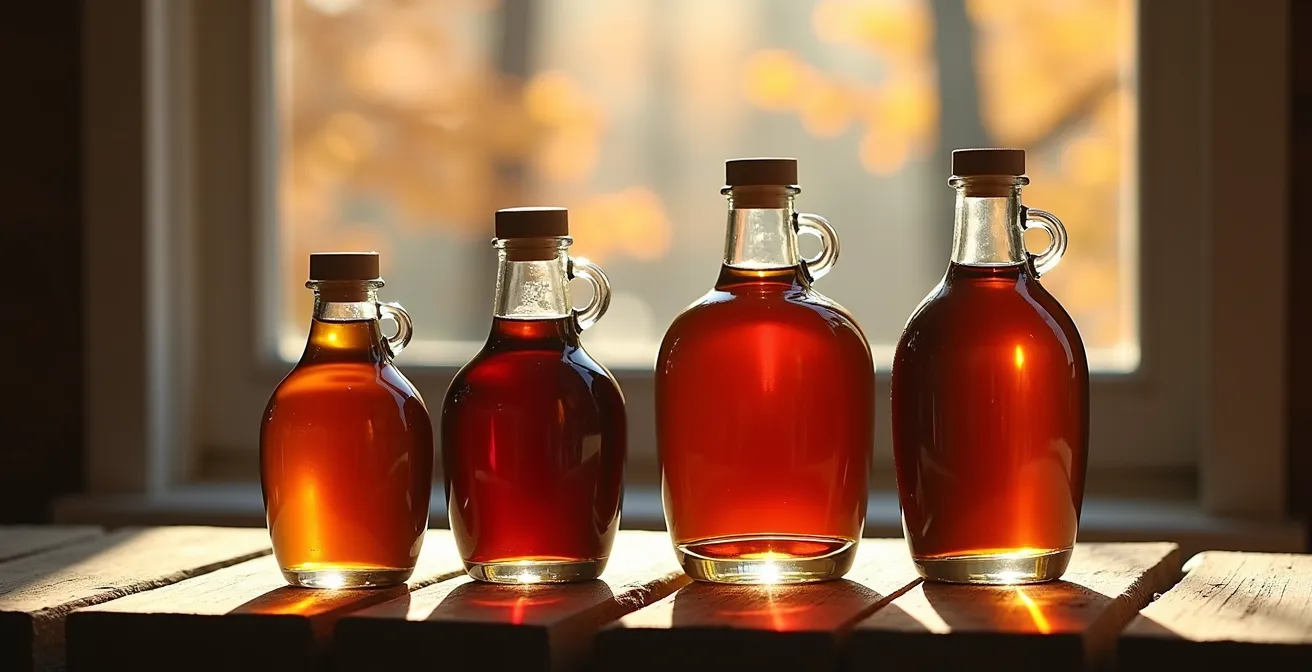
The colour on a maple syrup label isn’t a measure of quality; it’s a direct snapshot of when the sap was harvested during the brief Canadian spring.
- Early-season harvests yield Golden and Amber syrups with delicate, lighter flavours.
- Late-season harvests produce Dark and Very Dark syrups with robust, complex profiles ideal for cooking.
Recommendation: Think like a wine sommelier. Match the syrup’s seasonal character to your dish—delicate for drizzling, robust for bold flavour architecture.
You’re standing in the grocery aisle, a wall of Canadian maple syrup before you. Golden, Amber, Dark, Very Dark—the labels are a spectrum of liquid sunshine, but the choice feels anything but clear. For years, the conventional wisdom was a confusing mix of “Grade A” versus a supposedly inferior “Grade B,” leaving consumers to wonder if they were buying the “best” product. That old system is gone, replaced by a new one that classifies everything as Grade A, but the core confusion remains: what is the actual difference, and which one should you bring home?
The secret doesn’t lie in a hierarchy of quality. In truth, all pure maple syrup is a premium product. The key is to stop thinking about “better” or “worse” and start thinking like a sommelier. The colour and taste of maple syrup are not arbitrary; they are a direct gustatory reflection of the Canadian forest’s brief, magical awakening. Each grade tells a story about a specific moment in the short harvest season, a concept we can call the “seasonal snapshot.”
This guide will help you decode that story. We will explore the fleeting natural phenomenon that makes syrup possible and demystify the grading system by linking it to flavour, not quality. We’ll cover the practicalities of storage and baking, the logistics of travelling with this liquid gold, and even touch on how a changing climate impacts this iconic Canadian treasure. By the end, you won’t just be buying a sweetener; you’ll be selecting the perfect expression of the sugarbush terroir for your palate and your plate.
To help you navigate this delicious world, this article breaks down everything you need to know. From the science of the sap run to the art of choosing the right bottle, you’ll find clear answers to guide your next purchase and deepen your appreciation for Canada’s signature product.
Summary: A Connoisseur’s Journey Through Canadian Maple Syrup
- The Freeze-Thaw Cycle: Why Does Sap Only Run for a Few Weeks in Spring?
- Why “Grade A” Doesn’t Mean “Better”: Decoding the Flavor Profiles
- Fridge or Cupboard: How to Stop Mold from Growing on Your Open Syrup?
- Baking with Maple: How to Adjust Recipes When Swapping White Sugar for Syrup?
- Cans vs. Glass: Which Packaging Travels Best in Your Luggage?
- Receding Ice: How Much Has the Athabasca Glacier Shrunk in 10 Years?
- Can You Bring Food into Canada? Understanding CFIA Restrictions
- Tapping the Trees: Can Tourists Participate in the Actual Maple Harvest?
The Freeze-Thaw Cycle: Why Does Sap Only Run for a Few Weeks in Spring?
The production of maple syrup is a fleeting miracle of nature, dictated by a precise and delicate climatic dance. It’s not a year-round process; the entire harvest is captured in a remarkably short window. According to Quebec Maple Syrup Producers, the entire year’s production happens in only 20 to 25 days. This is all thanks to the “freeze-thaw cycle,” a phenomenon unique to late winter and early spring in North America’s “Maple Belt.” During this period, the weather must follow a specific pattern: nighttime temperatures need to drop below freezing (0°C), and daytime temperatures must rise above it.
This oscillation creates a natural pump system inside the maple tree. At night, the cold causes the tree’s fibres to contract and suction water up from the roots. As the sun warms the tree during the day, the internal pressure builds, pushing the slightly sweet sap out through any opening—including the taps installed by syrup producers. This pressure is what causes the sap to “run.”
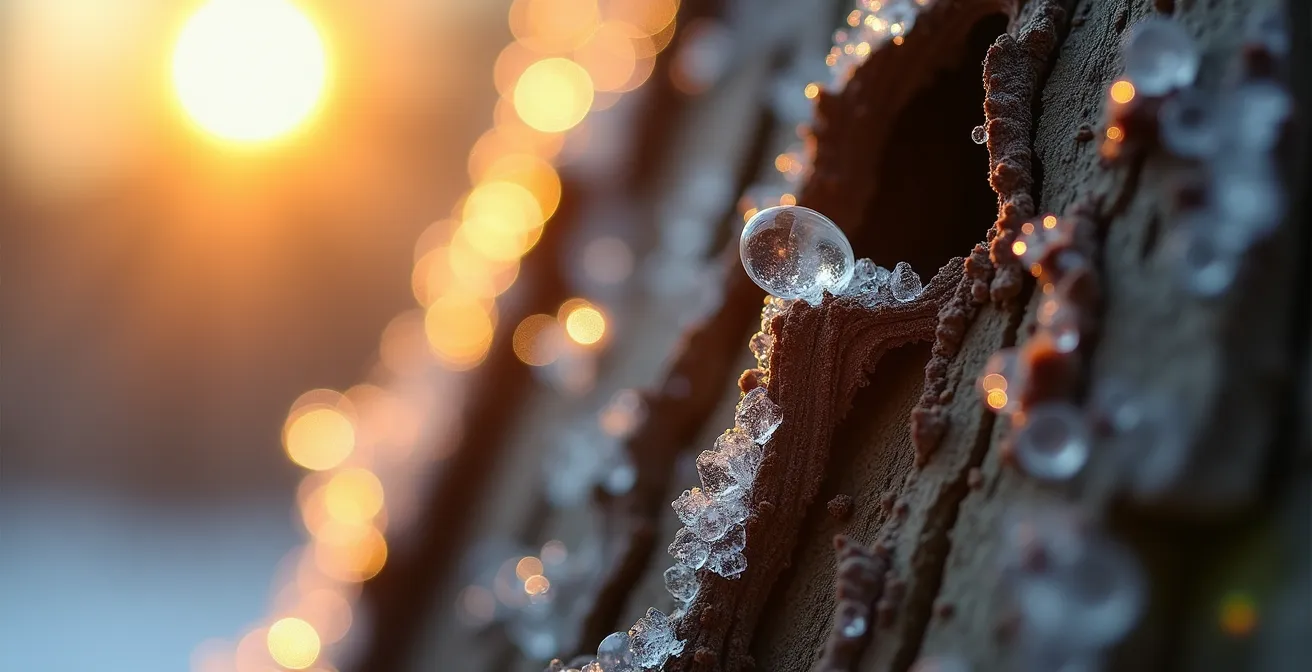
As you can see in the delicate melting of ice on the bark, this is a moment of transition. Once the nights no longer freeze or once the tree begins to bud, the pressure mechanism ceases, and the chemical composition of the sap changes, making it unsuitable for syrup. This is why the harvest is a frantic, weather-dependent race against time. It’s this very urgency and dependency on a perfect climate balance that makes pure maple syrup a true seasonal treasure, a captured essence of the Canadian spring.
Why “Grade A” Doesn’t Mean “Better”: Decoding the Flavor Profiles
One of the biggest sources of confusion for consumers is the grading system. In the past, you might have seen “Grade B” syrup, which many incorrectly assumed meant it was of lower quality. To eliminate this confusion, Canadian and U.S. producers worked together to harmonize the system. The result, as explained by The Canadian Encyclopedia, is that now all syrup sold to consumers is designated Grade A. This strategic shift ensures that the product is recognized for its purity, not ranked by a misleading letter. The difference between the bottles you see on the shelf—Golden, Amber, Dark, and Very Dark—is not one of quality but of flavour and colour.
This variation is a direct result of the “seasonal snapshot” concept. Syrup made from sap collected at the beginning of the short harvest season is lighter in colour and more delicate in taste. As the season progresses and the weather warms, the sap’s chemistry changes. This results in syrup that is progressively darker and more robust in flavour. Think of it like a photograph’s exposure: the longer the season runs, the deeper and more intense the resulting image—or in this case, taste—becomes.
To help you choose, this distinction is officially outlined in Canada’s grading system. The following table breaks down the flavour architecture of each grade, helping you select the perfect syrup for your culinary needs. As detailed in resources like The Canadian Encyclopedia’s profile on the industry, each grade has a distinct and valuable role.
| Grade | Color | Taste Profile | Best Uses |
|---|---|---|---|
| Golden | Light golden | Delicate taste | Drizzling, yogurt, cocktails |
| Amber | Rich amber | Rich taste | Pancakes, waffles, oatmeal |
| Dark | Dark brown | Robust taste | Baking, glazes, marinades |
| Very Dark | Very dark brown | Strong taste | Commercial cooking, meat glazes |
Fridge or Cupboard: How to Stop Mold from Growing on Your Open Syrup?
You’ve brought home a beautiful bottle or can of pure Canadian maple syrup. Before you open it, storage is simple: a cool, dark cupboard is perfect, where it can last for years. However, the moment you break that seal, the rules change completely. Unlike fake “pancake syrups,” which are loaded with preservatives, pure maple syrup is a natural product. Its high sugar content (around 66% Brix) is a preservative, but it’s not enough to prevent mold from growing once exposed to air. Storing an opened container in the cupboard is a recipe for a fuzzy, heartbreaking discovery.
To preserve its flavour and safety, opened maple syrup must be refrigerated. This slows down the potential for mold growth and maintains its quality. If you’ve purchased your syrup in a traditional metal can, the first step is crucial: transfer it immediately into a clean, airtight glass container. Storing it in the opened can is not recommended, as it can impart a metallic taste over time.
For those who buy in bulk during sugaring season, many Canadian households use a time-honoured trick: freezing. Due to its high sugar concentration, maple syrup won’t freeze solid. It simply becomes extremely thick, allowing you to scoop out what you need and return the rest to the freezer. This method preserves the peak flavour of the syrup for a year or more, making it an excellent long-term storage solution.
Your Action Plan: Perfect Maple Syrup Preservation
- Transfer syrup from opened metal cans into airtight glass jars immediately.
- Store all opened maple syrup in the refrigerator, ideally between 2-4°C.
- For long-term storage of large quantities, place the airtight container in the freezer; it will remain viscous but not solid.
- Keep any unopened containers in a cool, dark cupboard away from light and heat.
- For the best taste and quality, aim to use your refrigerated syrup within 12 months of opening.
Baking with Maple: How to Adjust Recipes When Swapping White Sugar for Syrup?
Using maple syrup as a substitute for white sugar in baking is a fantastic way to introduce nuanced flavour into your creations. However, it’s not a simple one-to-one swap. Because syrup is a liquid and has a different chemical composition, you need to make a few adjustments to your recipe to achieve the right texture and consistency. The general rule is to use about 3/4 cup of maple syrup for every 1 cup of granulated sugar called for in the recipe.
Since you’re adding a liquid, you must also reduce the other main liquids in your recipe (like milk, water, or oil) by approximately 3 tablespoons for every cup of maple syrup used. Maple syrup also browns faster than sugar due to its natural sugars caramelizing. To prevent your baked goods from burning on the outside before they are cooked on the inside, it’s wise to lower your oven temperature by about 25°F (around 15°C). The unique flavour of maple syrup comes from the Maillard reaction between amino acids and sugars during the boiling process, and that reaction continues in your oven, creating a wonderful depth.
For baking, the grade you choose matters immensely. While Golden or Amber syrups are lovely, their delicate notes can get lost. To ensure that distinct maple character shines through, opt for Dark or Very Dark syrup. Their robust, more complex flavour architecture is strong enough to stand up to the other ingredients and the heat of the oven, imparting a rich, caramel-like dimension to your final product.
- Replace Sugar: Use 3/4 cup of maple syrup for 1 cup of white sugar.
- Reduce Liquid: Decrease other liquids by 3 tablespoons per cup of syrup added.
- Lower Temperature: Reduce oven temperature by 25°F (15°C).
- Neutralize Acidity: Add 1/4 teaspoon of baking soda per cup of syrup if the recipe is sensitive to acidity (this is often optional).
- Choose Grade: Use Dark or Very Dark grades for the most pronounced maple flavour.
Cans vs. Glass: Which Packaging Travels Best in Your Luggage?
If you’re visiting Canada and want to bring home maple syrup as a souvenir or gift, you’ll face one final choice in the store: a traditional metal can or an elegant glass bottle? The decision depends on a balance of practicality, aesthetics, and your travel plans. For travelers, especially those flying, the packaging can make a significant difference.
Metal cans are the quintessential sugar shack packaging. They are lighter and far more durable than glass, making them the superior choice for packing in checked luggage. There is virtually no risk of a can breaking and creating a sticky catastrophe in your suitcase. They are also typically more economical, allowing you to buy more syrup for your money. The only downside is that once opened, the syrup must be transferred to a separate container for storage.
Glass bottles, on the other hand, offer a beautiful presentation. They look premium, make for a more refined gift, and allow you to see the gorgeous colour of the syrup inside. They also have the advantage of being a ready-to-use storage container. However, they are heavier and extremely fragile. If you choose to travel with a glass bottle, it must be wrapped with extreme care and cushioned well within your checked luggage. Never pack a container of syrup over 100ml in your carry-on luggage, as it will be confiscated at security.
To help you decide, here is a direct comparison of the two packaging types for a traveling connoisseur:
| Factor | Metal Cans | Glass Bottles |
|---|---|---|
| Durability | High – won’t break | Low – fragile in luggage |
| Weight | Lighter | Heavier |
| Authenticity | Traditional sugar shack feel | Premium gift presentation |
| Storage after opening | Must transfer to glass | Can store as-is |
| Price | More economical | Premium pricing |
Receding Ice: How Much Has the Athabasca Glacier Shrunk in 10 Years?
While a discussion about a receding glacier in Alberta might seem disconnected from Quebec’s sugarbushes, they are two sides of the same Canadian coin: iconic natural heritage sites threatened by a changing climate. The delicate freeze-thaw cycle required for maple sap to run is a finely tuned climatic event. As global temperatures rise, this balance is being disrupted, posing a direct threat to the future of maple syrup production.
The shrinking of the Athabasca Glacier is a dramatic, visible symbol of the warming trend affecting the entire country. This same warming is felt in the eastern forests. Studies and producer observations show that climate change is impacting maple syrup production, causing the harvest season to shift progressively earlier in the year. Warmer winters mean the freeze-thaw window is less reliable, and increased summer heat can stress the maple trees, potentially reducing the sugar content of their sap in subsequent years.
This cross-Canada connection, from the melting icefields of the Rockies to the struggling maple forests of the East, highlights a national challenge. The very things that make Canada a unique destination and producer are vulnerable. When you purchase a bottle of pure maple syrup, you are buying a product that is intrinsically linked to a stable, predictable climate. Its existence depends on cold nights and cool spring days—conditions that are becoming less certain. Appreciating maple syrup, therefore, also involves an appreciation for the fragile ecosystem that creates it.
Can You Bring Food into Canada? Understanding CFIA Restrictions
For visitors to Canada, the question is often not what you can bring in, but what you can take out. While the Canadian Food Inspection Agency (CFIA) has strict rules for importing food items to protect local agriculture, pure maple syrup is generally a straightforward item for tourists to handle. If you are entering Canada, commercially packaged maple syrup is typically permitted. However, for most travellers, the primary concern is getting their delicious souvenirs back home.
The good news is that most countries allow you to bring in commercially processed and packaged maple syrup for personal use. It is widely recognized as a safe, processed food product. In 2024, Canada exported 155.7 million pounds of maple syrup to over 70 countries, a testament to its global appeal and acceptance by customs agencies worldwide. However, you must always declare it. Honesty is the best policy at any border crossing.
To ensure a smooth journey home with your liquid gold, follow a few key steps. First, always pack containers larger than 100ml (3.4oz) in your checked luggage. Second, check your home country’s specific customs regulations for quantity limits; most allow for one or two litres per person without issue. Finally, it’s a good practice to keep your purchase receipts handy, as they can serve as proof of purchase and value for customs officials. By following these simple guidelines, you can be confident your maple syrup will arrive home safely, ready to be enjoyed.
- Check Home Country Rules: Before you buy, know your own country’s customs limits for food imports.
- Declare Everything: Always declare maple syrup on your customs form. It’s almost always accepted, but failing to declare it can cause problems.
- Pack in Checked Luggage: All containers over 100ml must go in your checked bags. Protect glass bottles carefully.
- Respect Quantity Limits: Most countries permit 1-2 litres for personal use, but verify this to be sure.
- Keep Your Receipts: Hold onto your receipts as proof of purchase for the customs declaration.
Key takeaways
- Maple syrup grades (Golden, Amber, Dark) reflect the harvest time, not quality. All are Grade A.
- Early season syrup (Golden/Amber) is delicate and best for direct use; late season syrup (Dark) is robust and ideal for baking.
- Always refrigerate maple syrup after opening to prevent mold. For long-term storage, freeze it.
Tapping the Trees: Can Tourists Participate in the Actual Maple Harvest?
After understanding the science, the grades, and the flavours of maple syrup, a deeper appreciation often leads to a desire to connect with its source. For many, this means wondering if it’s possible to go beyond the store shelf and experience the harvest firsthand. The answer is a resounding yes. Maple syrup tourism is a cherished tradition in Canada, particularly in Quebec, offering an immersive journey from tree to table.
The “sugaring season,” from late February to early April, is when hundreds of “cabanes à sucre” (sugar shacks) open their doors to visitors. These experiences range from rustic, family-run operations to larger establishments. While you might not be doing the labour-intensive work of a full-time producer, many sugar shacks offer tours where you can see the taps and pipelines, watch the evaporator boil sap into syrup, and, most importantly, taste the fresh product. A quintessential part of the experience is “tire sur la neige,” where hot syrup is poured onto fresh snow to create a delicious taffy.
For a richer cultural context, seek out Indigenous-led tourism experiences. The process of collecting sap and making syrup was first developed by Indigenous peoples of the Maple Belt, including the Anishinaabe, Haudenosaunee, and Mi’kmaq. Participating in a tour or festival that honours this history, such as those offered by organizations like the TRCA at their Sugarbush Maple Syrup Festival, provides a profound understanding of the deep cultural roots of this practice. Visiting a sugar shack transforms maple syrup from a simple commodity into a living, breathing cultural and culinary tradition.
For any food lover or curious traveller, planning a trip to a Canadian sugar shack is the ultimate way to complete your maple syrup education. It’s an opportunity to connect with the land, the people, and the history behind this iconic product, turning your appreciation into a lifelong passion.