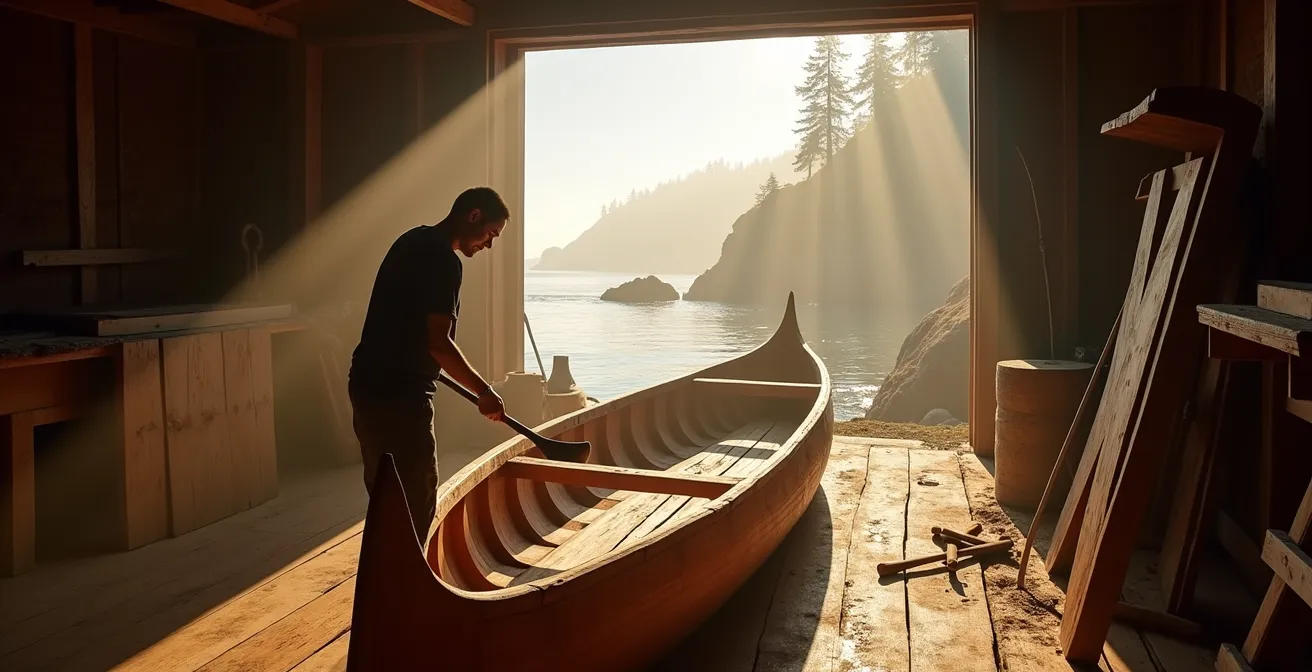
The West Coast dugout canoe is not a primitive craft; it is a pinnacle of naval engineering, perfectly optimized for the demanding waters of the Pacific Ocean.
- Indigenous builders employed a sophisticated understanding of thermodynamics, using steam and hot water to shape a hull wider than the original log.
- The iconic high prow was a masterful hydrodynamic feature, designed to cut through waves, provide buoyancy, and keep the crew dry.
Recommendation: To truly appreciate these vessels, one must view them not as static artifacts, but as enduring lessons in sustainable, purpose-driven design.
To a modern observer, the idea of crossing a treacherous stretch of open ocean in a vessel carved from a single log seems almost impossible. It evokes a primal image of brute force against wood. We might know that the Indigenous peoples of Canada’s Pacific Northwest created magnificent cedar dugout canoes, but our understanding often stops at a vague notion of “hollowing it out with fire and tools.” This simple view, however, misses the profound engineering genius at the heart of their construction. These canoes were not merely dug out; they were sculpted, engineered, and optimized with a level of sophistication that rivals modern naval architecture principles.
From the perspective of a naval architect, the creation of a West Coast canoe is a masterclass in material science, thermodynamics, and hydrodynamics. The builders were not just artisans; they were engineers who possessed an intuitive, multi-generational knowledge of their materials and environment. They understood how to select the perfect tree, how to release the tension in its wood grain, and how to permanently reshape it into a complex, compound-curved structure. But what if the true key to their success wasn’t just the removal of wood, but the masterful addition of heat, water, and pressure? This article will deconstruct the engineering principles behind these vessels, moving beyond the artifact to reveal the living science within the cedar.
We will examine the specific properties that made cedar the ideal material, the ingenious thermodynamic process used to widen the hull, the hydrodynamic function of the iconic prow, and the complex systems of navigation and coordination that brought these vessels to life. Prepare to see the dugout canoe not as a relic, but as a triumph of engineering.
Summary: The Engineering Genius of Cedar Canoes
- Softwood Properties: Why Is Cedar Easier to Carve Than Oak or Maple?
- Spreading the Hull: How Does Steam and Water Widen the Canoe?
- The Prow Design: Why Do West Coast Canoes Have High, Overhanging Bows?
- The Rule of Twelfths: How to Calculate Safe Crossing Windows?
- Do You Need a Pleasure Craft Operator Card to Rent a Boat in Ontario?
- Oil and Moss: How Were Traditional Canoes Waterproofed and Repaired?
- Team Coordination: How Do Pullers Synchronize in a 30-Foot Canoe?
- Tribal Journeys: What Is the Significance of the Annual Canoe Resurgence?
Softwood Properties: Why Is Cedar Easier to Carve Than Oak or Maple?
The choice of Western Red Cedar by First Nations builders was not one of mere convenience; it was a calculated engineering decision based on the wood’s unique material properties. Unlike hardwoods such as oak or maple, which have dense, interlocked cellular structures, cedar has a remarkably straight and uniform grain. This consistency means it splits predictably and can be worked with relative ease using tools like the adze. The wood’s low density makes the final vessel lighter and more buoyant, a critical factor for a human-powered craft. This was a material born for the water.
Furthermore, cedar contains high concentrations of natural oils, primarily thujaplicin. These compounds act as powerful fungicides, giving the wood an exceptional resistance to rot and decay in the damp Pacific Northwest climate—a form of built-in naval-grade protection. The sheer scale of these trees also played a crucial role. Historical accounts note that the largest known red cedar measures an incredible 178 feet high and almost 20 feet in diameter, providing the necessary raw material for massive, single-piece hulls. It is this perfect combination of carvability, natural durability, low density, and immense size that made cedar the undisputed optimal material for these ambitious naval projects.
Spreading the Hull: How Does Steam and Water Widen the Canoe?
The most profound engineering step in creating a dugout canoe is arguably the widening of the hull. A common misconception is that the canoe’s width, or beam, is limited by the diameter of the log. The reality is a brilliant application of thermodynamic engineering. After the initial hollowing, the hull was a thick-walled trough. Builders would fill it with water and introduce red-hot rocks, bringing the water to a boil. This process effectively turned the entire canoe hull into a steam chamber, a technique that requires immense control.
This is where the material science of cedar comes into play. The combination of heat and moisture softens the wood’s lignin, the natural polymer that binds cellulose fibers together, making the structure temporarily pliable. Expert research shows that steaming wood at precisely 100°C (212°F) for about one hour per inch of thickness achieves maximum plasticity. Indigenous engineers mastered this balance intuitively. Once the wood was softened, they would insert a series of thwarts—wooden spreaders—between the gunwales. These were gradually forced into place, stretching the pliable hull outwards and creating a wide, stable beam far exceeding the log’s original width. This controlled plastic deformation is what transformed a narrow log shape into a stable, seaworthy vessel with significant cargo capacity.

As you can see, the process is one of immense precision. Too little heat and the wood cracks; too much, and its structural integrity is compromised. Once the desired shape was achieved, the canoe was allowed to cool and dry, locking the lignin and cellulose fibers into their new, wider form. This was not just carving; it was a sophisticated act of thermoforming, transforming the very nature of the wood.
The Prow Design: Why Do West Coast Canoes Have High, Overhanging Bows?
The distinctive, soaring prow of a West Coast canoe is its most recognizable feature, often seen as a purely artistic or ceremonial element. From a naval architect’s viewpoint, however, this design is a masterstroke of hydrodynamic functionality. These canoes, especially the large Nuu-chah-nulth and Haida whaling and war canoes, were not meant for calm lakes; they were engineered for the powerful swells and turbulent waters of the North Pacific. The high, overhanging prow serves several critical functions in this hostile environment.
First, it provides essential buoyancy and lift when punching into an oncoming wave. Instead of the bow plunging underwater (a phenomenon known as “pearling”), the flared shape directs water away and allows the prow to rise over the wave, keeping the occupants and cargo dry. Second, the vertical “cutwater” at the front of the prow is sharp and deep, allowing the canoe to track straight in crosswinds and currents, providing crucial directional stability. This is particularly vital for vessels that historical records indicate ranged from 35 to 65 feet in length. Finally, the high profile acted as a “splash-guard,” providing a surprising degree of protection from spray. This elegant form is the perfect synthesis of function and beauty, a principle that all great naval design aspires to.
As the legendary Haida artist Bill Reid, a man who knew these vessels intimately, stated in the Victoria Times Colonist:
The Haida canoe is as beautifully designed and decorated an open boat as the world has ever seen.
– Bill Reid, Victoria Times Colonist
This was not decoration for its own sake, but the celebration of a form that had achieved functional perfection. The aesthetic beauty is a direct result of its hydrodynamic efficiency.
The Rule of Twelfths: How to Calculate Safe Crossing Windows?
Modern sailors rely on mathematical formulas like the Rule of Twelfths to estimate tidal flow and calculate safe passage. It’s a useful abstraction, breaking a six-hour tidal cycle into a neat, predictable sequence. But centuries before such tables existed, Indigenous mariners on the Pacific coast navigated the same treacherous waters using a far more holistic and sensory-based system. Their “rules” were not written in books but were read from the living world around them. They possessed an intuitive understanding of tides, currents, and weather that was a form of deep, experiential science.
This knowledge was critical for ambitious voyages, such as crossing the more than 80 treacherous kilometres of the Hecate Strait separating Haida Gwaii from the mainland. This was not a casual paddle; it was a calculated expedition requiring precise timing to avoid the strait’s notoriously violent currents and unpredictable weather. Navigators read the texture of the water’s surface, the patterns of ocean swells refracting around distant islands, and the flight paths of specific birds known to travel between landmasses. They used celestial bodies for orientation when out of sight of land, demonstrating that their dugout canoes were capable of traveling distances of over 500 km. This was a complete, integrated system of navigation that relied on total environmental awareness, not abstract calculation.
The steersman of a canoe was a living repository of this knowledge, able to predict how a current would shift and when a window of slack tide would open for a safe crossing. This was not guesswork; it was a highly developed skill, passed down through generations and honed by a lifetime of observation. It was, in its own way, a far more complex calculation than any simple rule of twelfths.
Do You Need a Pleasure Craft Operator Card to Rent a Boat in Ontario?
Today, operating even a small recreational boat in Canadian waters, such as in Ontario, legally requires a Pleasure Craft Operator Card (PCOC). This card certifies a basic knowledge of navigational rules and safety procedures—a modern, bureaucratic “license” to be on the water. For the builders and pullers of the great canoes, the ‘license’ to operate was of a different nature entirely. It was not a piece of plastic from the government but an unwritten contract earned through spiritual respect, community responsibility, and a deep understanding of the vessel itself.
The canoe was not seen as an inanimate object, but as a living entity with a spirit. The cedar tree from which it was born was honored before, during, and after the carving. This worldview created a profound sense of stewardship and responsibility that far exceeds the requirements of any modern licensing program. As Dennis Thomas (Whonoak) of Takaya Tours explains, this connection was fundamental to their survival and identity:
We always asked a lot of the cedar trees that were so important to our survival. So we honoured and we respected them, and we believed their spirits lived on in the canoe.
– Dennis Thomas (Whonoak), Takaya Tours
This belief system was the ultimate safety mechanism. When you believe the vessel you command has a spirit, you treat it with meticulous care. You learn its every nuance, you maintain it perfectly, and you never ask more of it than it can give. The “permission” to paddle was granted not by an exam, but by the elders and the community, who had to trust that you possessed the skill, respect, and knowledge to bring the canoe and its crew home safely.
Oil and Moss: How Were Traditional Canoes Waterproofed and Repaired?
A wooden vessel, no matter how well-built, is in a constant battle against water intrusion. The builders of cedar canoes developed a sophisticated and sustainable maintenance regimen that was both practical and ingenious, treating the canoe as a living vessel that needed regular care. The primary method of waterproofing was the application of eulachon oil. This oil, rendered from a small, energy-rich fish, has superb water-repellent properties. It was applied generously to the hull, soaking into the cedar fibers and creating a hydrophobic barrier that was renewed throughout the paddling season.
For sealing the small cracks and seams that might develop, they used another brilliant piece of bio-engineering: Sphagnum moss. This specific type of moss was used as a dynamic caulking. When dry, it could be packed tightly into crevices. When it got wet, the moss would swell, expanding to create a perfect, watertight seal that adapted to the hull’s flexing in the waves. In the event of more serious damage at sea, crews carried an emergency repair kit. This typically included pre-shaped wooden patches, small wedges, and a sealant made from heated spruce pitch. This system of proactive maintenance and reactive repair ensured the long-term integrity and safety of the vessel.
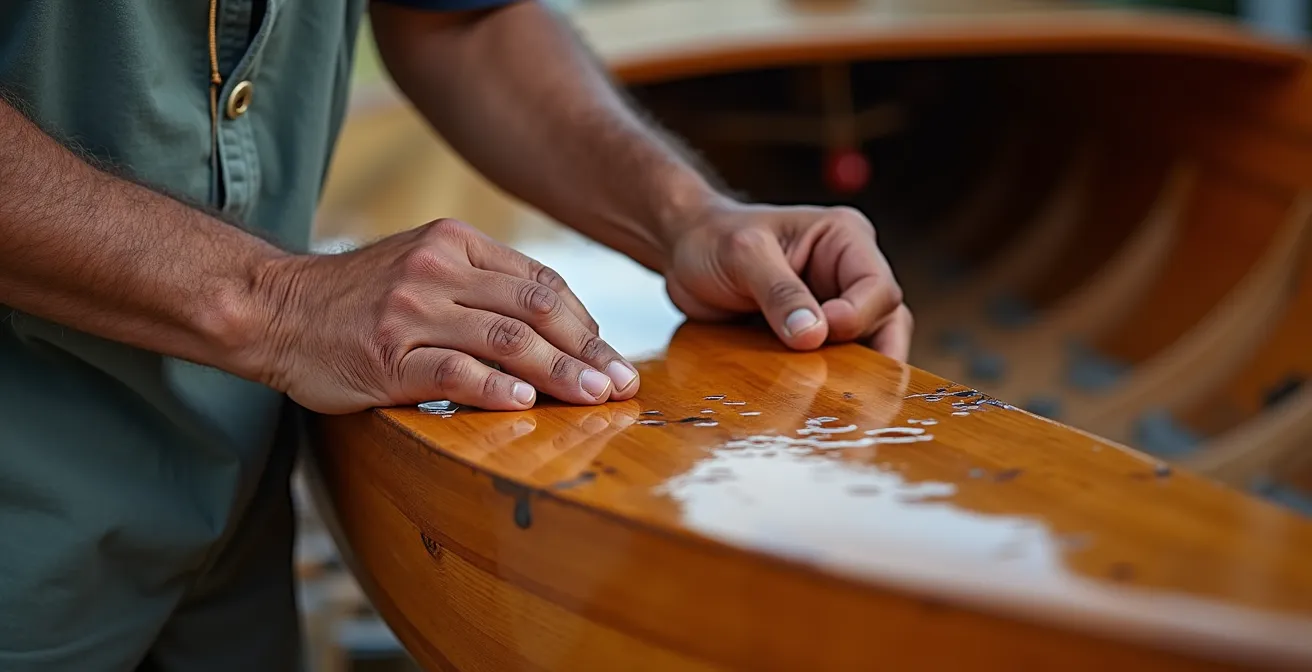
This cycle of care was a year-round commitment, a continuous dialogue between the crew and their canoe. It was a system that demonstrated a deep understanding of natural materials and their properties.
Your Action Plan: The Traditional Canoe Maintenance Cycle
- Spring Renewal: The process began in the spring by scraping the entire hull to remove old, gritty waterproofing and any marine growth from the previous season.
- Waterproofing Application: A fresh coat of eulachon oil was then meticulously applied, ensuring complete saturation of the outer wood fibers.
- Dynamic Caulking: Sphagnum moss was carefully inserted into any visible seams or joints, acting as a flexible sealant that would swell when wet.
- Emergency Preparedness: An emergency kit containing wooden patches, cedar wedges, and spruce pitch was always carried on board for at-sea repairs.
- Seasonal Upkeep: The canoe was re-oiled regularly throughout the paddling season to maintain the hydrophobic barrier and preserve the wood.
Team Coordination: How Do Pullers Synchronize in a 30-Foot Canoe?
A 30, 40, or even 60-foot canoe is a massive vessel, and its power plant is the synchronized effort of its human crew. Achieving perfect coordination among a dozen or more paddlers, known as “pullers,” is a complex challenge in biomechanics and communication. The solution developed by West Coast mariners was a highly structured system of roles and rhythmic calls, ensuring that every ounce of human energy was translated into efficient forward motion. This system turned the crew into a single, powerful engine.
The crew was not an undifferentiated group of paddlers. It was organized into specialized roles, each critical to the canoe’s performance:
- The Steersman, positioned at the stern, was the captain. They read the water, guided the canoe’s direction with a large steering paddle, and made the ultimate navigational decisions.
- The “engine room” consisted of the most powerful pullers, positioned in the middle of the canoe to provide the main propulsive force.
- The Bowman sat at the front, watching for hazards like rocks or floating logs and often setting the initial paddling pace.
- The Caller was the pacemaker. This individual used specific chants and songs, not just for morale, but as a crucial auditory signal. The cadence of the song set the rhythm for the paddle strokes, ensuring every puller entered and exited the water at the exact same moment.
This rhythmic synchronization, as shared by guides at Takaya Tours, is mesmerizing. The chants are not random; they are a functional tool for social and mechanical cohesion. This auditory cue eliminates the need for visual signals, allowing each puller to focus on their form and the water. The result is a smooth, powerful, and incredibly efficient application of force, allowing the canoe to maintain speed over long distances with minimal wasted energy. It’s a perfect example of human-powered ergonomic design.
Key Takeaways
- Cedar was the optimal material due to its straight grain, natural rot resistance, low density, and immense size.
- Indigenous engineers used steam and hot water to thermoform the hull, making it wider and more stable than the original log.
- The iconic high prow was a critical hydrodynamic feature for buoyancy, stability, and keeping the crew dry in ocean swells.
Tribal Journeys: What Is the Significance of the Annual Canoe Resurgence?
The great canoes are not relics confined to museums. They are living traditions, and nowhere is this more evident than in the annual Tribal Journeys. This modern resurgence is a powerful testament to the enduring cultural and engineering legacy of the canoe. What began in the 1980s as a way to revive and honour canoe culture has grown into a monumental event. Each summer, canoe families from across the Pacific Northwest paddle for weeks along their ancestral water highways, converging at a final host destination for a week of celebration and potlatch.
The event is a massive undertaking, with over 100 different First Nations from Canada and the United States participating. For the youth, it is a floating classroom. On the water, they learn the discipline, teamwork, and songs required to pull together. On land, they connect with elders, share protocols, and learn the stories and languages of their people. This is the ultimate experiential education, forging a direct link to the skills and values of their ancestors. The journeys are a statement of sovereignty, resilience, and cultural pride.
The revival of canoe carving itself is a cornerstone of this movement. In 2017, for instance, the Little Shuswap Indian Band in British Columbia carved its first new black cottonwood dugout in 60 years. The project became a focal point for the community, a place for elders to pass on knowledge and for youth to learn a tangible skill, reconnecting them to a core part of their heritage. The finished canoe is now a source of immense pride, displayed at the band’s Quaaout Lodge. This act of building is just as important as the act of paddling; it is the physical embodiment of cultural continuity.
By participating in or witnessing these journeys, one can see that the dugout canoe is more than a vessel; it is a vehicle for cultural revitalization, a symbol of engineering prowess, and a living connection to the past, present, and future of Pacific Northwest First Nations.