The short answer is no, but the real answer is more interesting: your trip’s quality doesn’t depend on French fluency, but on understanding a few key cultural signals.
- Using basic greetings in French acts as a “politeness signal,” immediately changing how you’re perceived.
- Local customs, from unique road signs to mealtime terms like “souper” for dinner, are easy to learn and show respect.
Recommendation: Focus less on language perfection and more on embracing these simple cultural codes to unlock a warmer, more authentic Montreal experience.
The thought of a weekend in Montreal conjures images of charming cobblestone streets, vibrant festivals, and delicious food. But for many English-speaking visitors, one question casts a shadow over the excitement: “Will I be okay without French?” This anxiety is common, fueled by stories of linguistic pride and the fear of appearing as a rude, unaccommodating tourist. The standard advice often feels generic: “learn a few words,” “people are bilingual,” or “just use a translation app.” While not wrong, this advice misses the heart of the matter.
The truth is, Montreal offers a unique linguistic duality that is far more nuanced. Navigating it successfully isn’t a test of your high school French. It’s about recognizing that language here is more than just communication; it’s a powerful cultural signal. The real key to a fantastic trip isn’t achieving fluency, but mastering a handful of specific cultural cues that demonstrate respect and awareness. It’s about shifting your mindset from a fear of making mistakes to an appreciation of the local culture.
This guide moves beyond the platitudes to decode the “why” behind Montreal’s linguistic landscape. We will explore the five simple words that act as a secret handshake, demystify the road signs and menu terms that trip up visitors, and show you where to find thriving anglophone culture. By the end, you won’t just feel prepared; you’ll feel like an insider, ready to engage with the city on its own, welcoming terms.
This article provides a complete roadmap for English-speaking tourists to feel confident and culturally aware in Montreal. The following sections break down everything from essential greetings to decoding local customs, ensuring you have a smooth and enjoyable visit.
Summary: A Cultural Guide to Navigating Montreal
- Bonjour and Merci: The 5 Words That Change How Locals Treat You
- Arrêt vs. Stop: Understanding Quebec’s Road Signs for Drivers
- Menu Anxiety: How to Order Food When the Menu Is Only in French?
- Why Is “Dinner” Called “Souper” in Quebec? Decoding Meal Times
- English Theatre in Montreal: Where to Find Anglophone Culture in a Francophone City?
- Navigating the Language Barrier: Where Is French Essential Outside of Quebec?
- Montreal Museum Secrets: Enjoying Culture Without a Language Barrier
- Old Montreal Tourist Traps: Which Restaurants Offer Authentic Quebec Cuisine?
Bonjour and Merci: The 5 Words That Change How Locals Treat You
The single most important thing to understand about Montreal is that attempting to speak French is not about necessity, but about respect. It’s a powerful politeness signal. When you walk into a shop or café and lead with “Bonjour,” you are not being tested on your pronunciation. You are acknowledging the city’s francophone identity. This small effort completely reframes the interaction. It says, “I see you, I respect your culture,” and it almost always elicits a warm, helpful response, often immediately in English.
The city’s workforce is incredibly bilingual. In fact, a recent analysis from Statistics Canada confirms that nearly 80% of Montreal workers are bilingual, if not multilingual. They can, and will, switch to English to help you. The initial “Bonjour” is simply the key that unlocks that willingness. Without it, a direct English greeting can sometimes be perceived as assuming that service *must* be in English, which can feel abrasive.
To navigate 99% of your daily interactions, you only need five key phrases:
- Bonjour: The universal greeting. Use it everywhere, every time you enter an establishment.
- S’il vous plaît: “Please.” Use it when asking for anything.
- Merci: “Thank you.” Essential for showing appreciation.
- Excusez-moi: “Excuse me.” Perfect for getting someone’s attention.
- Anglais?: “English?” A polite way to ask if the person speaks English after you’ve made the initial “Bonjour” effort.
Mastering these five phrases is not about language proficiency; it’s about mastering cultural code-switching. It is the most effective tool for transforming your status from a lost tourist to a respectful visitor, ensuring every interaction starts on the right foot.
Arrêt vs. Stop: Understanding Quebec’s Road Signs for Drivers
For tourists arriving by car, Montreal’s linguistic landscape presents its first practical challenge on the road. While many international symbols are used, Quebec’s language laws mandate that signs be in French. This can be intimidating, but most signs are easy to decipher with a little preparation. The most famous example is the red octagon sign, which reads “ARRÊT” instead of “STOP.” While the shape and color are universal, seeing the French word can be a momentary shock. Rest assured, its meaning is identical: a full stop is required.
Beyond “ARRÊT,” a few other key terms are crucial for safety and avoiding hefty fines. Understanding these will make driving far less stressful. The most critical local rule to know is the island-wide ban on turning right on a red light, which is an expensive mistake for many visitors.
| Quebec French Sign | English Translation | Critical Note for Drivers |
|---|---|---|
| ARRÊT | STOP | Full stop required at all times |
| Cédez le passage | Yield | Give way to oncoming traffic |
| Voie réservée | Reserved lane | Bus/taxi only – heavy fines if violated |
| Ralentir | Slow down | Speed reduction zone ahead |
| Dégel | Thaw warning | Spring road damage – drive carefully |
| Interdiction de tourner à droite au feu rouge | No right turn on red | Specific to Montreal Island – $100+ fine |
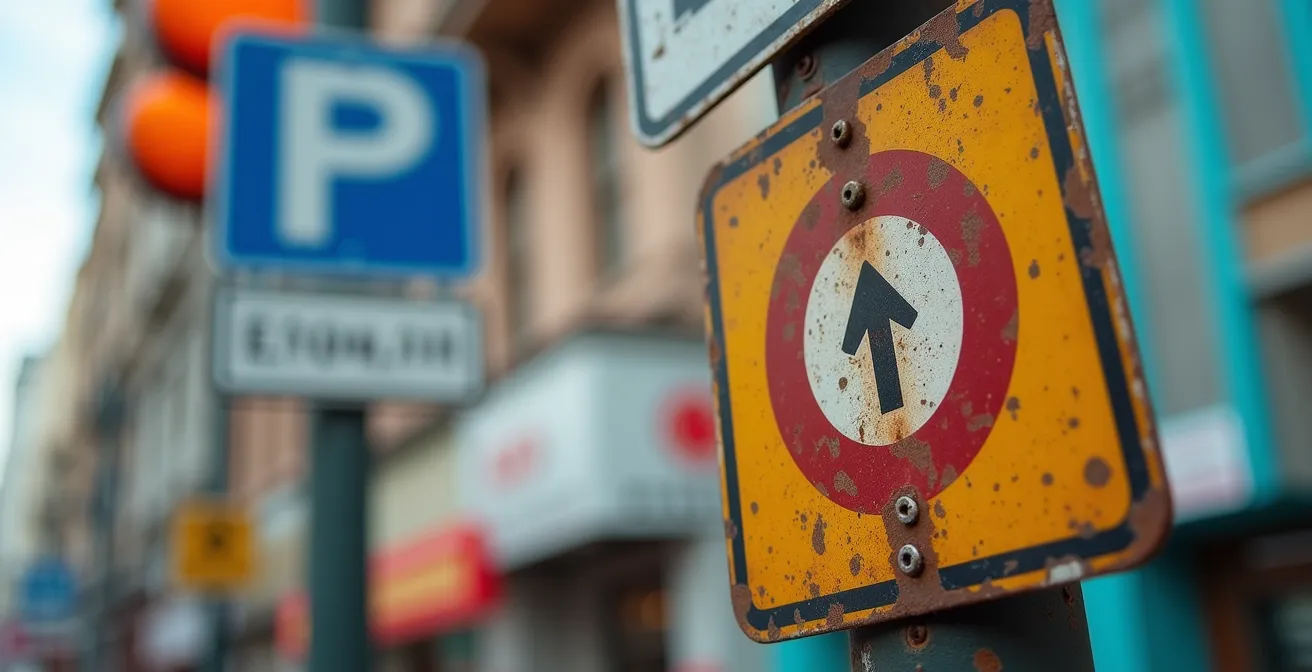
The real challenge often isn’t the primary signs, but the famously complex parking signs. These multi-panelled totems, with their layers of times, dates, and exceptions, can baffle even locals. When in doubt, it’s always safer to find a paid parking garage than to risk a ticket.
This macro shot captures the feeling of overwhelm many drivers face when trying to decipher a Montreal parking sign, with its multiple stacked panels and complex restrictions.
Ultimately, a quick review of these key terms before you get behind the wheel is all you need. It transforms a source of anxiety into a manageable part of the Montreal driving experience, allowing you to focus on navigating the city’s beautiful streets.
Menu Anxiety: How to Order Food When the Menu Is Only in French?
One of the most common fears for English-speaking tourists is facing a menu written entirely in French. This “menu anxiety” is real, but it’s also an opportunity to discover one of Montreal’s most unique and rewarding dining customs: the “Apportez Votre Vin” (Bring Your Own Wine) restaurant. These establishments, often beloved local gems found outside the main tourist-heavy zones, offer authentic cuisine without the high markups on alcohol. Embracing this tradition can turn your anxiety into a cultural adventure.
Case Study: The “Apportez Votre Vin” (BYOB) Experience
Montreal’s “Apportez Votre Vin” (BYOB) culture offers a fantastic way for tourists to enjoy high-quality meals on a budget. These restaurants, easily identified by BYOB signs, allow you to bring your own wine, which can be purchased at a nearby provincially-run liquor store (an SAQ). As detailed in one tourist’s experience with Montreal’s restaurant scene, this can save you 200-300% on typical restaurant wine costs. More importantly, servers in these establishments are often exceptionally patient and helpful with non-French speakers who are participating in this local custom. Your effort to engage with this Quebec-specific tradition is seen as a sign of respect, and staff are usually happy to help you decipher the menu.
When you do encounter a French-only menu, don’t panic. First, remember your five key phrases. A simple “Bonjour, parlez-vous anglais?” will almost always get you the help you need. Most servers in Montreal are bilingual and are happy to walk you through the menu. Second, have a translation app ready on your phone as a backup. It’s a quick and easy way to look up key ingredients like “poulet” (chicken), “boeuf” (beef), or “poisson” (fish).
Finally, look for the “Table d’hôte”. This is a prix-fixe menu that typically offers an appetizer, a main course, and a dessert for a set price. It’s almost always the best value and provides a structured way to experience the restaurant’s specialties without having to navigate the entire à la carte menu. By embracing these strategies, a French menu becomes less of an obstacle and more of a doorway to an authentic culinary experience.
Why Is “Dinner” Called “Souper” in Quebec? Decoding Meal Times
You’ve made a reservation for “dîner” at 7 p.m., but the restaurant host seems confused. This common scenario highlights one of the most charming and initially perplexing aspects of Quebecois French: mealtime terminology is different from international French and English. Understanding this simple code is key to avoiding confusion when making plans or reading restaurant hours.
The difference stems from Quebec’s agricultural heritage. Historically, the main, substantial meal of the day was eaten at noon to provide energy for an afternoon of hard labour. This meal was called “dîner.” The lighter evening meal was called “souper.” This tradition persists in the language today, even though urban lifestyles have changed. Many traditional restaurants, especially outside of downtown, still refer to lunch as “l’heure du dîner” and may even close between lunch and supper service, a quirk that can catch tourists off guard if they’re looking for a late afternoon meal.
This historical context is a perfect example of how Montreal’s language is woven into its cultural fabric. What seems like a simple vocabulary difference is actually a living piece of history. Knowing this not only helps you practically but also gives you a deeper appreciation for the local culture.
| Meal Time | Quebec French | International French | English | Typical Hours |
|---|---|---|---|---|
| Morning | Déjeuner | Petit-déjeuner | Breakfast | 7:00-10:00 |
| Midday | Dîner | Déjeuner | Lunch | 12:00-14:00 |
| Evening | Souper | Dîner | Dinner | 18:00-20:00 |
So, when you’re making plans, be specific. If you want to book a table for the evening meal, ask for a reservation for “souper.” It’s a small detail that shows you’ve done your homework and will be appreciated by your hosts.
English Theatre in Montreal: Where to Find Anglophone Culture in a Francophone City?
While Montreal is proudly a French-speaking metropolis, it is also home to a historic and vibrant anglophone community. For tourists looking for a break from language-based activities or wanting to connect with the city’s English side, there is a wealth of anglophone culture to explore. You don’t have to look hard to find English-language theatre, literature, and community hubs.
This thriving culture is supported by a significant English-speaking population. While the majority of Montrealers are francophone or bilingual, there remains a vibrant community where 16.64% of Montreal Island residents are native anglophones. This community has built and sustained its own cultural institutions for generations, offering a different but equally authentic Montreal experience. From world-class comedy to independent bookstores, anglophone culture is an integral part of the city’s identity.
Venturing into traditionally anglophone neighbourhoods like Westmount or Notre-Dame-de-Grâce (NDG) offers a glimpse into this side of the city, with its distinct architecture and community feel. These areas are excellent places to find English-language services, cozy cafes, and local shops.
Your Action Plan: Finding Anglophone Montreal
- Explore the Neighbourhoods: Visit Westmount for its upscale shops and stunning Victorian architecture, or explore NDG for a more down-to-earth, authentic community feel.
- Check Local Media: Pick up a copy of *The Gazette* newspaper or tune into CBC Montreal radio for up-to-date English-language event listings and news.
- Laugh Out Loud: Attend the world-famous Just for Laughs festival in the summer, which features a massive lineup of English-language stand-up comedy and shows.
- Find a Good Read: Browse the shelves at Librairie Drawn & Quarterly in the Mile End, a renowned independent bookstore with a fantastic selection of English-language books and graphic novels.
- Catch a Show: Look for performances at the Centaur Theatre, the premier English-language theatre in Montreal, for a taste of local and international stage productions.
Engaging with Montreal’s anglophone culture is not about avoiding French; it’s about experiencing the city’s full, complex identity. It’s a testament to the city’s true linguistic duality and its ability to house multiple vibrant cultures side-by-side.
Navigating the Language Barrier: Where Is French Essential Outside of Quebec?
The bilingual bubble of Montreal is a wonderful and convenient reality for tourists, but it’s crucial to understand that this bubble has its limits. If your travel plans include a day trip outside the city to destinations like Mont-Tremblant, the Laurentians, or the Eastern Townships, your relationship with the French language will change dramatically. Assuming Montreal’s bilingualism extends throughout the province is a common mistake that can lead to challenging situations.
The demographic reality is stark: while Montreal is a bilingual hub, the rest of Quebec is overwhelmingly francophone. In fact, demographic data reveals that outside the Montreal metropolitan area, you’ll find a region where only 3% of the population are native anglophones. This means that once you leave the island, you can no longer assume that service staff, gas station attendants, or shopkeepers will speak English. In these areas, French is not just a polite courtesy; it becomes an essential tool for communication.
This isn’t meant to discourage exploration, but to help you prepare. A tourist who ventures into the scenic Laurentians will find that while their “Bonjour” is appreciated in a downtown Montreal coffee shop, it becomes a necessary starting point for a more basic, functional exchange at a rural “cantine” (snack bar) or “dépanneur” (convenience store). Staff may not understand English at all, and your five key phrases, combined with pointing and patience, will be your best friends.
Before heading out on a day trip, it’s wise to download an offline translation app and learn a few extra practical phrases related to ordering food, asking for directions, or buying gas. This preparation shows immense respect for the local reality and will ensure your journey through Quebec’s beautiful countryside is a positive and memorable one, free from the stress of communication barriers.
Montreal Museum Secrets: Enjoying Culture Without a Language Barrier
For many travellers, a city’s museums are a top priority. In Montreal, tourists can rest easy knowing that the city’s major cultural institutions are fully prepared to welcome an international, multilingual audience. You do not need to speak French to have a rich and fulfilling experience at world-class venues like the Montreal Museum of Fine Arts (MMFA), the McCord Stewart Museum, or the Pointe-à-Callière archaeology museum.
These institutions are designed from the ground up to be bilingual, a fact that directly addresses any anxiety a tourist might have about missing out on cultural context. This commitment to accessibility is a point of pride for the city’s cultural sector.
All major Montreal museums, like the Montreal Museum of Fine Arts (MMFA) and Pointe-à-Callière, are fully bilingual, with all signage and special exhibits in both French and English.
– Tourism Montreal Official Guide, Montreal Visitors Guide
This means that every wall panel, exhibit description, and directional sign will be presented in both languages. Furthermore, audio guides are always available in English, providing in-depth commentary that ensures you don’t miss any of the nuance or history behind the art and artifacts. This complete bilingual service makes museums a perfect, stress-free activity for any English-speaking visitor.
To make your museum visits even better, here are a few insider tips for budget-conscious travellers:
- Montreal Museum Pass: If you plan on visiting multiple museums, this pass offers excellent value, providing access to over 40 institutions over a 3-day period.
- First Sunday of the Month: Many of Montreal’s museums offer free or significantly reduced admission on the first Sunday of each month, making it a popular time for both locals and tourists.
- Free Evenings: Keep an eye on the websites for museums like the McCord Stewart Museum and the Canadian Centre for Architecture, as they often host specific free admission evenings or events.
With these tips in hand, you can confidently immerse yourself in Montreal’s incredible arts and history scene, knowing that language will be a bridge, not a barrier.
Key Takeaways
- Politeness over proficiency: Using a few basic French words like “Bonjour” is a sign of respect that transforms interactions.
- Montreal is not all of Quebec: The city’s bilingualism doesn’t extend to rural regions, where French becomes essential.
- Cultural codes matter: Understanding local quirks like “souper” for dinner or BYOB restaurants shows awareness and enriches your experience.
Old Montreal Tourist Traps: Which Restaurants Offer Authentic Quebec Cuisine?
Old Montreal, with its historic charm and bustling squares, is a magnet for tourists. It’s also a prime location for “tourist trap” restaurants that often prioritize location over quality and authenticity. As a visitor, it can be difficult to distinguish between a genuine Quebecois dining experience and a generic eatery serving overpriced, mediocre food. However, by learning to spot a few red flags, you can easily navigate away from the traps and towards an authentic meal.
The most obvious traps are often located on the main, high-traffic thoroughfares like Place Jacques-Cartier. They rely on aggressive street hawkers, menus translated into five or more languages (often with glossy photos), and prominent “Tourist Menu” signs. In contrast, authentic restaurants are typically found on quieter side streets, are filled with the sound of locals speaking Quebecois French, and present their menus primarily or exclusively in French. They let their reputation and the quality of their food do the talking.
Here are the key indicators to watch for:
- Tourist Trap Red Flags: Aggressive street hawkers, menus in 5+ languages with photos, prime location on a main square, “Tourist Menu” heavily advertised.
- Authenticity Green Flags: Locals speaking French inside, French-only or French-primary menu, located on a quieter side street, features a “Table d’hôte” with seasonal Quebec products.
A perfect example of an authentic experience discovered by tourists is the iconic 24/7 poutine restaurant, La Banquise. As highlighted by the Canadian travel experts at Authentik Canada, this Plateau institution has been a local favourite since 1968. Despite its international fame, it remains deeply authentic, evidenced by its location outside the Old Port, its predominantly French menu, and its late-night crowds of local francophones. It proves that venturing just a little beyond the main tourist-heavy zones is the best way to find the real taste of Montreal.
Frequently Asked Questions About Montreal’s Food Scene
What is a ‘Table d’hôte’ on Quebec menus?
A “Table d’hôte” is a prix-fixe menu that offers a complete meal, typically including an appetizer, main course, and dessert, for a single set price. It’s usually the best value and a great way to sample the chef’s specialties.
What does ‘poutine’ actually consist of?
Poutine is Quebec’s most famous dish, made from a base of french fries topped with fresh cheese curds and smothered in a rich, brown gravy. Legendary spots like Montreal’s La Banquise offer over 30 different creative varieties.
What are ‘pets-de-soeur’ on dessert menus?
Literally translating to “nun’s farts,” these are a traditional Quebecois pastry. They are made from rolled pie dough filled with butter and brown sugar, then sliced and baked to create a sweet, pinwheel-shaped treat.