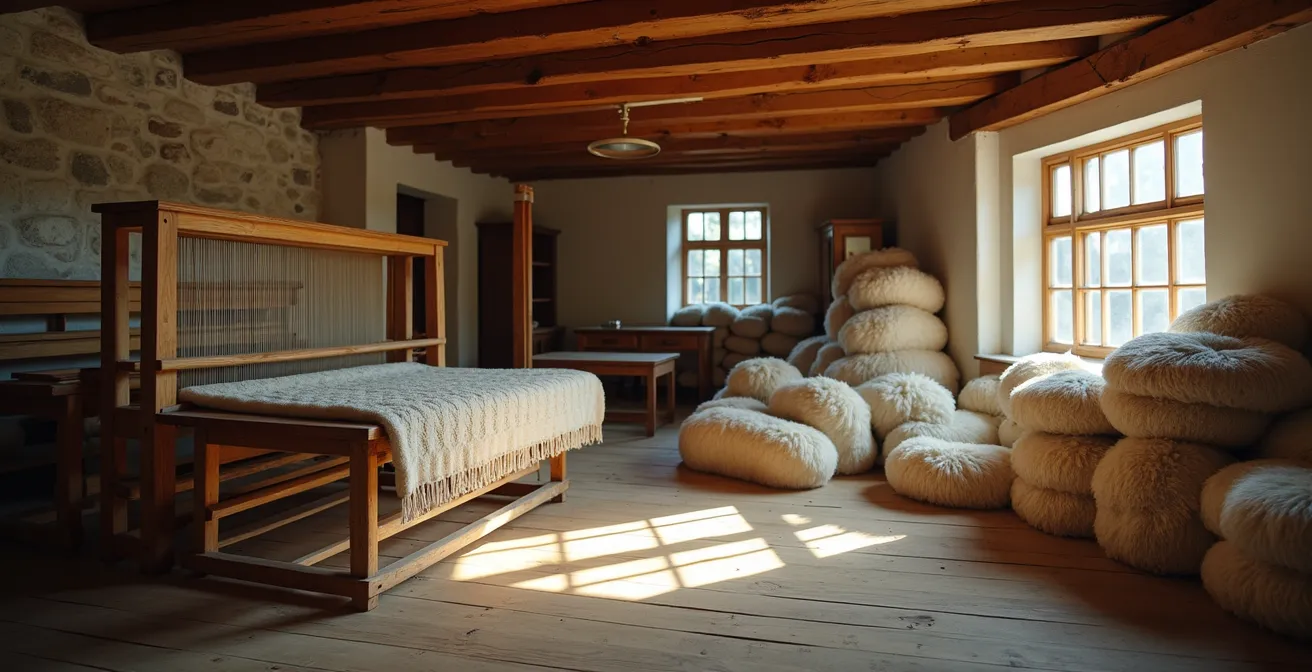
The high price of a Charlevoix wool blanket is a direct measure of its authentic Quebecois soul, not an arbitrary markup.
- It starts with hyper-local, high-quality wool from specific sheep breeds, a resource that is becoming scarcer.
- Artisanal value is added through complex, time-intensive heritage techniques like boutonné, which are impossible to replicate by machine.
Recommendation: Look for the Économusée label and feel the texture; you’re not buying a product, but investing in a piece of living history.
You’re standing in a charming boutique in Baie-Saint-Paul, sunlight streaming through the window. You run your hand over a thick, richly textured wool blanket. The colours are deep, the pattern is unique, and it feels incredibly warm. Then you see the price tag: $300, $400, or even more. The immediate question flashes through your mind: “Why is it so expensive?” It’s a valid question, and the simple answer of “it’s handmade” barely scratches the surface. That price isn’t just for a blanket; it’s for a story woven from the very fabric of Quebec’s landscape and history.
Many people assume the cost is just about the time an artisan spends at a loom. While that’s part of it, it’s far from the whole picture. The real value is a complex tapestry woven from specific agricultural realities, ancestral techniques passed down through generations, and a conscious economic choice to preserve a cultural identity against the tide of mass production. The secret isn’t just in the weaver’s hands; it’s in the sheep’s fleece, the spinner’s wheel, and the historical resilience of an entire region.
But if the real key isn’t just the labour, what is it? It’s what I call the “fiber terroir”—the idea that the quality and character of the wool are intrinsically linked to the specific place it comes from. This is coupled with the immense value of “time-as-ingredient,” where hours of skilled work are not a cost to be minimized, but the essential element that creates an heirloom.
This article will unravel that price tag for you. We will explore the specific sheep that provide the wool, decode the intricate techniques that machines can’t replicate, and understand the historical context that makes each thread precious. By the end, you won’t just see a blanket; you’ll see a piece of living, breathing Quebec heritage.
To fully grasp the journey from fleece to finished product, this guide breaks down every element that contributes to the final value. The following sections will guide you through the heart of Quebec’s weaving tradition.
Summary: Why a Quebec Woven Blanket is an Investment in Heritage
- The Sheep Breeds: Which Quebec Sheep Produce the Warmest Wool?
- The “Boutonné” Technique: How Do Weavers Create the Raised Patterns?
- Washing Wool: How to Clean Your Heirloom Blanket Without Shrinking It?
- The “Paysanne” Roots: How Weaving Survived the Industrial Revolution in Quebec?
- The Économusée Network: Where Can You Watch Weavers at Work?
- Why Does a Hand-Knit Cowichan Sweater Cost Over $400 CAD?
- The Underground Railroad: Did Quilt Patterns Really Guide Escaping Slaves?
- Made in Quebec vs. Made in China: How to Spot Real Souvenirs in the Old Port?
The Sheep Breeds: Which Quebec Sheep Produce the Warmest Wool?
The value of a Charlevoix blanket begins long before a weaver sits at a loom; it starts in the fields with the sheep themselves. Not all wool is created equal. The quality, warmth, and texture are directly tied to the breed of sheep and the environment in which it lives. In Quebec, artisans prioritize wool from breeds known for their dense, warm, and resilient fibers, which is the foundation of a product designed to last for generations. This concept of “fiber terroir” is central to understanding the blanket’s worth. The wool carries the story of the land.
Breeds like the Canadian Arcott, developed by Agriculture Canada, are prized for their unique characteristics. While originally bred for meat, their wool has found a niche in high-quality textiles. This cozy fiber is precisely what artisans at places like Upper Canada Weaving seek out for their products. However, access to this high-quality, local wool is not limitless. The agricultural landscape is changing, and according to recent industry data, there are 167,600 sheep in Quebec, a decrease from the previous year. This slight decline signals a growing scarcity, making each fleece more precious.
The process from shearing to spinning is meticulous. The raw fleece must be “skirted” to remove lower-quality belly and leg wool, washed to remove dirt and excess lanolin (the natural grease that makes wool water-resistant), and then carded to align the fibers. Only then can it be spun into yarn. Each of these steps, when done by hand or in small, local mills, adds to the cost but ensures a superior quality yarn that retains its natural loft and strength. This is a far cry from mass-produced wool, which is often chemically treated and processed harshly, stripping it of its unique character.
The “Boutonné” Technique: How Do Weavers Create the Raised Patterns?
Once the perfect yarn is spun, the artisan’s true magic begins. The distinctive, bumpy texture you see on many Charlevoix blankets is not an accident; it’s a highly skilled, traditional patterning technique called boutonné. This method is a hallmark of Quebecois weaving and is a major contributor to the textile’s value because it is incredibly time-intensive and cannot be authentically replicated by industrial machines. It literally builds the pattern, loop by loop, from the ground up.
The boutonné technique involves using multi-coloured weft threads (the horizontal threads) that are manually pulled up in small loops between the warp threads (the vertical ones). According to textile historians, this was one of the two primary hand-patterning techniques used for bed coverings in traditional Quebec. Artisans use their fingers or a small tool to create motifs like stars, pine trees, or geometric shapes. Each loop is a deliberate, individual action. Weaving a single row with a boutonné pattern can take exponentially longer than weaving a simple, flat stripe. This is the epitome of “time-as-ingredient.”
This method doesn’t just create a visual pattern; it adds structural integrity and texture to the blanket. The raised loops trap more air, making the blanket warmer. They also create a durable, three-dimensional surface that is both beautiful to look at and wonderful to touch. The macro view below reveals the artistry in each individual fiber.
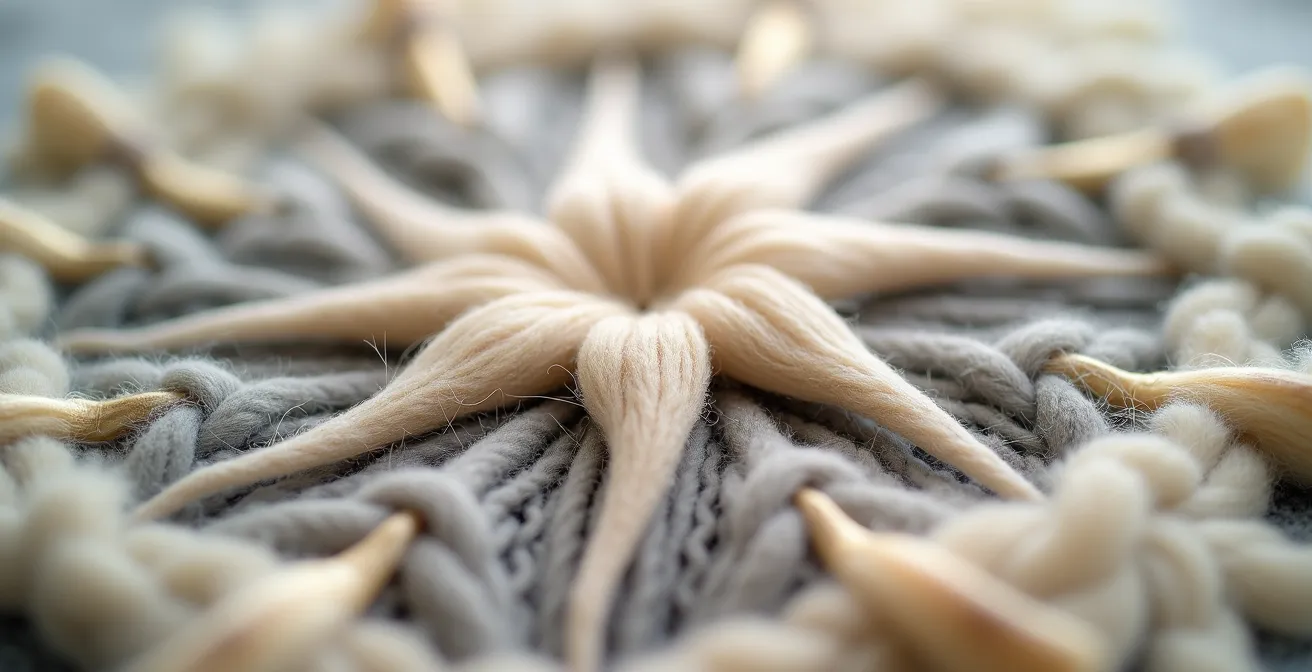
As you can see, the loops are not merely decorative but are an integral part of the fabric’s structure. An industrial loom is designed for speed and uniformity, weaving flat fabric at an incredible pace. It lacks the “hands” to stop, select a specific thread, and pull up an individual loop. Therefore, any blanket featuring a true boutonné pattern is a guaranteed product of slow, methodical, artisanal craftsmanship.
Washing Wool: How to Clean Your Heirloom Blanket Without Shrinking It?
A $400 blanket is not a disposable item; it is an heirloom. Part of its value lies in its longevity, but that durability depends entirely on proper care. Many people are terrified of washing wool, having had a favorite sweater shrink to a doll’s size in the wash. This fear is justified, as improper washing can irreversibly damage the fibers. Understanding how to care for your blanket is understanding another layer of its intrinsic value.
The key to wool’s structure is the microscopic scales on each fiber. As textile experts from Puffy Home Textiles Research explain in their guide, the risk is clear:
Wool requires specific care because heat, agitation, and shock cause fiber scales to lock irreversibly
– Puffy Home Textiles Research, How to Weave a Blanket: A Comprehensive Guide
This locking process is called “felting,” and it’s what causes shrinkage. To prevent this, you must treat the wool with the same gentleness the artisan used to create it. It’s not about using harsh chemicals or machines, but about respecting the natural properties of the fiber. A handwoven blanket only needs to be washed very rarely, but when it does, following a precise method is crucial to preserving your investment for decades.
Your Action Plan: Preserving Your Wool Heirloom
- Use cold water only: Fill a bathtub or large basin with cold water. Hot or even warm water will open up the fiber scales, making them prone to locking and shrinking.
- Choose a specialized wool detergent: Use a pH-neutral soap with lanolin preservatives. Regular detergents are too harsh and strip the wool of its natural oils, leaving it brittle.
- Gently squeeze, never agitate: Submerge the blanket and gently squeeze the soapy water through it. Never twist, wring, or scrub the fabric, as this agitation is the primary cause of felting.
- Lay flat to dry: Drain the water and press out the excess without wringing. Lay the blanket flat on a bed of clean, dry towels, reshaping it to its original dimensions while damp. Flip it periodically, replacing the wet towels until it is completely dry. Never hang a wet wool blanket, as its own weight will stretch it out of shape.
- Store with natural moth repellents: For long-term storage, keep the blanket in a breathable cotton bag with blocks of cedar wood. This naturally deters moths without the use of harsh chemicals.
The “Paysanne” Roots: How Weaving Survived the Industrial Revolution in Quebec?
The existence of a vibrant weaving tradition in 21st-century Quebec is a historical anomaly. To understand its value, one must look back to the 19th century, when the Industrial Revolution mechanized textile production in Europe, putting countless skilled weavers out of work. This historical event is directly responsible for the deep-rooted weaving culture in Canada, particularly in rural Quebec.
Many of the experienced weavers from Scotland, Ireland, and Germany, who were displaced by factory looms, immigrated to Canada. As The Canadian Encyclopedia notes, they initially expected to become farmers but quickly found that their traditional skills were not only useful but profitable in their new home. In many communities, these professional male weavers took on the complex work, while housewives often prepared the yarns. This established a professional, artisanal class that kept high-level skills alive, rather than letting weaving devolve into a purely domestic, utilitarian task. They weren’t just making blankets for their own families; they were running businesses.
While the rest of the world moved towards mass production, parts of Quebec, due to their relative isolation and strong attachment to tradition, preserved this “paysanne” or rural mode of production. The loom remained at the heart of the home and the local economy. This act of cultural preservation, whether intentional or not, created a reservoir of knowledge that is now the foundation of the modern artisanal industry. Today, that legacy is carried on by a small but dedicated group. The most recent agricultural census data reveals only 97 sheep and goat farming businesses in Quebec, highlighting the small-scale, specialized nature of the entire supply chain.
Therefore, when you buy a handwoven blanket from Charlevoix, you are purchasing a direct link to this unique history. You are supporting an economic model that values human skill over machine speed, a tradition that survived against all odds. It’s a tangible piece of resistance to the homogenization of global manufacturing.
The Économusée Network: Where Can You Watch Weavers at Work?
Reading about heritage is one thing, but seeing it in action is another. For any visitor to Quebec wondering where to find these authentic artisans, the answer is the Économusée network. This brilliant concept is more than just a series of workshops or boutiques; it’s a living museum experience that makes the entire artisanal process transparent, and it’s a cornerstone of Quebec’s cultural tourism.
An Économusée is an artisanal business that opens its doors to the public, transforming its workshop into an interactive space. Here, visitors can meet the artisans, see them work at their looms, and learn about their craft, history, and raw materials firsthand. According to the Government of Canada, the network was founded in 1992 and includes dozens of artisans across the province, specializing in everything from crafts to agri-food. The goal is to convey traditional know-how and preserve intangible heritage.
Visiting a weaving Économusée in Charlevoix or elsewhere allows you to witness the “time-as-ingredient” principle in real time. You can watch as the shuttle flies back and forth, see the intricate boutonné patterns emerge loop by loop, and feel the quality of the wool for yourself. It demystifies the price tag completely. When you see the hours of focused labor, the physical effort, and the deep knowledge required, the cost no longer seems high but entirely justified.
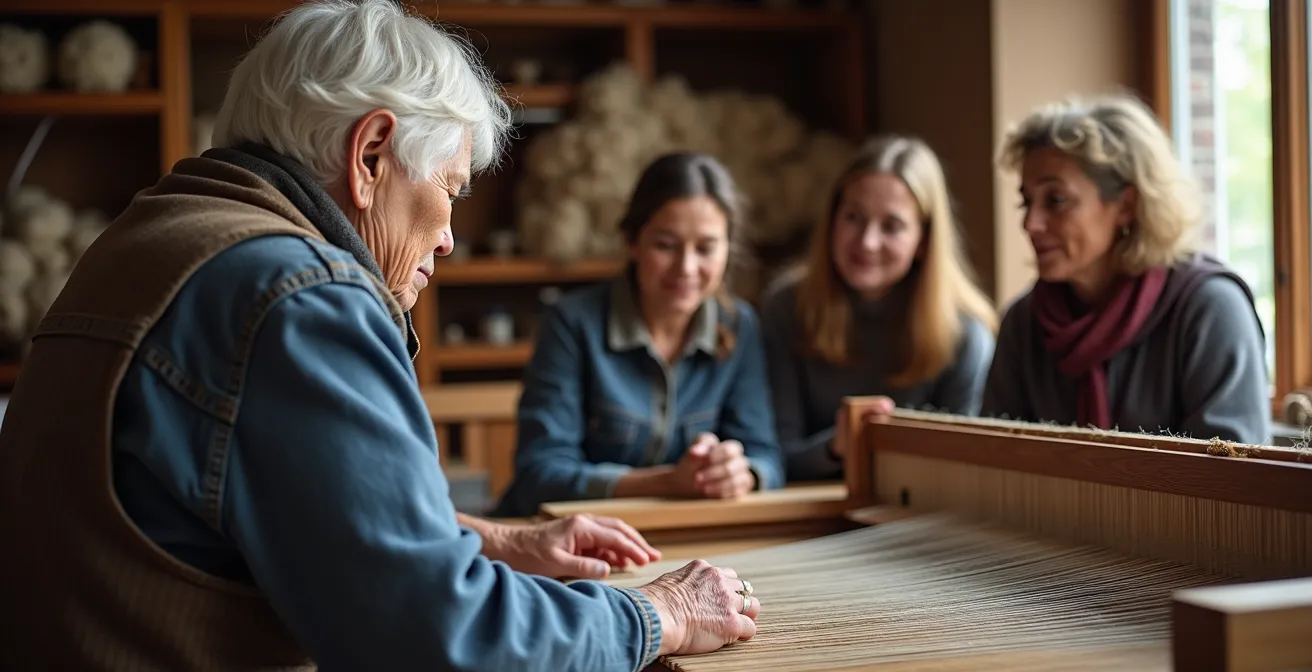
This model creates a direct and meaningful connection between the producer and the consumer. You’re not just buying a product off a shelf; you’re often buying it from the very person who made it, in the very place it was created. This experience adds an immeasurable layer of value to the object, transforming it from a simple souvenir into a cherished memory and a testament to a living culture.
Why Does a Hand-Knit Cowichan Sweater Cost Over $400 CAD?
The economic principles that dictate the price of a Charlevoix blanket are not unique to Quebec weaving. They are part of a broader “heritage economics” seen in other iconic Canadian artisanal products, most notably the Cowichan sweater from British Columbia. By looking at this parallel, we can better understand that the price reflects a universal valuation of authentic, locally-rooted craftsmanship.
A genuine Cowichan sweater, hand-knit by Coast Salish artisans, easily commands a price of over $400 CAD. Like the Charlevoix blanket, its value is derived from a specific chain of value. It begins with natural, un-dyed wool from a particular sheep stock, which retains its lanolin, making the sweaters water-resistant and incredibly warm. The wool is hand-spun in a unique, thick way that is characteristic of the style. The knitting itself is a complex art, incorporating traditional motifs and a seamless construction method passed down through generations. Just like the boutonné technique, this cannot be authentically replicated by a machine.
The entire Canadian sheep and wool industry operates on a scale that prioritizes quality over quantity. While farm cash receipts for sheep and lamb totaled $221 million in Canada, this is spread across a network of predominantly small, family-run farms. This is not a massive, industrialized commodity market. It is a series of local ecosystems where farmers and artisans often have direct relationships, ensuring a supply of high-quality, specific fibers for these heritage products.
Whether it’s a woven blanket from Quebec or a knit sweater from British Columbia, the story is the same. The price tag accounts for rare raw materials, deep-rooted historical knowledge, and an extraordinary amount of skilled human time. These are not just garments; they are cultural artifacts, and their price reflects the cost of keeping these unique Canadian traditions alive and thriving.
The Underground Railroad: Did Quilt Patterns Really Guide Escaping Slaves?
When discussing North American textile traditions, the romantic story of quilt patterns serving as secret maps for escaping slaves on the Underground Railroad often comes up. While a powerful and compelling narrative, most historians now consider it a myth or folklore that emerged in the late 20th century, with little to no primary evidence to support it. Redirecting our focus from this myth allows us to appreciate the genuine, documented, and equally fascinating textile traditions of the land, particularly those of Canada’s Indigenous peoples.
Long before European settlers arrived, Indigenous communities across Canada had developed sophisticated weaving practices. These were not based on the floor looms and shuttle systems brought from Europe but evolved from ancient basket-making techniques. One of the most remarkable methods is weft-twining, where two weft threads are twisted around each warp thread. This technique was used to create prestige items of immense cultural significance, such as the magnificent ceremonial Chilkat blankets of the West Coast.
The skill and time involved in these methods were immense. As The Canadian Encyclopedia highlights, Indigenous weavers produced beautiful and high-quality textiles without the benefit of a shed-making device (the core mechanism of a floor loom). This made their work incredibly painstaking. It underscores a universal truth of artisanal work: the less technology involved, the more time and skill is required from the artisan. The value of these pieces was measured not in money, but in the time, spirit, and cultural knowledge woven into them.
Acknowledging these deep-rooted traditions is crucial. It provides a broader context for the history of textiles in Canada. The value we place on a Charlevoix blanket today is part of a long continuum of appreciating textiles not just for their utility, but for their role as carriers of culture, skill, and identity. The true story of Canadian weaving is rich enough without needing to rely on myths; it is a story of many threads, from many different cultures, weaving the fabric of a nation.
Key Takeaways
- The price of a Charlevoix blanket is a direct reflection of its “fiber terroir,” starting with scarce, high-quality wool from specific Quebec sheep breeds.
- Complex, time-intensive techniques like boutonné weaving add immense value and cannot be replicated by machines, guaranteeing an artisanal product.
- The weaving tradition in Quebec is a historical anomaly, preserved by immigrant artisans and a rural culture that resisted the Industrial Revolution, making each piece a link to the past.
Made in Quebec vs. Made in China: How to Spot Real Souvenirs in the Old Port?
In the bustling tourist areas of Old Quebec or the Old Port of Montreal, you will find a dizzying array of souvenirs. Alongside the authentic, locally-made crafts are shelves of mass-produced trinkets, often “designed in Canada” but made overseas. For a visitor wanting to take home a genuine piece of Quebec, learning to distinguish between the two is the final, crucial step. The price difference is your first and most obvious clue, and now you understand why.
An authentic handwoven wool item will feel different. It will have more weight, a richer texture, and subtle variations in the weave and color that are the hallmarks of a human touch. A machine-made item will be perfectly uniform, lighter, and often made of acrylic or a low-quality wool blend that feels flat and lifeless. Look for a tag that doesn’t just say “100% Wool,” but one that names the artisan or the workshop. Better yet, look for the Économusée logo, your guarantee of authenticity.
But the most staggering justification for the price difference lies in the raw material itself. The global market has driven the price of bulk, low-grade wool to near zero. However, the high-quality, small-batch wool used by Quebec artisans is a completely different commodity. The economic reality is stark: market data reveals that in 2022, wool producers in Quebec were paid just $0.09 CAD per kilogram for their raw fleece, compared to $1.08 CAD in British Columbia. This dramatic disparity highlights that the Quebec market for bulk wool is non-existent; artisans must therefore work through specialized networks or directly with farmers to source premium fiber, paying a much higher price for this quality, which is then reflected in the final product.
So when you pick up that $400 blanket, you are seeing the culmination of this entire chain of value. You see the cost of supporting a local farmer who raises a heritage sheep breed, the cost of a small mill to process the fiber with care, and the cost of an artisan’s weeks of skilled labor. You are seeing the price of cultural survival.
Your purchase becomes an investment in preserving a unique piece of Quebec’s identity. By choosing the real thing, you ensure that the shuttle will continue to fly, the looms will continue to hum, and this beautiful story will continue to be woven for generations to come.